Part 1
Art is always ahead of its time, and that is how Egon Schiele (1890-1918) proved to be our perfect contemporary after a century. Just visit the monographic exhibition in Paris at the Louis Vuitton Foundation, organized by Suzanne Page, Diète Bûchait and Olivier Michelson more than a hundred paintings and drawings, most of them private, on display until January 14, 2019, to realize the prodigy of foresight that Schism expresses in terms of the representation of modernity in its particular characteristics, namely the loneliness of the individual, desperate narcissism, the sexual drive between libido and death instinct, the isolation of the artist who arrives at his negation and negation of art. All the themes that cross the culture of the crisis in Vienna at the end of the century, the Vienna of Schoenberg, Wittgenstein, Adolf Loos, the cosmopolitan theatre of the Weltuntergang Experience, a magnificent laboratory where, speaking twelve languages, we lived the end of the world and the advent of decadence under the auspices of the Imperial Reggie, a monarchy now at the top, without blood, where each artist, prisoner in his cell, could cry out to the world his madness as he thought.
Yet nothing seemed to predestine this frail and tiny boy, son of a station manager in Tulle der Donna, a small town on the outskirts of Vienna, who was orphaned at the age of 14 when his father died of syphilis in 1904 after a slow mental degeneration. It is true that he started drawing at a very young age. He was only eighteen months old when he took a pencil and never gave up. He was an early genius, very innovative, and he would have consumed his life in a flash, dying at only 28 years of Spanish fever, after anticipating the crisis of modernity, the wounds of the Great War, and many of the lacerations of the 20th century. From the beginning, he burned the scenes, exasperating his drawing teacher at the Academy of Fine Arts, Christian Griepenkerl, who reassured his mother: His son is too talented, he disturbs the whole class. He was a taciturn and ardent child, and from an early age he showed a certain vocation, neglecting to do his homework to draw all the time, until his father went mad, who is a one day, tormented by the myriad sheets scattered throughout the house, jumped on all the rage and made a good fire. Schism was traumatized for life, and experienced the trauma as an adult, in 1912, when sentenced for indecent exposure spent three weeks in prison and had to attend the second stake of his drawings, commissioned by an inflexible judge.
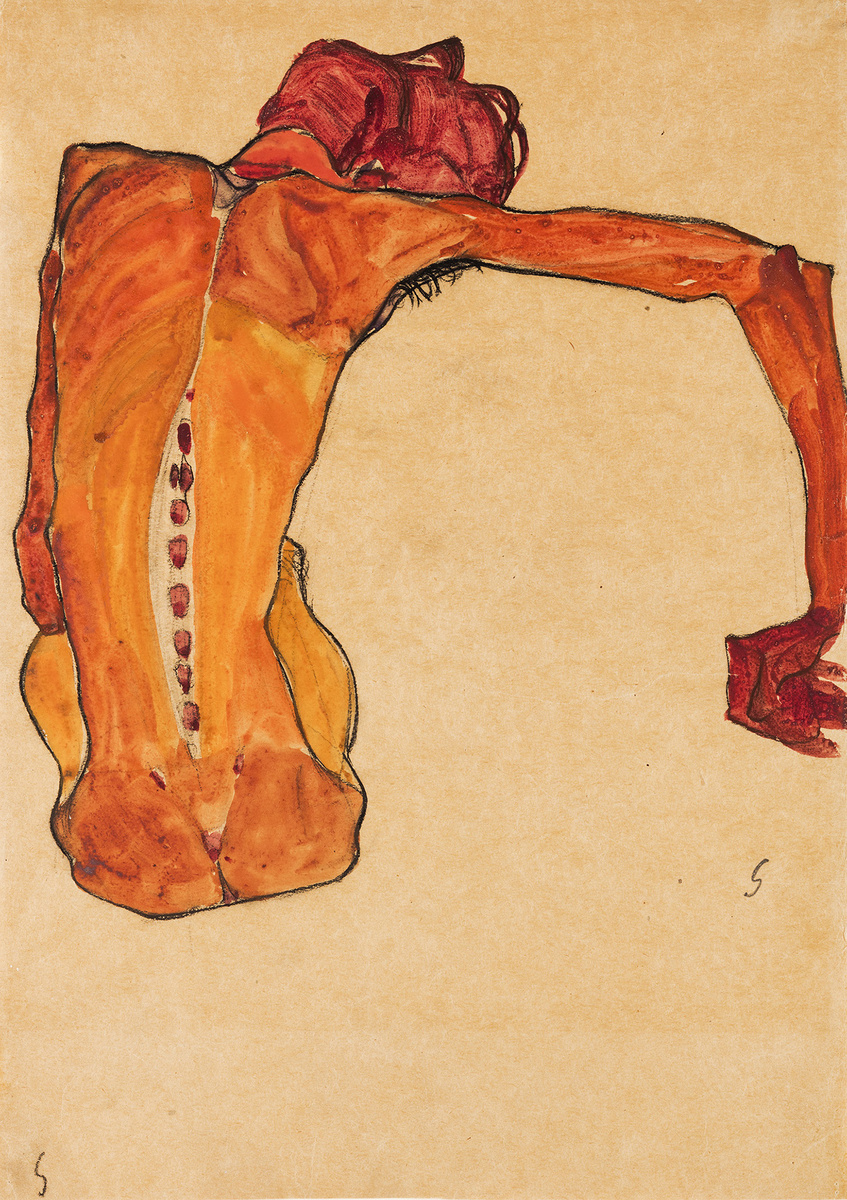
At first, to continue his torments and anxieties, Schism chose drawing and a line capable of anchoring the content in form, as Warner Hoffman writes. From the ornamental line of the Secession, close to the Jugendstil, he then moved on to the expressionist line of the 1920s, in reaction to Gustav Klimt's mythological compositions and worldly themes, producing portraits and self-portraits with distorted and unbalanced lines, where the lightly coloured outlines put the figures in tension with the void of the background. He experimented with new techniques such as wet-on-wet, leaving him in the water to produce the shapes, as shown by some surprising watercolours exhibited in Paris (Seated nude man, seen from behind, 1910, or Me, 1911). And he sets out in search of a renewed balance, pursuing a more disturbing fluidity, attentive to the psyche of his subjects, open to puppet theatre, to the world of mime. Thus, over a period of ten years, Schisme has been able to propose a range of extraordinary solutions, of which the Paris exhibition offers a perfect synthesis. He devoted himself to knowledge through the flesh and the deformation of the body as such, in the absence of space, according to Warner Hoffman, as if it were a landscape in ruins, adds Diet Buchhart.
He used the line as a chisel to engrave himself and spread his discoveries, explains Alessandro Communist, cultivating extreme exhibitionism, without false caution, to offer strong, shocking and impudent images of himself and others. After leaving the Academy, Schism immediately entered the world of art, breaking into the garden of Josefstadt, where is the studio of his master Gustav Klimt, who seems fascinated by this student with an emaciated and rebellious look. At 19 years old, conscious of himself and his talent, Schism needed only few means to create: he just needed an old mirror inherited from his mother, drawing paper, pencils, greasy pastels to start drawing in a new and provocative way, renouncing the three-dimensional relief and shadows and following the line itself, indifferent to the sense of shame, pity, modesty and lack of emotion, the atrocious obsessions and the defeatism of the most pressing impulses.
Read more in the following article-- https://zen.yandex.ru/profile/editor/id/5d6287904735a600adf0e5b8/5d95b8d63642b600ac2a888d/edit