The most hardcore thing in such bikes can be considered, perhaps, "suicide clutch" in combination with jockey shift. The fact is that American manufacturers are notable for their considerable conservatism. While motorcycle manufacturers all over the world switched to foot shift and manual clutch, Harley Davidson and Indian, faithful to tradition, continued to produce bikes with foot pedal and manual gearshift, the handle of which was at Harley Davidson on the left side of the tank, and at Indian on the right side. The shift handle was connected to the gearbox with a special connecting device. Of course, in order to simplify the design and increase the reliability of the beavers, the handle was mounted directly on the transmission under the seat - this is the jockey shift 🙂 As for the foot clutch, it is important to note that the original pedal was made according to the scheme of a lever (heel-foot) and had no return spring. The pedal was locked in place when the toe was pulled out so that both feet could be lowered to the ground during the stop. Pressing with the heel released the clutch. This construction is quite safe, but for racing it was not the most suitable, so it was subjected to radical alterations. The back of the pedal was cut off and thrown away, then the return spring was added. This design made switching speeds faster and easier. But if you forget to turn on the neutral gear and take your foot off the pedal at the intersection, you could go very quickly to the other world. Hence the name suicide clutch.
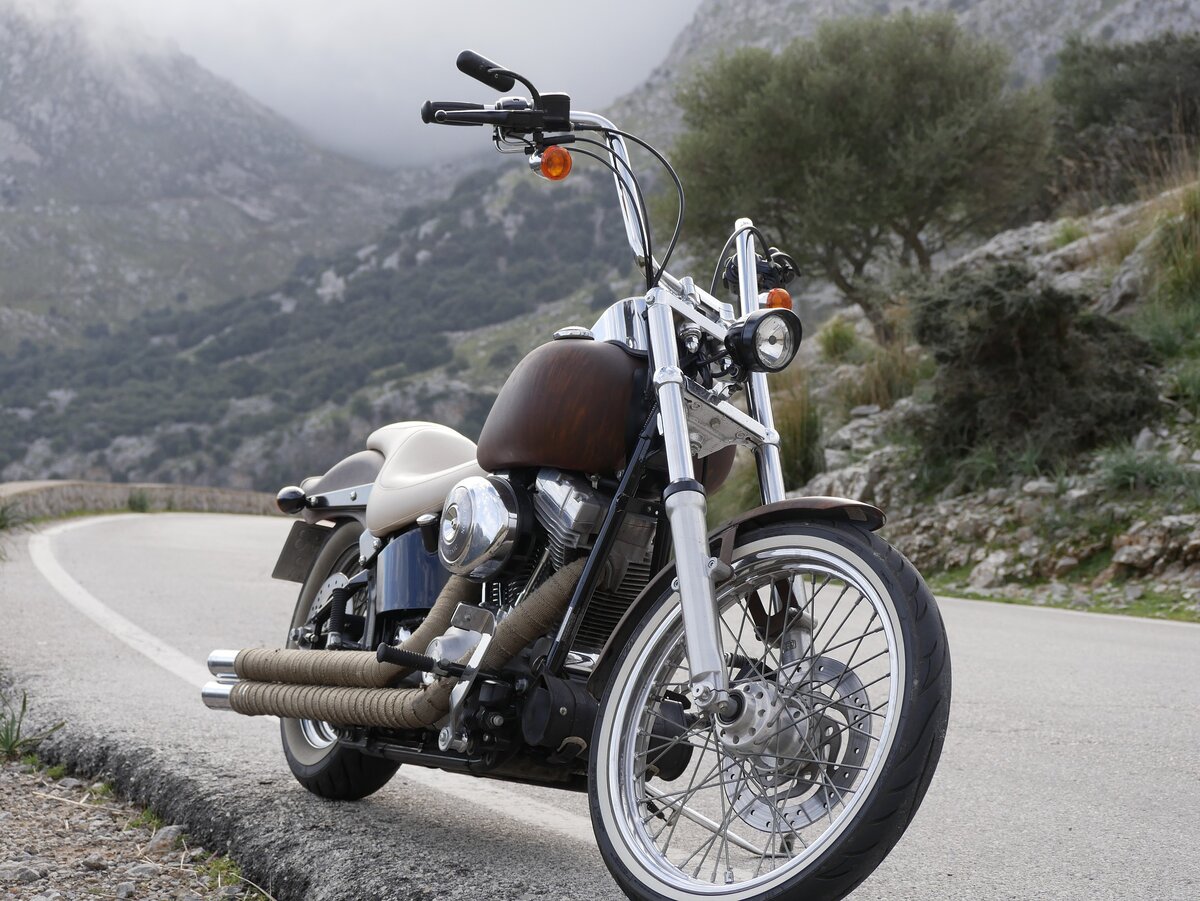
These are the main changes that began to make in motorcycles in California. What happened in the end was called californian bobber, a Californian beaver. This direction became very fashionable and not only small bikes, but also huge Harley Davidson Big Twin and Indian Chief began to be remade under it.
Percentages
Percentages can be considered a very important milestone in the history of the chopper. Without them, it would not have been possible as we know it now.
In the late forties, the young men who had returned from the war turned out to be extremely disappointed by the striking mismatch between the ideals of the American Dream for which they had fought and for which their friends had laid down their lives, and the disgusting commercialized, puritanical and ostensible khanzhens' morals of the real America of the time. However, and now it is obviously not better than
Many of them have been unable to fit into this society for the rest of their lives. Others, having saddled their bikes, began to unite with their peers, living by the familiar and understandable front principles of male brotherhood and camaraderie. The first motorcycle clubs, which were originally part of the AMA - American Motorcycle Association, began to appear. The favorite steel horse in such clubs was a big American motorcycle - Harley Davidson or Indian - transformed into a California beaver
As part of the AMA, these guys took part in all the races held under the auspices of this organization. However, given their youth and frankly rebellious moods, it is not difficult to imagine how many problems they caused to "law-abiding citizens". During the AMA races in 1947, this resulted in an unprecedented situation - bikers captured and terrorized two Californian cities - Hollister and Riverside.
Within a few days, life in these cities was paralyzed by crowds of bikers traveling all over the streets, having fun, wrecking everything and drinking uncontrollably. The police were powerless and the National Guard had to calm the bikers down.
After this incident, the term outlaw bikers was used by the sheriff of Riverside for the first time.
These events, as well as the image of a biker immortalized in the 1950s film The Wild Man, ruined the reputation of all motorcyclists.
AMA was probably the hardest hit, because it was incredibly difficult to negotiate with the authorities to hold another race. As a result, the president of the AMA, in an attempt to clean up the tarnished reputation of American motorcyclists, made a speech in which he particularly noted that of all the motorcyclists in the U.S. "evil and bad" is only 1%, and all the rest - law-abiding decent citizens.
Needless to say, after that speech, outlaw- bikers proudly put a 1% patch on their jackets?
Continued in the next part...
https://zen.yandex.ru/media/id/5d92c71fe6e8ef00b15bb4a2/history-of-the-chopper-part-3-5d9569a805fd9800b1aa1399