Part 11
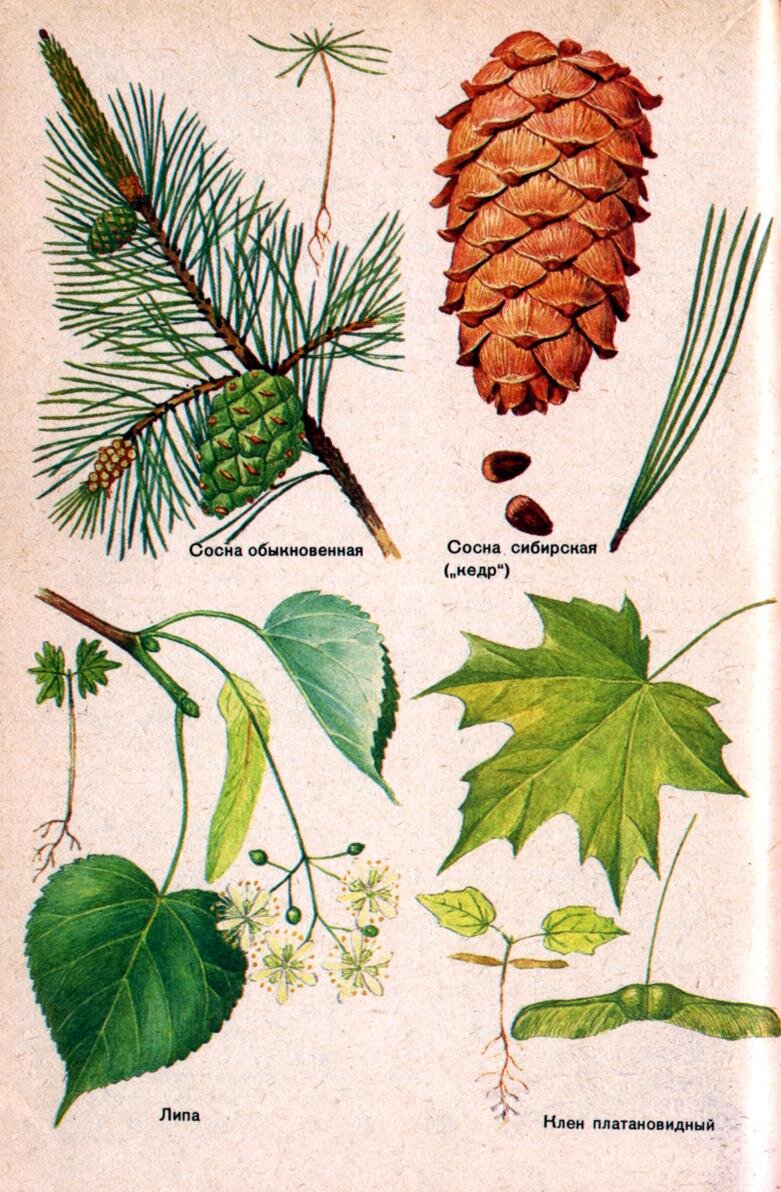
Almost all of our country's forests are located in a temperate climate zone, where winters are quite frosty and snowy. These are temperate forests of the climate zone. They are either pure conifers, like a real taiga, or mixed, where coniferous and deciduous trees grow together, or purely deciduous. They include many dozens of tree species. It is noteworthy that among deciduous trees we have only deciduous trees. They turn green in summer and lose their leaves in autumn. This is how birch and aspen, oak and linden, maple and elm behave. Leafness is one of the biological adaptations to the unfavorable winter conditions. Eternally green deciduous trees in our forests do not grow - they are inhabitants of subtropics and tropics.
Coniferous trees of the Soviet Union are quite diverse. These are different types of pines, spruce, larch and fir. Most of them are evergreen. Only larch leaves its needles for winter. In this respect, it is similar to deciduous wood species. Some coniferous trees have loose, openworked crowns that let in a lot of light - ordinary pine, all kinds of larch. The forests formed by these trees are light, and there is no thick shade in them. And the appearance of the forest itself, if you look at it from somewhere far away, is unique. The forest area is quite light green. Such forests are called light coniferous. But there are also other coniferous trees, such as different types of spruce and fir. Their crowns are thick, dense, creating a strong shade. In the forest of these trees is very dark, always reigns deep darkness. And the forests themselves seem dark, dark green from afar: they are dark coniferous forests.
Our deciduous trees are also quite diverse. Among them there are broad-leaved and small-leaved trees. The first ones include, for example, different species of oak, linden, maple, ash, etc. Many of these trees have really large, wide leaves. Small deciduous trees are aspen, birch, grey alder, etc.
The two groups of deciduous trees mentioned above differ, however, not only in the size of the leaf plates. They also differ in the role they play in the vegetation cover. Thus, broad-leaved tree species, as a rule, form primary, indigenous forests. Such forests are characteristic of natural vegetation cover not disturbed by human activity (for example, our Central Russian oak groves). The role of small-leaved trees is completely different. They most often form secondary forests, derivatives, i.e. those that appeared on felling, fires, abandoned arable land, etc. We are well aware of their examples - birch, aspen, alder, etc. These are forests that are obliged to human activity, they are usually short-lived and more or less quickly replaced by indigenous forests (e.g. birchwood - sprucewood).
However, there are no rules without exceptions. In some rare cases, however, broad-leaved trees may form derivative forests (pure oak on the place of the cut down complex pine forests). Similarly, small-leaved trees occasionally form primary forests (birch trees in Western Siberia, "aspen bushes" in the steppe zone of the European part of the USSR, etc.).
Forests in different parts of our country differ greatly in the number of tree species they contain. In the northern taiga, there are few species of trees - no more than 3-4. Another thing is somewhere in the Central Russian forest-steppe oak tree. Here you can count over a dozen different species of trees. The wood species of forests in the southern regions of the Far East are even richer.
Let us now focus on the biological peculiarities of our forest-forming trees.
One of the common features of many trees is pollination with the help of wind. This feature is characteristic of all coniferous and most deciduous tree species. Among the latter are aspen, all kinds of birch, poplar, elm, alder, oak, etc. Only relatively few of our trees are pollinated by insects (different types of linden, maple, apple, pear, willow).
The wind also plays an important role in the distribution of the seeds of most trees. "Wind services" are used by almost all conifers, many deciduous (aspen, all kinds of birches, poplars, willows, elm, alder, linden, maple, etc.). Few trees in our country have seeds distributed by other means than wind (Siberian and Korean pines, apple trees, oaks, pears).
Therefore, the wind plays a very important role in the life of our trees. It carries both pollen and seeds. And it is observed in the majority of tree species, which is typical for our forest-forming trees.
We have to say a little more about the peculiarities of tree reproduction. All of them form seeds and all of them can reproduce with the help of these small carriers of life. But there is one important detail here. Some tree species have abundant seed yields almost every year (aspen, various types of birch, etc.), while others only once every few years (spruce, pine, oak, etc.), and the repeatability of more or less abundant yields varies from species to species. In this respect, there is no uniformity. Pine, for example, has higher yields than oak. Interestingly, even the same tree species have slightly different frequency of yields depending on the climate in which the tree grows. In more severe climatic conditions, seed years are much less common than in more favorable ones.
The continuation should be...