3. Results and Discussion
In microwave-fired potato chips fried in corn oil, the acrylamide content ranged between 380 and 12301 ppb. The acrylamide level in potato chips fried at 160°C ranged between 380 and 1040 ppb and was lower than the acrylamide levels detected for frying at other temperatures. In addition, there was degradation of acrylamide with a frying time of 60 s at 180°C, as shown in (Table 2). The same behavior was observed by Amrein et al.; Granda et al.. The acrylamide concentration increased significantly with increasing frying temperature and frying time (P < 0.05). Similar values ranging from 224 to 3700 ppb have reported by others (Becalski et al.; Roach et al.; Rosen et al. ; Tareke et al.. Studies in China have reported a much higher value of acrylamide content in potato crisps of 3,016 ppb. Shamla et al. observed acrylamide concentrations of 1465 ppb in potato chips. Overall, the lowest amount of acrylamide 282 ppb was detected in potato chips fried in RBD palm olein at 160°C, 30 s. The lowest concentration of acrylamide in chips fried in corn oil was 380 ppb. The highest levels (12301 and 13230 ppb) were detected in potato chips fried in corn oil and RBD palm olein, respectively. The results in (Table 2) showed the degradation of acrylamide with time at 180°C/ 150 s. The temperature increase may not be the only effect that needs to be considered. Reactant concentrations (asparagine and reducing sugars) in potato chips may be also being evaluated.
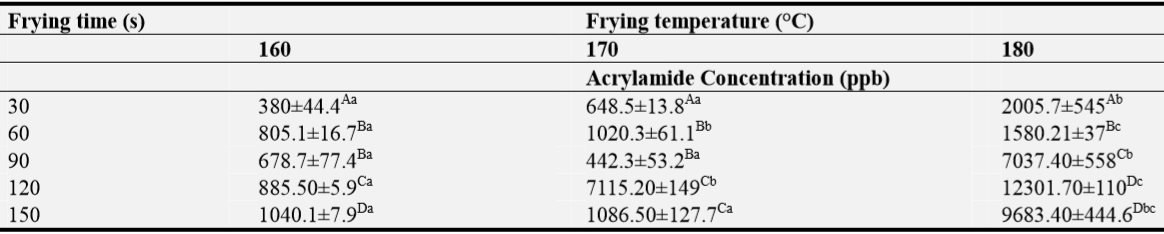
The increase in acrylamide formation in potato chips fried in corn oil at 170°C was higher than in those fried in RBD palm olein at the same temperature. The acrylamide content increased from 442.28 ± 53.2 ppb at 170°C during the 90 s of frying to 7115.20 ± 149.5 at 170°C/120 s. The acrylamide content in the potato chips fried in PBD palm olein was slightly increased at 170°C.
These results indicate that acrylamide content in the microwave-fried potato chips fried in RBD palm olein in comparison with the samples for microwave-fried potato chips fried in corn oil may be due to the higher thermo oxidative stability of RBD palm olein in comparison with corn oil. This result was similar to previous finding that the presence of natural antioxidant components in frying oil can reduce the concentration of acrylamide formation in crisps by improving therm-oxidative stability of frying oil.
The effect of temperature on the formation of acrylamide in potato chips fried in corn oil presented in (Table 2). Acrylamide increases with temperature increased from 160 to 180°C at 120 s of frying; the acrylamide content reduction in microwave-fried potato chips was about 92% (from 12302 to 885.5 ppb). This decrease in acrylamide content is because of the lower temperature used during microwave frying. In this study, potato chips fried in corn oil showed an increase in acrylamide formation as the temperature frying and frying time increased. The acrylamide formation in potato chips continuously increased with increasing frying time at 120 s. Moreover, the decreasing the temperature from 180 to 160°C caused a decrease in acrylamide content of about 90%. The results in (Table 2) showed that at 30, 60s, the acrylamide content were lower ≈ 1600 ppb. There were significant differences in acrylamide content (P < 0.05) between potato chips fried in corn oil at different frying temperature.
4. Conclusion
According to the present study, there was a significant difference in acrylamide contents in the potato chips fried in corn oil and RBD palm olein which ranged between 380 and 12,301; 282 and 13,230 ppb, respectively. Among the potato chips samples, 40% had lower acrylamide levels than the maximum values recommended by the European Commission recommendation. High levels of acrylamide were observed in the remaining 60% of the potato chips samples may be due to high thermal processes during microwave frying. In conclusion, the potato chips fried at (200 W), low temperature (160°C) and low frying time led to minimum acrylamide content. The acrylamide content in microwave-fried potato chips increased significantly as microwave power level, frying temperature and duration increased. The results showed that microwave frying at 800 W, and 180°C might be more favorable to the formation of acrylamide compared with low microwave power level and low temperature. Therefore, it is recommended to use lower frying temperatures and low frying time, which will lead to a reduction of acrylamide formation. In addition, we found that the formation of acrylamide had a relationship with the increase in temperatures and frying time. This study confirmed that, to control the level of acrylamide in fried foods, it is important to control the microwave power, frying temperature and frying time during the microwave frying process.