Part 1
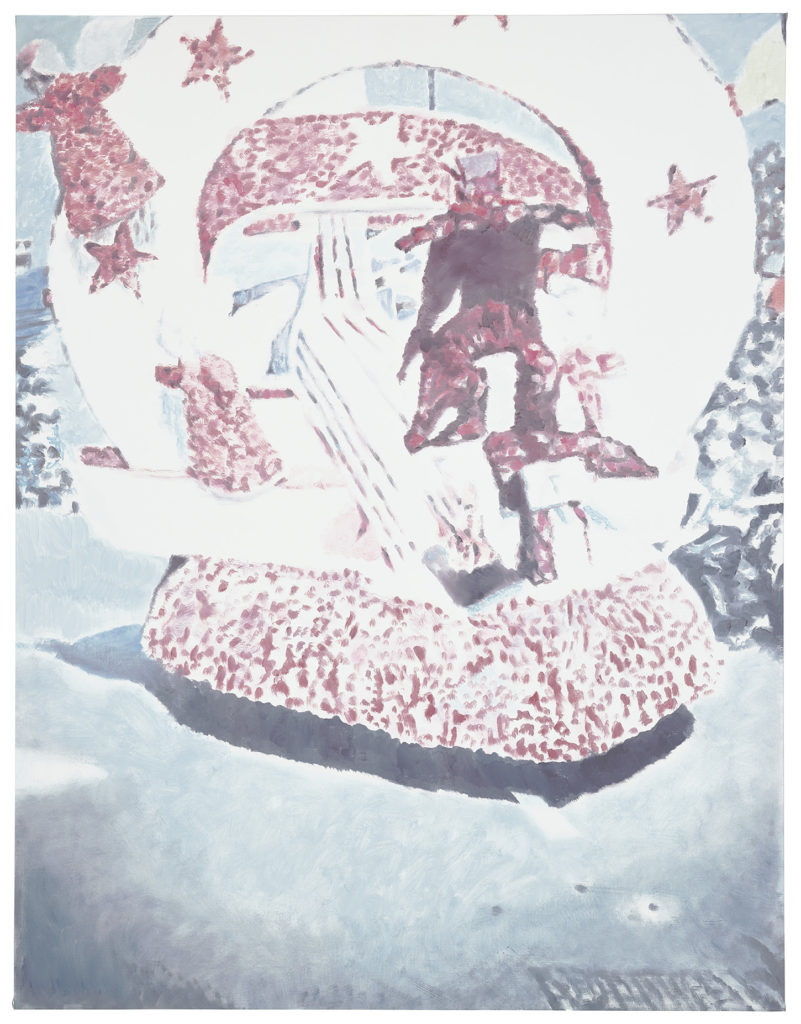
Attention for those who want to visit Lucy Tympan great exhibition at Palazzo Grass if: take advantage of the indispensable guide published by Marc Donna die (you can find it on the site). Read it carefully. Otherwise, you run the risk of leaving the exhibition having lost the most intense moments. This is not the opinion of the writer, Tympani himself makes this suggestion: "The short space between the explanation of a painting and the painting itself represents the only possible perspective in painting". In other words: what you see represented on the Antwerp painters paintings will not be understandable without you being aware of the reasons that led the artist to choose this subject. For example, when you stand in front of a portrait of a man wearing a colonial hat, nothing on the canvas will make you realize that it is the Sahara test image as its title suggests. And without knowing that the subject represented is the Japanese man who, in 1981 in Paris, murdered and cannibalized a fellow Sorbonne student, one can in no way intercept, in his eloquent ambiguity, the poetry of this image. It is clear that the style, the formal choices, the undeniable technical skill of the artist, are essential for the game to work, otherwise it would be enough to read the explanations, without even going to the exhibition. So: one eye on the paintings, one eye on the guide. End of the warning. In fact, if you think about it carefully, rather than as a warning, it is already the key to interpreting an artistic research that feeds its charm thanks to the aura of mystery it covers itself with.
An aura that Caroline Bourgeois, curator of the exhibition, defines as "her silence", explaining that Tympans does not take the spectator by the hand: it leaves him the freedom to decide what is the real subject of the painting according to what is said and suggested out of scope. Thus, visitors left to their own devices, but with a guide in format, enter with courage and curiosity into the bright inner courtyard of the Palazzo Grassi. Here, the painter had a large marble mosaic made, which occupies the entire floor and uses the title and motif of a 1986 work: Schwarzheide. The image is that of a line of trees seen from below, which stands out against the white sky. The work is divided into eight vertical lines that divide it into nine bands. Donna Dieu explains that is the name of one of the labour camps (not extermination camps) of the Third German Reich. The subject is based on a drawing by one of the prisoners, Alfred Kant Or, who, not wanting it confiscated, had cut it into strips.
The work is practicable. After crossing it, you take the Great Staircase, on which stands a small work: Secrets (1990). This is the closed portrait of Albert Speed, chief architect of the Nazi Party and Minister of Armament and War Production of the Third Reich. The framing of the face is narrow, like a passport photo. He faces Schwarz from, but does not see him. Speed, in his two books Mémoire off the Tard Reich and Secret Diaries off Pandas, claims not to have been aware of the final solution on Jews commissioned by Hitler. It is an opening that lives up to the reputation of a committed artist, who frequents dense themes such as the Holocaust, colonialism, the shadows of religion or contemporary politics. His own biography is marked by the contradictions of history: his mothers family had participated in the Dutch Resistance and hidden refugees, while two of his fathers brothers had been members of Hitlers Youth. One of them, by the way, is called Luck, like Tympan s. Uc Turbans, Candle, 2017, oil on canvas, private collection.
Courtesy and photos: Luck Turbans Studio, Antwerp. During the exhibition, which presents 80 works created throughout his career, the theme of Nazism is repeated several times. In Not nouveaux quarters (1986), the artist reproduces the model of one of the postcards that the Theresienstadt prisoners, a model transit camp built by the Nazis to mislead the foreign media about the reality of the extermination camps, were invited to send to their relatives. In the triptych Recherché (1989), the painter uses images taken by himself in the concentration camps of Auschwitz and Buchenwald: a lamp from the office of a Nazi officer, a prisoners tooth and the view from an office window. In To term Gang (2018), he represents the image of the steel door that gave access to the Hitler Bunker complex in Berchtesgaden. These are reflections on the regimes propaganda, the desecration of bodies and absolute evil. They are almost notes, painted with a calculated haste that is his stylistic signature (each painting, large or small, is made in a single day). Horror is never dealt with directly, the abyss is always hidden behind the banality of common objects or everyday situations. It is also surprising to see how Tympani approaches the theme of September 11. The occasion was the edition of Document 11 in Kassel in 2002, where a few months after the attacks in New York, we expected the artists to try to confront each other on this theme. My wife and I were there. We saw the planes entering the skyscrapers from our hotel room. At that time, I thought it was impossible to do anything to depict the event. Thats not how painting works, explains the artist. He therefore chose to do Sil Lie (2002), which with its 3 metres by 5 beings probably one of the largest still life in the history of art.
A delicate composition of fruits next to a jug of water floats in a neutral space, where the plane on which the objects rest can be imagined thanks to the short shadow they cast. Donna God wrote: It is not a question here of showing the explosion, the eviscerated buildings, the bodies thrown into space or the bodies buried under the rubble, but what remains after the disaster, beyond good and evil, when the cloud of dust has settled: the natural, or human, determination to continue despite everything, to take up or rethink, the fruits and waters, the substance and colour, the density of life, the rebirth. Isn't the literal translation of Still Life still alive? In Venice, the large painting is displayed alongside the small canvas William Roberts on (2014), a portrait of the Scottish historian and theologian who lived in the 18th century, represented by a narrow plane of his face that highlights his intense blue eyes. It is as if, to look at Still Life, Tympan borrowed the penetrating gaze of the Intellectual Lights.
continued in the next article-