- And it is in this context that the first experiments of a Telemachus in his early twenties, or slightly older, are also inserted, reread through his relationship with his father (always friendly, points out Bietoletti, and fed by a lively family atmosphere and inclined to support the young): It is in fact on the image of Florence, mediated by the paternal filter, that his artistic personality begins to form, as is evident from two new ovals, a Panorama of Florence from the hill of San Miniato and a View of the Arno and Santa Maria del Fiore from the Fort of Belvedere, which is connected to the Harvest of which we have just said because of their idyllic atmosphere.
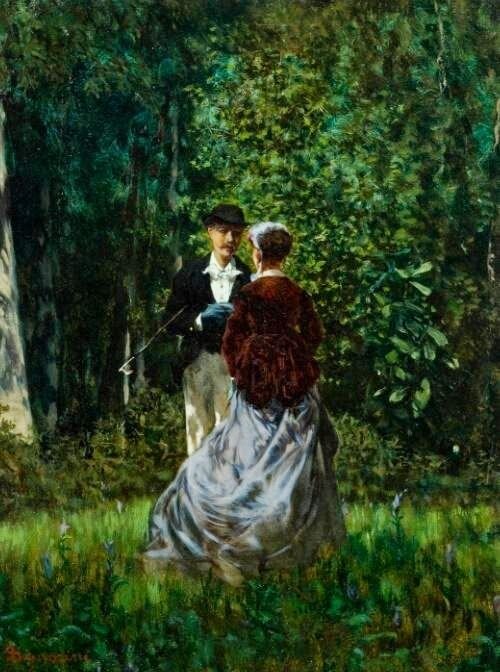
However, they are also works that, the curators explain, "attest to a modern use of light, conducted through intense contrasts of chiaroscuro, which until now the painter had used to increase the narrative involvement and sense of truth in episodic historical-literary or in studies of urban architecture, but which now connote the relevance of a vision of the landscape observed in the open air, before the usual reworking in the studio. This romantic image of the city is the one that, at the time of the proclamation of the Kingdom of Italy, marked the production of many painters active in the area: This is the case, for example, of Lorenzo Gelati (Florence, 1824 - 1899), whose View of the Church of San Miniato al Monte almost invites us to admire a glimpse that seems to have been made especially for a postcard, or of Nino Costa (Rome, 1826 - Marina di Pisa, 1903), the leading name in real painting in the mid-nineteenth century, who with his painting Un pomeriggio alle Cascine seeks the suggestive effect.
At the same time, the young Telemaco, towards the end of the fifties, by then abandoned the path traced out by his father to undertake his own, began to develop his painting of "stain", which to some extent would also enunciate theoretically in an article published in La Gazzetta del Popolo of 1862, in response to an anonymous critical controversy that, as is known, adopting the term "Macchiaioli" intended to connote negatively those young people who proposed to "reform painting": "in the heads of their figures", we read in the small unsigned article, "you look for the nose, the mouth, the eyes, and the other parts: you see their stains without form [...]. That the effect must be there, who denies it.
But that the effect must kill the design, even the shape, this is too much". To these attacks, Signorini replied by writing that "the stain was nothing more than a too precise way of the chiaroscuro, and effect of the necessity in which the artists of the time found themselves to emancipate themselves from the capital defect of the old school, which, to an excessive transparency of the bodies, sagrified the solidity and the relief of his paintings". The stain of Signorini, Fattori, Borrani and colleagues, wrote Bietoletti in 2009, was born to respond to the need to free painting from the didacticism that had characterized the historical romantic painting and, vice versa, to renew this genre in search of a more passionate involvement of the observer.
This very first season of spot painting is not documented by the exhibition at Palazzo Antinori, which, on the contrary, focuses on the new landscape painting, elaborated at the turn of the period that preceded and followed the second war of independence. At the end of the hostilities, Signorini, after the death of his father Giovanni in 1862, moved to Argentina, in the countryside just outside Florence, where he founded a sort of free school of painting with Silvestro Lega (Modigliana, 1826 - Florence, 1895) and Odoardo Borrani (Pisa, 1833 - Florence, 1905), based on open-air painting that kept in mind the example of the Barbizon school (whose results Signorini had been able to appreciate while staying in Paris a few months earlier), on the observation of the mere natural fact, on the desire to sever the ties with the academy, on the awareness that it was necessary to imprint a feeling on the canvas. Three of the best-known works from Piagentina's period are on display, thus constituting a nucleus that is small in quantity but of the highest quality.
The bridge over the Africa stream, a compendium of this interest filtered through the interest in rustic life that often returns in Signorini's production, and again The Honeymoon, a fully Macchiaioli painting cloaked in delicate lyricism, and the Renaioli on the Arno, full of those atmospheric effects that the painter was looking for with insistence at this time of his activity. Telemachus had by then become completely independent of his father's example.
To be continued.