In nature, the sun is rarely yellow, we see it as dazzling light or shining orange if it is above the horizon. Still, the concept of yellow is easily linked to the sun, as are children who draw the sun in yellow. The yellow colour is perceived by us as the sun, light and shining. Yellow is light, shining, exciting and therefore warm. After white, it is best to reflect the falling yellow light. It seems as if the light is sliding on a light surface and does not penetrate the dark inner depths.
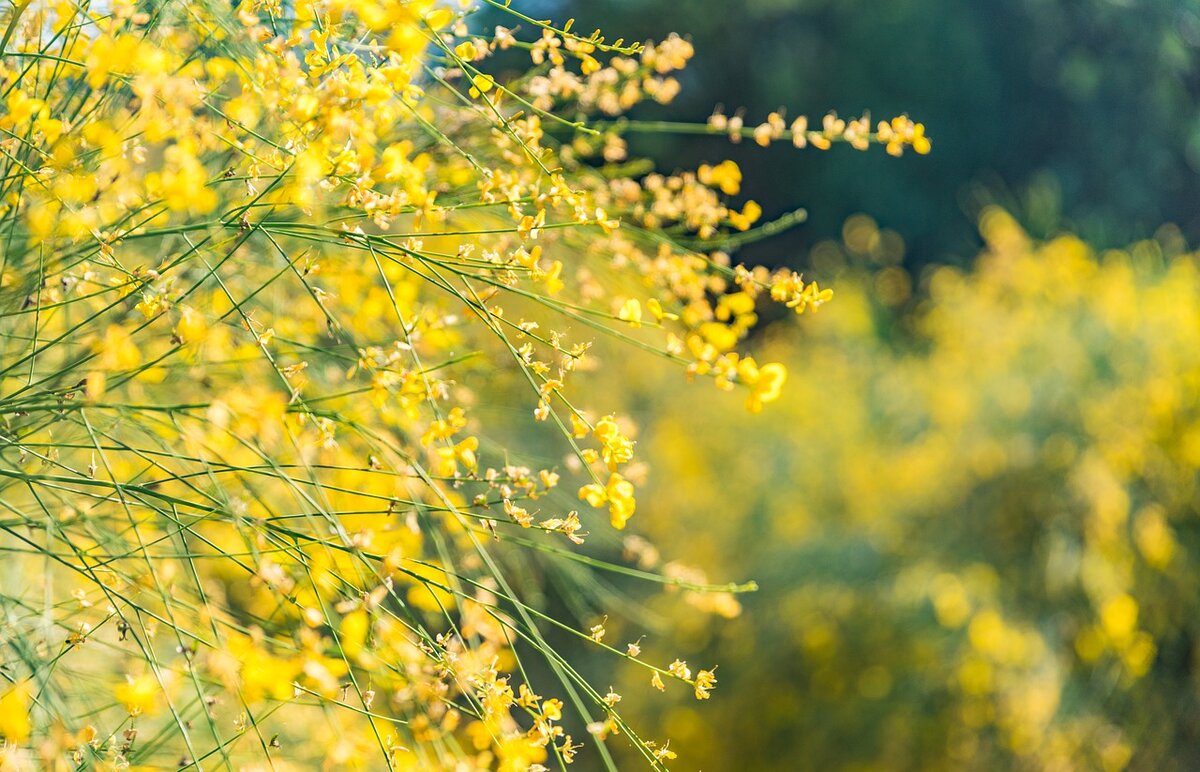
On the other hand, yellow worries the person excites his character and reflects the nature of the force expressed in this colour, which, in the end, becomes bold and intrusive. This property of yellow, gravitating towards lighter tones, can reach an unbearable height and strength for the eye and soul. In this case, it sounds like a trumpet singing louder and sharper, or a high fanfare sound. If you add red to green (an additive mixture of colours), it turns yellow. This optical association of both colours in yellow corresponds also to a psychological beginning of yellow colour.
Red as excitation and green as a direction create as a result of a state of excited tension. As from red and green, there is another colour - yellow, and excited tension leads to a different mental state: to explosion, discharge, eccentric relaxation, as, say, laughter after the final phrase of the joke.
Yellow expresses the eccentric resolution of the exciting voltage. Green is concentric tension and inertia, yellow is eccentric discharge and change. If we compare green with charged, statistical potential energy, yellow corresponds to discharged, dynamic, kinetic energy.
Preference of yellow colour to the rest means the search for liberation, carrying happiness because there is no such thing. If at the same time, blue is rejected - the colour of rest, satisfaction and unity - it is a miserable, unsuitable for the real connection of man, who is constantly concerned, looking for satisfaction in the idol of love. This preference for yellow for blue often indicates, for example, "agitated depression", which pharmacologists should treat with antidepressants that reduce arousal, and psychoanalytically as a positive or negative maternal connection.
If the blue colour (excited anxiety, sensitivity) is rejected and yellow (search and waiting for release) and green (tension, self-affirmation) is chosen, then this is characteristic of an ambitious person who lacks friendships in the team and who seeks to gain recognition through superiority. In this case, when the lack of a sense of security (-blue; conflict of connections) leads to such tension (+green) that compensatory discharge (+yellow) is required, there often comes a psycho-vegetative sensitization of organs (stomach, intestines, gallbladder).
Whenever green and yellow stand next to each other in a row of eight colours, they form one group, the voltage and discharge are combined to directly remove and neutralize the voltage. Choosing green and yellow requires immediate confirmation that it is valued, respected so that the (+yellow) voltage (+green) can be relieved. The one who rejects both these colours also can no longer tolerate stressful pressure (-green) and irritating excitation (-yellow). In this case, ambition is so slowed down by neurotic fear that it is the strikingly indifferent and careless manner of behaviour. If green is preferred as the voltage pole and yellow is rejected as the discharge pole, it can be compared to a battery that has given away a lot of voltage and requires a new charge. If green is preferred as the pole voltage and requires new charging. If, on the contrary, green is rejected and yellow is preferred, this state can be compared to a recharged, "boiling" battery. If both poles - voltage (green) and discharge (yellow) - do not close into the group, but are connected to excitation (red), the three of them form an "ergotropic functional group". And, conversely, in the case of a combination of green and yellow with blue (rest) in these three colours is revealed "trophotropic rest group".
While disorders in the range of blue and red colours (rest and excitement) are especially manifested in the form of cardiovascular diseases, tension (green) and discharge (yellow) are mainly related to gastrointestinal diseases. For this reason, patients with a tendency to spasm of smooth muscles (gastrointestinal, bile and urinary tract) often have a specific preference for green and yellow.