Part 1
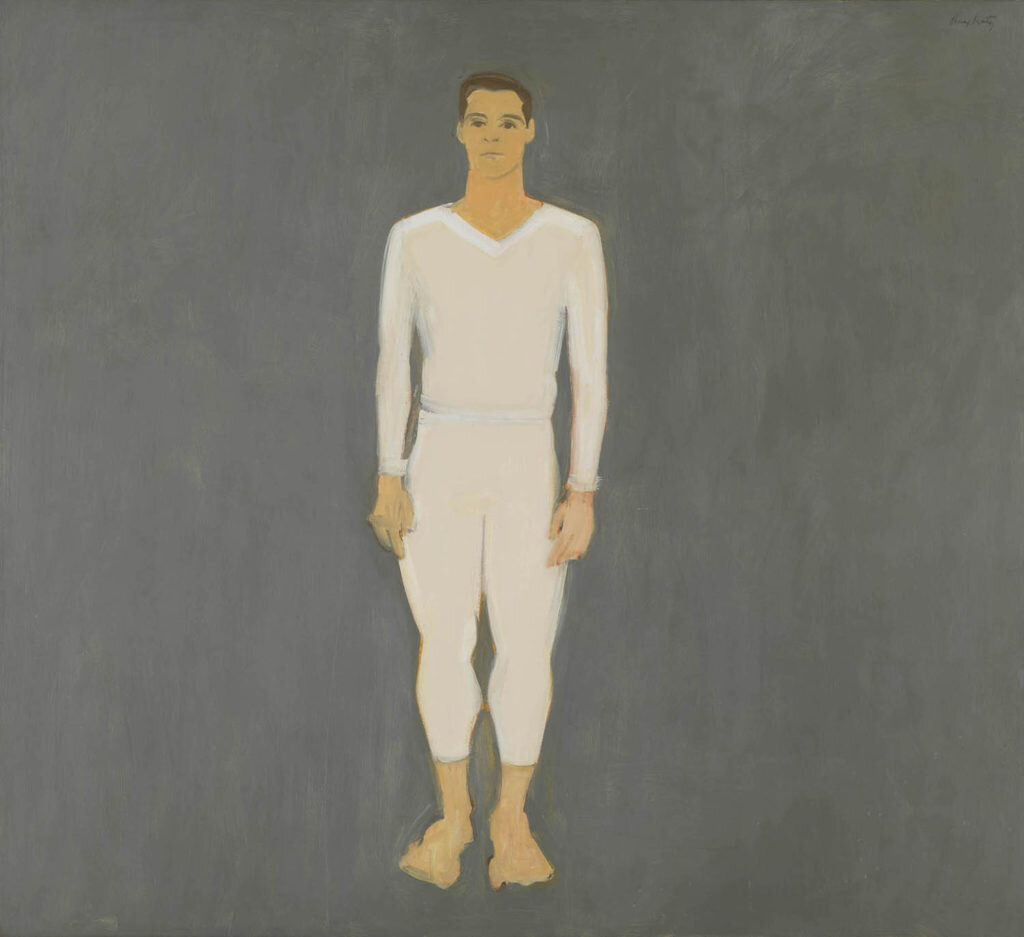
Alex Katz is one of those artists who question the categories that try to sweep away the undulating flow of art history. Born in New York in 1927, fifteen years after Jackson Pollock and just one year before Andy Carol, he could be considered as the link between two generations of American painting: abstract expressionism and Pop Art, but around eight, in 2019, Katz continues to paint his large enigmatic paintings sixty-three years after the death of the inventor of dumping and thirty-two years after the death of the Pope off Pop. And he is not a survivor of the golden age of American art: his work continues to flow freely, without time being able to archive it. Just look at the large paintings in a recent exhibition at the Timothy Taylor Galley in London, entitled Coca-Cola Girls: they have the vitality of the works of a young painter s studio. It is difficult to say what the elixir of eternal youth inspired him, but the main way to enter his universe is probably a visit to the retrospective exhibition dedicated to him in recent months at the Brand Horst Museum in Munich (scheduled until April 22), organized by Jacob Proton. More than ninety works, including large and small canvases, cut-outs and sketches, mainly from the sumptuous collection of Do and Annette Brand Horst (he is alive, she died in 1999).
The presence of about twenty works by Katz among the purchases of refined German patrons (over the years they have built up the most important European collection of Ce Tomboy and more than a hundred works by Andy Carol), says a lot about the consensus that has been established around the work of the New York painter. In Munich, it is possible to trace the entire production of the American artist from the 1950s to the second decade of the 2000s, also through symbolic paintings such as The Black Dress (1960), Paul Taylor Dance Constant (1963-64), Winter (1996) and Grès Court (1997).
The story of Alex Katz, in his own words, was a story of continuous misunderstandings between critics and the public. They always put me in contexts to which I don't belong, he says in an interview with Donald Kuspit in the early 1990s: I make big heads, so they think he's a pop artist. They think it's a weak solution to Pop's problem. On the other hand, he continues: Since I was not an abstract expressionist, they believed that I had no depth, nothing to do with the unconscious, as if it could only be articulated in one direction, through a single style. The painter never concealed his admiration for the greats of the New York Shoot, Jackson Pollock, Mark Roth ko, Franz Koinè, Willem de Kooning: the world belonged to them then.
No one had the same dynamism, the same energy, to the point of being able to shift the centre of gravity of the world of the art of rubble from old Europe to the canvas of Manhattan's skyscrapers. It was in the early 1950s. Katz looks and understands, but he doesn't hear about the game. It cannot share what has become almost a dogma: a modern image can only be abstract. When he started working, the first exhibition was in 1954, Edward Hopper was still in full expansion, but it is clear that this kind of figuration belongs to the past. Young Alex knows that if you want to continue playing in the field of figurative painting, you have to go in another direction. Thus he began to develop a truly physical representative art, as he explained to Constance Legal in 1991: It is a modern idea in the field of painting and that is what I wanted to do. Since it is said that the representative act is obsolete, I propose to find a way to integrate it into the modern world.
The path taken, and it is easy to understand why, is all uphill: recognizable subjects, such as the old figuration, and the monumental scale introduced by the Scheol off New York. Over the years, Katz's style has become more precise: the human figure or figures stand out on homogeneous backgrounds (such as The Piper by Eduard Manet), the story is absent. Sometimes the subject is repeated once or several times (his wife ADa, in Thé Black Dres, is repeated six times). And it is perhaps the kind of group portrait that most intensely restores the alienating temperature of Katz painting. It can be seen in works such as Laon Part (1965) and Private Domain (1969), with the majesty of its six meters wide, present in the Brand Horst exhibition. For his Italian debut at the Emilio Malpoli Gallery in 1990, Achille Benito Olive writes: The American artist founded a kind of oblique realism, aiming to affirm a clear and precise vision, a focus and a point of view that reflect the perspective of photography and cinema.
Read more in the following article- https://zen.yandex.ru/profile/editor/id/5d6287904735a600adf0e5b8/5d953f14fbe6e700b1483985/edit