Signorelli's interest in Roman antiquities, however, goes far beyond simple quotations or formal filming. It is certainly necessary to reiterate that, with regard to his first stay in Rome, we do not have documents that can provide us with certain testimonies, nor have survived drawings that are able to hand down to us in a more precise way what were the objects of his care. It should also be noted, as the scholar Eloisa Doidero points out in her essay in the catalog, that "the encounter with the ancient heritage of Rome is mediated, in Signorelli's work, by the lessons of the Florentine masters, who introduce the painter to the study of anatomy and the naturalistic rendering of the body.
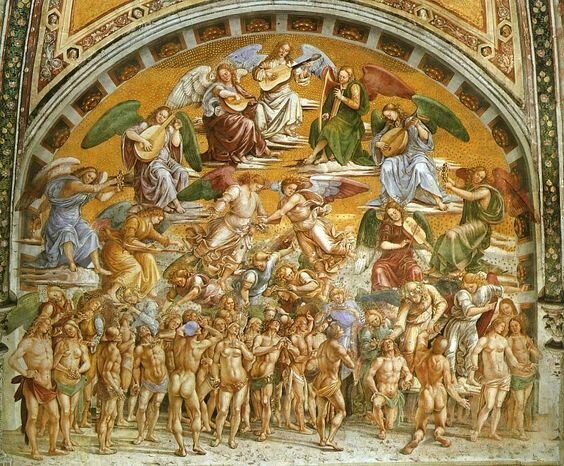
The result is a formal language permeated with classical suggestions, while the sculptural dimension, three-dimensional figures of ours, is the most incisive proof of his familiarity with ancient statuary. It is therefore above all in the nudes and figures that one sees the most substantial contribution taken from the ancient (the catalog mentions the Flagellation of Brera, the same frescoes of the Sistine Chapel, the Medici Madonna, the Education of Pan and several other works that are not included in the review, and one could extend the reasoning to the Crucifixion of Annalena itself, which is present instead), but not only.
There are at least two other reasons that should be mentioned: the first is what Francesca de Caprariis, in her contribution to the catalog, defines as "rhetoric of ruins", of which we find a formidable essay in the Martyrdom of St. Sebastian in Città di Castello, restored on the occasion of the exhibition. Here, Signorelli creates a landscape of ancient ruins that is certainly completely unrealistic, but that represents a deep and tangible sign of his passion for antiquities: so, on the hills that serve as a backdrop to the main scene, you can admire the Colosseum, a reworking of the arch of Constantine, what seems to be the top of the Tower of the Militia.
The latter appear infested with vegetation, as was typical of that rhetoric "sign of admiration and triumph over a past world" (so de Caprariis), while the same does not happen to the facade of the temple in the foreground and the bridge in the background: here, the absence of weeds could become a symbol of an antiquity raised from oblivion and recontextualized in contemporary Christianity. The second reason is instead the archaeological interest exemplified by the titulus crucis that Signorelli affixes to the cross of Christ in the Crucifixion of Annalena: in 1492, in fact, what was believed to have been the plaque actually hung on the cross of Jesus as a sign of mockery had been found in Rome, and Signorelli may have been the first artist to have reported the famous trilingual inscription (in Hebrew, Latin, and Greek) in a work of art (the primacy is disputed with the Crucifix of the Holy Spirit by Michelangelo).
A passage on the frescoes of the Chapel of San Brizio made between 1499 and 1504, with the reproduction (in reduced scale of course) of some details of the scenes (a presence justified on the basis that the repertoire of nudes exhibited in the compositions of Signorelli Orvieto derives from his knowledge of the ancient) allows the curators to exhibit the so-called tile of Orvieto, which introduces the sections on critical fortune, since the debate around the autography of this singular plate exacerbated the spirits on the occasion of the monograph of 1953, decreasing a halt to the consensus that the artist had obtained among scholars.
- The exhibition in Rome is limited to providing a few, very brief, nods to the story, which had already been retraced (with greater depth) in the context of the exhibition in 2012: summarizing, the tile (a tile on which are painted, on the front side, the portraits of Luca Signorelli and Niccolò di Angelo Franchi, chamberlain of the Opera del Duomo of Orvieto at the time when the artist was entrusted with the frescoes of the Last Judgement) became in fact a real scapegoat that opened to bitter attacks on both the curator of the exhibition, Mario Salmi, as well as Signorelli himself, a painter who, according to the detractors, wrongly extolled the exhibition as "a man with all sense and physicality, superb of his dilated muscles, schematic in his pseudo-epic massiveness" (as written in 1953 by a twenty-two year old Alberto Martini, the pupil of Roberto Longhi who died prematurely at thirty-four years of age).
Francesco Federico Mancini wrote in 2012 that in this chorus of criticism, somewhat inspired by Longhi and able to include personalities such as Ragghianti, Salvini and Castelnuovo, "years and years of personal grudges, of different methodological approaches, of contrasts between groups, of rivalry between schools of thought, of changing ways of understanding and interpreting art were pouring in": Longhi particularly focused on the tile, which he hastily branded as a nineteenth-century fake. This was followed by a passionate defense by Mario Salmi, but the question of the tile's autograph remains substantially unresolved: a bit 'because the controversy of 1953 almost completely cut off the debate (it followed only the stance of Scarpellini, who in 1964 remained equidistant, Zeri who in 1995 expressed in favor of Signorelli, and McLellan and Henry who expressed their opposition between the end of the nineties and the beginning of the two thousand), a bit because the story is complex and difficult to summarize here (it will be worth remembering, however, that the last position, that of the aforementioned Mancini, is in favor of an autograph signorelliana).
To be continued.