Thanks to the ingenuity of many designers in different European countries, art Nouveau has found its brightest expression in architecture.
Belgium.
Perhaps because of cultural ties between England and Belgium is in Brussels, the art Nouveau is identified with the works of two architects: Victor Horta and Van de Velde, especially in the field of hotel construction, that is, private residences for a large business bourgeoisie. These are buildings in which a surplus of rooms and spaces still had to reflect the ancient principle of conformity between noble splendor and social prestige.
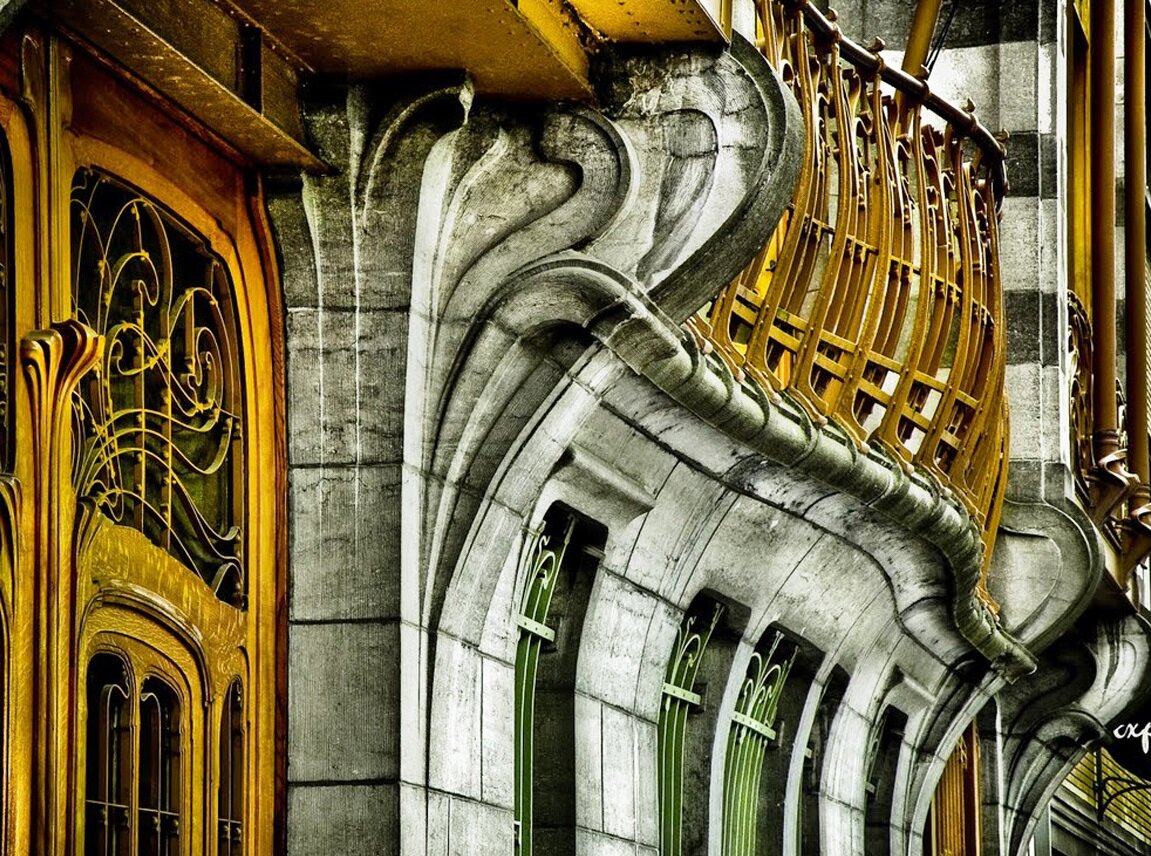
Victor Horta created a new concept of architecture, where visible structural elements became both decorative details. Fundamental aspects are the predominance of glass surfaces, the elegance of the curved line bending the wall, and the decorative invention that defines every detail. The Solvay House is a valuable testimony to how modernity is perceived as a movement that breaks with the past, only with a few phenomena such as eclecticism or the use of several styles that belonged to previous eras.
The Solvay House is the core of eclecticism, with its facade characterized by recesses and protrusions and many glass elements. It is the Noveau art centre with a smooth base and railing. The key element of the art Nouveau style is the same attitude to the interior and exterior. The railing is a great structural innovation, all of which are modular elements that are joined together by a cold joint. Belgian architecture is characterised by a curved line that prefers to be decorated with flowers, a whip or a curve with a small twist.
France.
In France, very interesting works by Hector Heymar, who uses cast iron elements in a wavy way, like flowers, to decorate the subway entrances, giving them a naturalistic aspect. A typical feature of modernity is also the handwriting used on the signboards of entrances, rich in the production of advertising cartoons.
Spain.
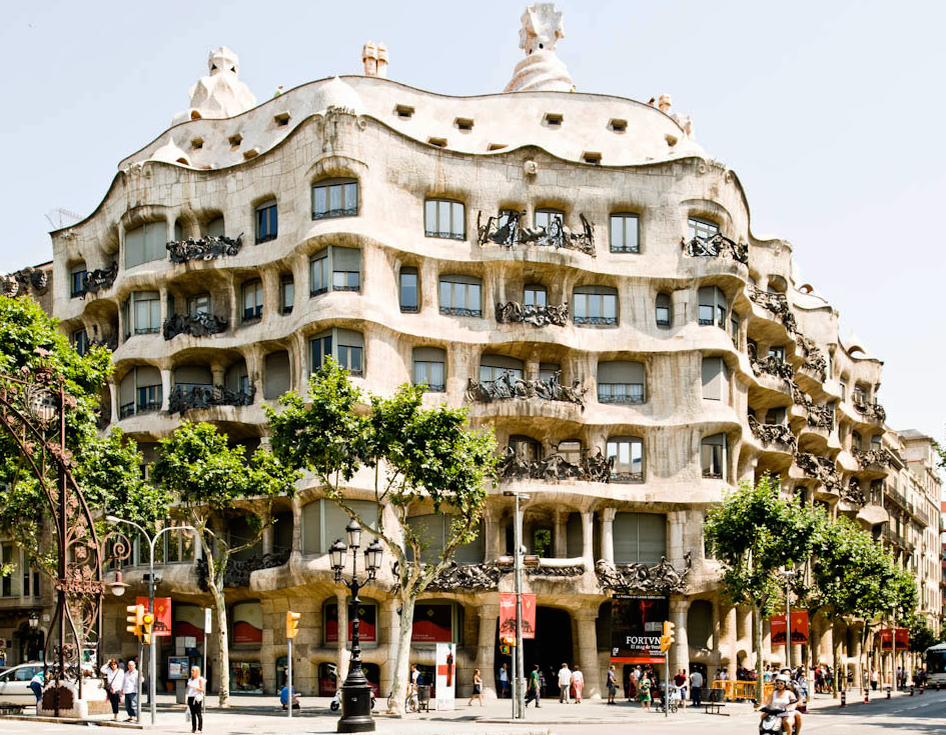
One of the greatest personalities of modernism was the Spaniard Antonio Gaudi, who was able to destroy the rigidity and geometry of architectural forms, using the imagination of movement. He prefers very complex and colorful geometric shapes with neo-Gothic and baroque influences. Gaudí's freedom of creativity shapes forms that are not linked to classic, familiar shapes. He creates them regardless of the geometry, which is characteristic of the architecture of all times.
The movement of curves and bends can be observed on the exterior surfaces of Casa Mila, or continuous modeling that rounds off the corners of the Casa Batlo wall surfaces. The Catalan architect seems to be interested in restoring the natural world after this trick. The last and most famous of his works is the unfinished construction of the Sagrada Familia, built in 1883 with the only financial support from alms and donations from the faithful. The structure itself provokes a spiritual approach even in the coldest visitor, with its apparent structural fragility, hinting at both the transient nature of human creations and the childlike purity that a person must have in order to come closer to God.
The Sagrada Familia was built on a basilica basis, combining Gothic architecture with modernity, with peaks belonging to Gothic art. It has not been completed because the project has changed, even when the work has not yet been completed.
Italy.
The vitality and originality of modern art Nouveau is emphasized by contemporary art historians, who overcome the negative assessments of other eras, despite the fact that many architectural works, unfortunately, were lost as a result of the war, remained neglected and despised. Raimondo d'Aronco and Giuseppe Sommaruga, who were responsible for the construction of the Castiglioni Palace, are the most important figures of the Italian Art Nouveau movement.
One of the most influential artists was Ernesto Basil, a very cultural man and a scientist sensitive to Sicilian architecture. After an initial period marked by eclectic mannerism (copying and renewing eclecticism), Basil moved to a more autonomous language, rich and extremely cultural. The basilica also made an original contribution in the field of furniture, executed as a designer of the company Ducrot. In general in Italy it is possible to tell that on the classical base, on a square building there are primitive ornaments from wrought iron, after all Italy always was classics.