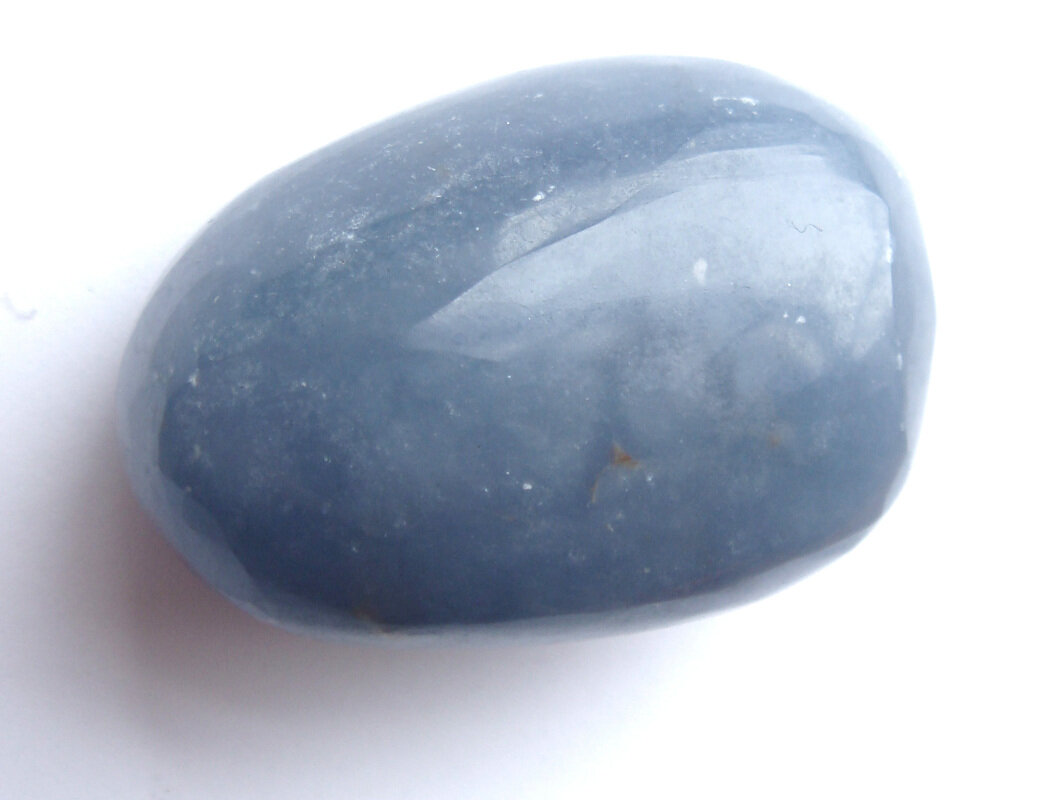
The mineralogy of the angelite does not know. There is no angelite among the list of rocks, precious and semi-precious stones. The resounding name of the gem came into use only 30 years ago: the discovery of blue anhydrite deposits in Peru pushed marketers to create a new commodity trend.
Angelite acquired its name thanks to the unusual coloring of stones in blue and purple tones. Angelita's second name also sounds very attractive - the stone of angels.
The mineral has an unusual property, which is that when exposed to water Angelite turns into gypsum, so the main rule when handling this stone is that it should be protected from any exposure to moisture.
Angelitis is a typical representative of the varieties of anhydrous calcium. The color of the stone in nature is both white and blue, grayish, purple and reddish. The mineral is characterized by: glass luster, hardness - 3,0-3,5 and density in the range of 3,0-3,5 g/m3.
The main Angelita deposits are known in the USA, Switzerland, Germany and Peru.
Angelite jewelry and its prices:
Angelite is a very soft mineral. On its surface it is possible to make an inadvertent scratch, damaging the beauty of the stone.
Angelites are easily and successfully processed, so they are mostly used as ornamental stones from which original jewelry and various figures and statuettes are carved.
However, we should not forget about the property of Angelite, as well as anhydrite, which manifests itself in prolonged contact with water and changes the state of the mineral, which turns into a plaster structure. Therefore it is necessary to be more attentive at the handling of this stone in any case not to take it in a shower or on sea trips.
Magical properties of angelite:
Angelite as a fragile and soft mineral is a short-lived and very capricious mineral that does not paint it, but does not diminish its magical powers. Astrologers have come to the conclusion that Angelite is a real guide and a link between man and the heavenly patron. In order to attract the help and assistance of his guardian angel, the owner of the Angelite must carry out a conspiracy on the stone with the address: "My angel, be with me. You are ahead, I am behind you", and then ask for the fulfillment of your desire. The stone will inform you of the guardian's request for your life and will do its best to help you. However, Angelita has a strong memory and he fixates on the first desire of the owner, so with another desire to turn to the mineral makes no sense, because he will diligently fulfill the original request.
If you do not apply to the mineral with a request for mediation, but only to have it with you as a decoration or a talisman, it will carefully attract the attention of the owner of the good forces, so the owner of this stone angels need to eliminate all the evil actions and gloomy random thoughts with malicious intent, as will follow a rapid and severe punishment of higher powers.
This stone, as a talisman, provides great help to newborn babies. Angelite, like the guardian angel, will protect the baby from the influence of the negative forces of evil, to preserve and protect his health, as well as to help in his development and upbringing, so that the child grew up moral, kind and decent man.
Therapeutic properties of angelitis:
Therapeutic properties of the angelite in a pronounced manifestation was not observed, but the lithotherapists in this regard, as they believe that the stone angels diligently strengthens the immune system, and most importantly helps to detect any disease in its early stages. The affected organ begins to hurt so badly that the stone owner needs a visit to the doctor. At the early intervention of doctors acute pain is released and then Angelita makes every effort to the owner to cope with the disease and fully cured.
Angelitis astrology:
Angelitis will promote any sign of the zodiac, but if handled correctly. It is necessary to comply with all the conditions discussed above and to use its magical power correctly. Particularly diligent is the mineral in relation to persons who were born under the signs of the Virgin and Pisces.
Interesting fact:
For contact with the guardian angel it is possible to resort to Ivan Ognev's technique and to address with the request for the help.