Requirements for the SR-71 pilots were very strict: flight time on jets was not less than 2000 hours, and 1500 hours — as a crew commander or instructor, the service life in the Air Force or reserve — not less than 16 years, medical requirements are comparable with the requirements for astronauts, the mandatory availability of access to documents with the stamp “Top Secret”. Somewhat more lenient requirements in terms of raid and health were imposed on the operators of reconnaissance equipment. Recruitment was carried out only on a voluntary basis. Among the first ten pilots of the 4200 th wing five flew earlier on the B58, two on the U-2, two on the B-47 and one was a graduate of the Air Force test pilots' school.
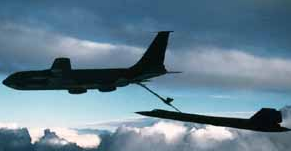
Preparing for flights on the “Black Bird” began with flights on the T-38 and work on the ground simulators of the scout. After passing all the tests, the SR-71B was allowed to take off. The duration of the first flight was usually about two hours, and the aircraft did not exceed the speed of sound, but simulated refueling in the air from the tanker KC-135Q. In the second and third flight, the novice got acquainted with the peculiarities of the car's behavior at supersonic and practiced contact with the refueled, the fourth flight was performed at night. Practice has shown that the flight at night only after 8-9 hours of raid on the SR — a rather risky event, then the first night flight was allowed only after the raid on the SR-71B for at least 50 hours. After the completion of the fifth flight, the newcomer was considered prepared to work independently on the SR-71A. The pilot received the status of ready to perform a combat mission by performing six training flights on the SR-71A. The commissioning program averaged 30-35 flight hours on the SR-71A/B and at least 100 hours of work on simulators.
Even more, time was spent on training the technical staff. The aircraft proved to be extremely challenging operating. The nearest analog of the SR-71 flight preparation process is the process of relaunch preparation of a space launch vehicle. However, the rocket does not require post-flight inspection, and SR'a had to conduct about 650 checks after landing! Five technicians spend six hours studying the condition of the aircraft's glider, and two powertrain technicians also spend several hours scrutinizing air intakes, engines, exhaust and bypass devices. And that's after each flight! After every 25, 100 and 200 hours of flight, the scout was examined and partially disassembled. Thus, the 100-hour inspection of the condition took eleven 16-hour working days; the installation of the engine on the plane by 8-9 specialists with a hydraulic lift took 8-9 hours. In the course of this inspection, as a rule, both engines were changed, regardless of their condition, although according to the instructions, the engines were to be replaced after 200 hours of flight time, with 15 working days allotted for this procedure. Every three years, again, regardless of the flight time, the aircraft were inspected at the Lockheed plant in Palmate. The engines were overhauled by Pratt and Whitney after 600 hours of engine operation. Not surprisingly, the SR-71 required extra-class technicians and took several years of training.
Only NCO who had served in the Air Force for at least four years were selected, and then the NCO underwent an initial 18-24 month training course. After passing the tests, the new recruits were allowed to work on intelligence officers, but only under the supervision of more experienced senior colleagues. It took at least 18 months of apprenticeship to get the permit to work independently. Such a procedure, beautifully painted on paper, was not always followed for SR-71 technicians. There were also relatively poorly trained sergeants working on the material part, in which case the terms of routine work increased dramatically. Lockheed and Pratt and Whitney's engineers carried out the work in the shortest possible time, but their services cost much more than the soldiers' salaries. In some cases, the Air Force went to the conclusion of contracts with Lockheed on the maintenance of combat reconnaissance units.
Preparing for takeoff began long before the engines were launched. 1.5 hours before the launch, the pilot and the reconnaissance equipment operator are dressed in spacesuits; the spacesuits from portable systems are supplied with pure oxygen for breathing and cooled air to prevent overheating of the body. Pilots are brought to the aircraft 45 minutes before the scheduled time of launch. Engines are started and tested in the hangar 30 minutes before takeoff. After the inertial navigation system is cleared to the runway, the initial exhibition of the inertial navigation system is held along the brightest visible star of the sky (the INSA memory stores the coordinates of 52 stars, the “sees” the star at any time of the day).