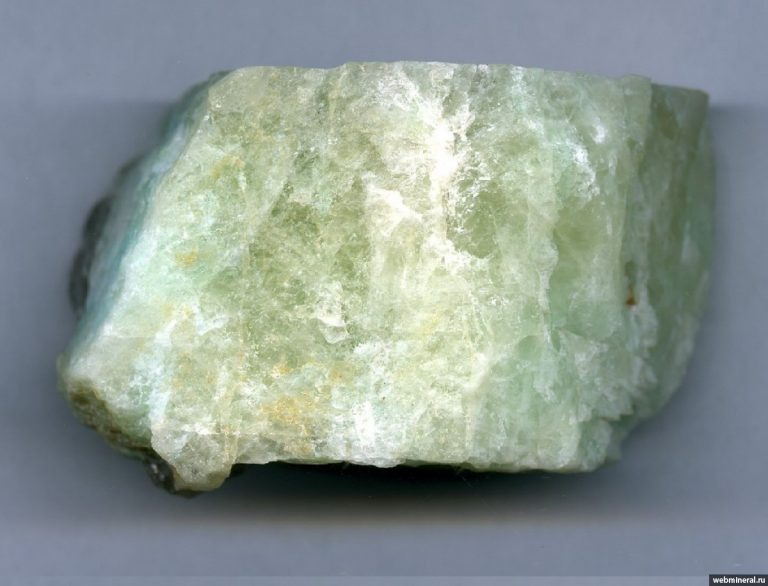
Ambligonite, montebrasite (gebronite) is a rather rare mineral, but even rarer are the stones that come to jewelers for processing.
Amblygonite from buckwheat is oblique, named so because of its cleavage in different directions, and is lithium-aluminum-fluorinehydroxyl phosphate. The color of the mineral ranges from colorless, yellow and cyan to pale pink. There is a glass shine. Hardness about 6; density within: 3,0-3,1 g/cm3.
It is not very popular with jewelers because it is difficult to find such a stone suitable for cutting, and if there are large minerals, the weight of the gemstone is not more than 15 carats after processing. The record weight of the cut amblygonite is 65.5 carats.
It was discovered by Ambligonite and also named by August Breithaupt (1791-1873) as a German by origin in 1817 in Saxony. Externally, he resembles Brazilite, Spodumene, feldspar and Scapolite.
Amblygonite and montebrasite are quite fragile stones and cannot boast of any special properties. And besides, very rarely are there large crystals suitable for cutting (the record belongs to the faceted amblygonite from Brazil, which is stored at the Smithsonian Institute - 65.5 carats). Usually cut amblygonites and montebrasites do not exceed 15 carats. But these gems in jewelry look very good, and the price for them is low, which often attracts buyers. Transparent ambligonite and montebrasite stones are mostly cut, while opaque stones are mostly polished in cabochons.
The main Ambligonite deposits are in Brazil, Namibia and the United States. Russian jewelers with ambligonites practically do not work. Used in jewelry, faceted stone looks quite attractive to the consumer, especially in combination with low cost. As a rule, colorless stones are chosen for cutting, dense white minerals with pink and blue inclusions are sent for making cabochons.
A variety of handicrafts are carved out of the stone and collected. In industrial production ambligonite is used as lithium ore.
Decorations from ambligonite and its prices:
Ambligonite for jewelry is found in Montenebra deposits in France, Burma and Spain. In Brazil, this mineral is found in pale yellow or brighter yellow tones. And the saturated purple Ambligonite is taken from Namibia.
The largest gold Ambligonite crystal was discovered in Brazil. Its weight after polishing was 65.5 carats. It is stored at the Smithsonian Institute in Washington, DC. For comparison, the weight of the cut ordinary jewelry stone does not exceed 15 carats.
Magical properties of amblygonite:
Amblygonite is an excellent energy conductor of all 4 elements, both Air and Water, Earth and Fire. Mineral is a favorite stone in use by healers, herbalists, psychics and magicians. People with unconventional knowledge in the field of magic and lithotherapy and similar abilities, with the help of Ambligonite are able to adjust the human biofield on the biofield of the stone, then on the sign of the human zodiac, calling for the help of his element. People without such extraordinary abilities to work with Ambligonite are not just dangerous, as the mineral does not forgive ordinary profanation and can pour out on the amateur its anger in the form of insomnia and unreasonable fears, up to the loss of memory, depriving the daredevil of mental and internal balance.
As a talisman, amulet or amulet Ambligonite is not recommended to use, as the only help of this mineral to man, is only to combine human bioenergy with the energy of its elements.
Therapeutic properties of amblygonite:
Ambligonite does not have its own healing properties, but it is an excellent assistant to masseurs and doctors. To strengthen his abilities and when compiling a treatment list of drugs for the patient, it is necessary to have a ring with ambligonitis on the left hand of the healer, on the middle finger of her ring. To achieve a greater effect, the masseur is recommended before the session to take in the hands folded together and hold between them Ambligonite or a product with him and hold for 5-7 minutes.
Astrology of ambligonite:
For those with psychic abilities, Ambligonite can be worn by everyone, regardless of the zodiac sign.
And it is completely contraindicated to persons with the Scorpion sign on the horoscope, as Ambligonite completely sucks energy out of them, so people who were born from 24.10 to 22.11, you need to completely avoid any contact with this mineral.
Interesting fact:
Ambligonite is called the stone of asceticism, it supports them and helps to adapt to any difficult Spartan conditions and to cope with any hardships and hardships of real daily life.