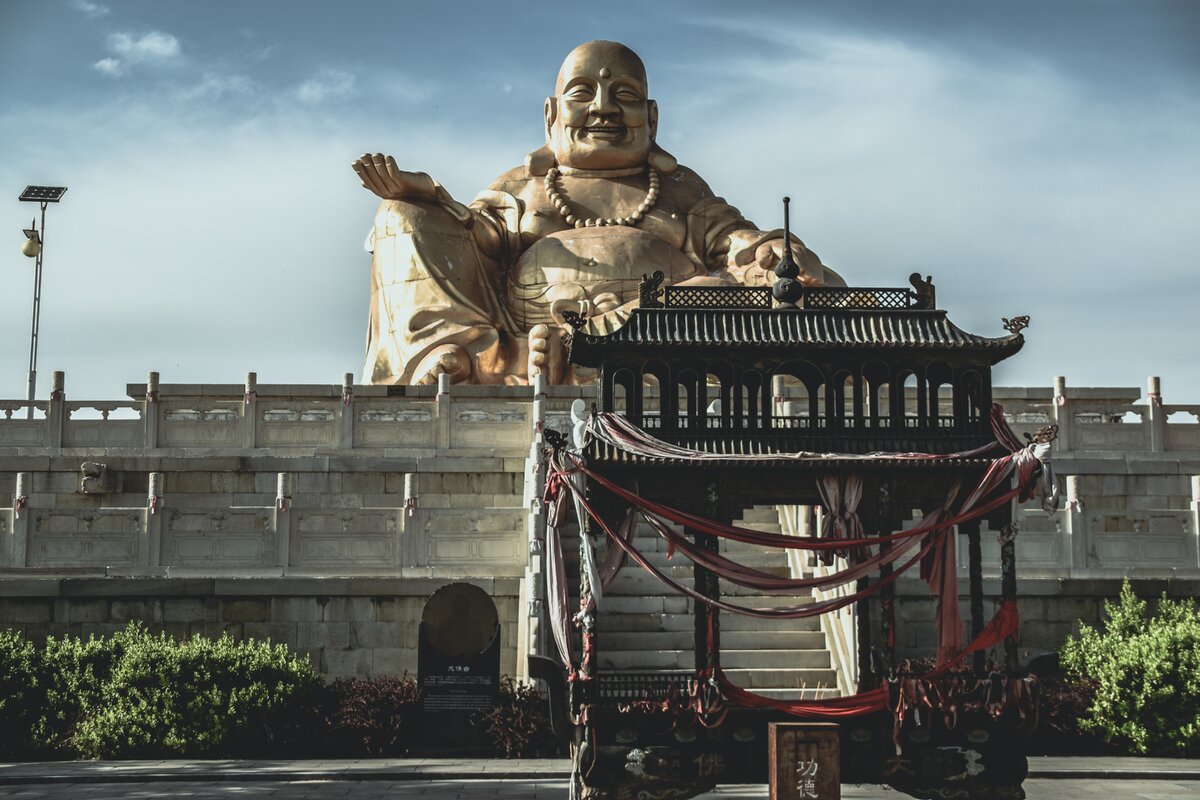
Buddhism — originated in Ancient India in the XI-V centuries. BC. The founder is Siddhartha Gautama. The main directions of Theravada and Mahayana. The heyday of Buddhism in India — V century. BC. — the beginning of the 1st millennium AD; spread in Southeast and Central Asia, partly in Central Asia, assimilating the elements of Brahmanism, Taoism, etc.
He opposed the prevailing external forms of religious life (including ritualism) inherent in Brahmanism. At the center of Buddhism is the doctrine of the “Four Noble Truths”: there is suffering, its cause, liberation, and the path to it. Suffering and liberation are subjective states and at the same time a certain cosmic reality: suffering is a state of anxiety, tension equivalent to desire and the simultaneous pulsation of dharma s; liberation (nirvana) — a state of incoherence by the outside world and at the same time the cessation of the dharma disturbance.
Buddhism denies the otherworldly liberation; in Buddhism there is no soul as an unchanging substance, the human “I” is identified with the cumulative functioning of a certain set of dharma s, there is no juxtaposition of subject and object, spirit and matter, there is no god as creator and unconditionally higher being. During the development of Buddhism, a cult of Buddha and Bodhisattva, a ritual gradually developed in it, sang ha (monastic communities) appeared, etc. Detachment from the world, individualism determine the deep asociality of Buddhism.
In Buddhism, the psychological state of inner being, lack of desire, perfect satisfaction and self-sufficiency, absolute detachment from the outside world; during the development of Buddhism, along with the ethical and psychological concept of nirvana, an idea arises of it as an absolute. In Jainism — the perfect state of the soul, freed from the shackles of matter, the endless play of life and death (saṃsāra).
Buddhist philosophy uses the concepts of an infinite, infinite world, which is in a constant state of emergence and disappearance. On this stage, the drama of life is played out.
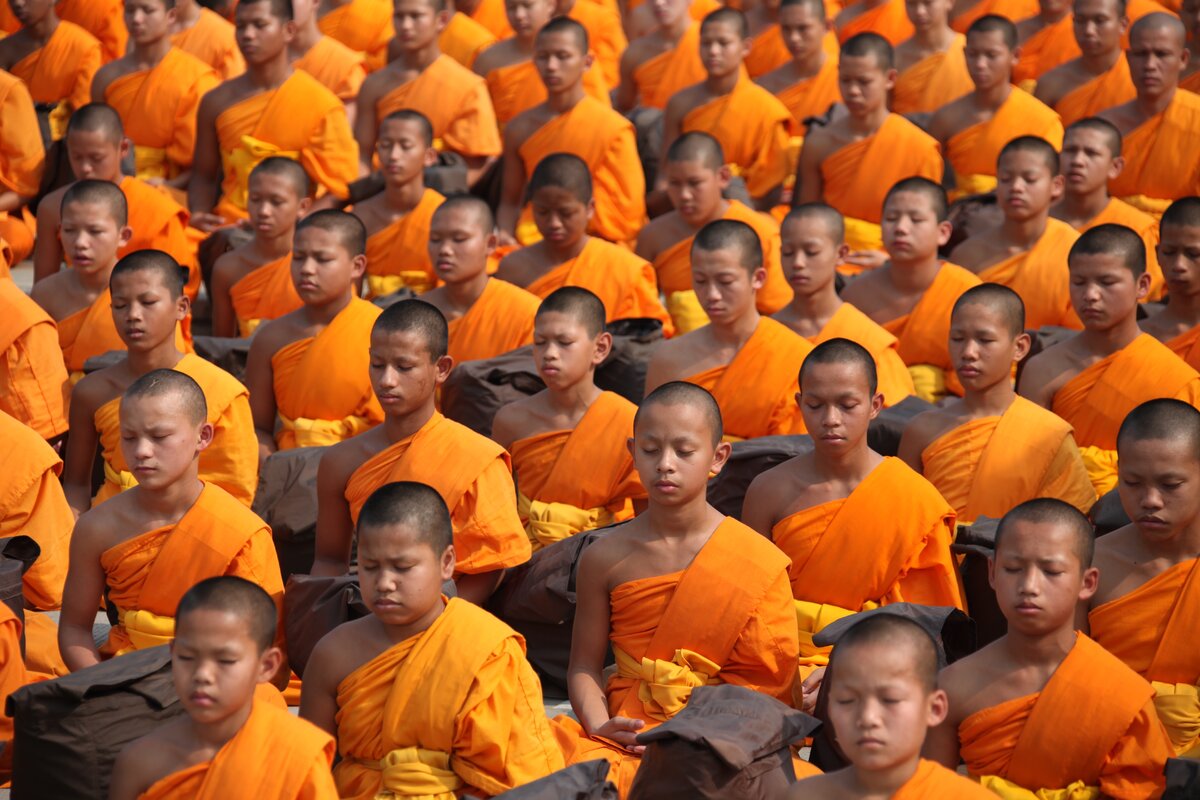
The world has no beginning or end, therefore, there is no place for the creator god and the act of creation. There is no question of God in Buddhism, he does not belong in this system. By God, Buddhists understand a certain absolute, universal principle, abstraction, emptiness. At the same time, heaven and earth, according to Buddhism, are inhabited by numerous gods from the pantheon of the Vedas, Brahmanism, Hinduism. Buddha is not a god. He is only a perfect man, a great guru. Pointing to other people the path to excellence. He is also not a savior of people. Many consider Buddhism an atheistic religion, for this point of view there are many reasons. Buddhism cannot be considered a monotheistic religion either, since all the many Vedic gods have been preserved in his creeds (although worshiping them has lost its meaning). In Buddhism, there is no belief in the afterlife. Buddha did not abolish or forbid the old gods, but in the new religion they became creatures of nature rather than its rulers.
According to ancient Buddhist traditions, the universe exists on several levels. The earth is somewhere in the middle. This is a cylindrical disk, in the center of which a mountain rises, surrounded by seas and concentric circles of mountain ranges. Beyond these chains is the sea, accessible to people's eyes, on it lie four islands. India is a triangular island. Its middle point is the tree under which the Buddha entered the state of nirvana. Earth is held in empty space. Under the ground there are terrible hellish caves, in which their inhabitants suffer, torment, boil and fry. Above the earth there are six heavens on which the gods live.
SEPARATION OF BUDDHISM
After the death of Buddha, the followers of the Master gathered in special councils in order to preserve and transmit his teachings. At these gatherings, dogmas were formed (unchanging, most important, not requiring evidence, accepted on faith provisions).
The first such cathedral took place, according to the traditional story, gathered soon after the death of the prophet. Among the five hundred monks were direct disciples of the Buddha, including his beloved disciple Ananda, who was almost removed from the cathedral, as he was believed to be guilty of not having time to ask the dying man for an exact explanation of the main points of the doctrine. Historians consider this first cathedral a myth rather than a reality.
The second cathedral took place 100 years after the first in Vaishali.
There were sharp debates on it, and in fact there was a split of the sang ha (Buddhist community) in two directions.
- first of them — Theravada (or southern Buddhism) consisted of the position of full and maximum preservation of each word, gesture and episode from the life of Buddha,
- the second interpreted Buddhism more freely. The Theravada followers are orthodoxy, that is, supporters of the unchanging and steady adherence to the doctrine.
In order to maintain unity, they periodically gather for the so-called sangiti (lit. joint chant), the last of them — the sixth - occurred in Burma in 1954-1956, when (according to the Buddhists' recognized date of death of the Buddha), the 2500th anniversary of the transition was celebrated Buddha in nirvana.
Northern Buddhism is called Mahayana (a large chariot, a wide path to salvation). The followers of the Mahayana consider themselves to be exclusively correct in interpreting the doctrine and are very contemptuous of the “southern school”. If early Buddhism is more like philosophy, then Mahayana is religion. What distinguishes it from southern Buddhism is that Buddha Gautama for God is more a god than a teacher of wisdom and a philosopher, and Mahayana teaches that Buddha is the embodiment of superhuman forces and their weapons.
In the Mahayana, it is believed that everyone can achieve the state of Buddha.
From the point of view of the Mahayanist s, not only monks, but also lay people can enter nirvana. In Mahayana, mythology is developing, somewhat reminiscent of the doctrine of paradise and hell, which was absolutely not characteristic of early Buddhism. The community of impoverished monks (sang ha) turned into a real church organization in Mahayana with many rich temples, monasteries, and powerful clergy.
So, in Buddhism at the turn of our era, two main directions gradually developed: southern Buddhism, based on the Theravada school, and later received the name of Hayana, and northern Buddhism, called Mahayana.
With the extinction of Buddhism in India, the Hindu religious and social system arises and continues to develop, which is, as it were, the result of the processing of previous trends and searches. She recognizes the caste system of relations, and singles out Vishnu and Shiva as the main gods. Vishnu appears in the form of Rama and Krishna. The distribution of roles is as follows: Brahma — the creator of everything, Vishnu — the keeper, Shiva — the destroyer and reconstructor at the same time.
The cosmogonic doctrine consists in the idea that the individual eternal soul (Atman) seeks to merge with the world soul (Brahman).