A few months after the last spy photos, our photographers have immortalized a forklift of the new BMW 1 Series struggling with a test session on snowy roads. The revamped German car, expected between the end of 2018 and 2019, is preparing to write a new page in the model's history, especially as regards the technical aspect.
Change of traction: the front is switched. The new 1 Series will, as is well known, abandon rear-wheel drive. The Ukl modular platform on which it is based, introduced by the 2 Series Active Tourer, X1, and Mini, will use either front or all-wheel drive. Not only that: according to rumors, this setting will result in the disappearance of the six-cylinder engines of the sports variants. The range will remain articulated, however, thanks to supercharged three- and four-cylinder engines, with conventional power supplies flanked by plug-in hybrid variants.
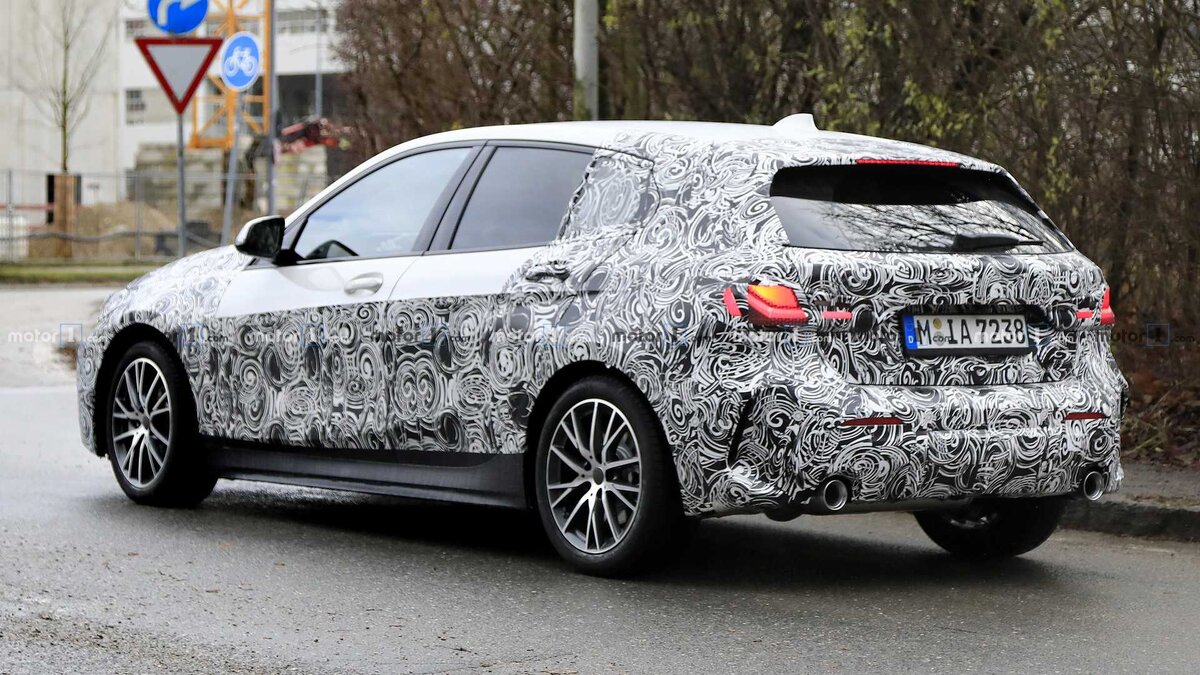
New car, new look. Although today's images show a forklift still heavily camouflaged, its shapes offer the opportunity for some considerations. At a glance, the future look will not be a stylistic evolution of the current model, but a clear change. The unprecedented arrangement of the various mechanical components will, therefore, entail a review of the dimensions and design. In this regard, the car seems to exploit a greater width and an increased wheelbase, with a frontal characterized by a more limited excursion of the hood. The most important changes, however, would concern the modernization of the roofline, the shape of the rear and the air intakes of the bumpers. Pending further information, the light clusters show for the first time the luminous signatures that, except for last-minute changes, will characterize the standard model.
The next generation of the BMW 1 Series has long been the focus of attention, although its debut is expected in the summer of 2019. The reason for this is the historic transition to the modular platform, which will mean a shift from rear-wheel drive to front-wheel drive and the abandonment of inline six-cylinder engines.
A sporty look. The prototypes have already been seen in the past, but those photographed on a car-maker are characterized by lighter camouflage. The first impression is that a rather long front bonnet has been maintained, with a line descending towards the double front kidney and a marked development in height of the component above the wheel arches. The latter is in evidence, distinguished by sporty curves. At the rear, on the other hand, you can see the LED light clusters with horizontal development. The presence of blue brake calipers, large-diameter alloy wheels, chrome-plated exhaust pipes and bumpers with air intakes and vents suggest that the examples in the images are those of the M Sport range. The 1 Series could also offer a longer wheelbase than in the past, which together with the new platform could provide more space in the cockpit.
Front or full and also hybrid. The BMW 1 Series should adopt the transverse three- and four-cylinder engines already proposed on the 2 Series and also used by the Mini models. The arrival of a plug-in hybrid version is logical, while there is no definite information on the more sporty variants of the M Performance range. Finally, it should be remembered that the platform was also created to support all-wheel drive: this option may be offered at least on the most powerful engines.
At this point we're just waiting for the veils to fall out of the car because getting closer than that to the new BMW 1 Series really can't be done: in recent weeks we've also tried a preview of the prototype still camouflaged (here's our road test). But the sightings of the forklifts by the automotive paparazzi continue, a sign that the debut of the third generation of the Bavarian compact is less and less missing.
Hidden news. The revolution, as we have known for some time now, is hidden under the front compartment, with the passage to the transverse engine and, above all, to the front-wheel-drive (or all-wheel drive). A technical change that does not change the stage presence of the BMW 1 Series, still characterized by a long, slightly raised bonnet. The carriageways will be a few centimeters wider in front, less at the rear, while the wheelbase should have been shortened compared to the current model. Nothing that could surprise us, in short, waiting to discover the distinctive features of the new design.