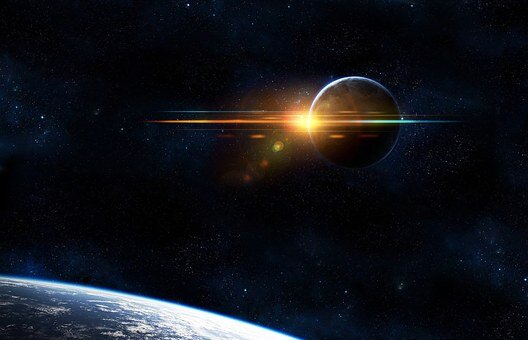
BLACK HOLE
Scientists have recently discovered that a giant black hole may be in the middle of our galaxy. Black holes are invisible space objects of very high density, formed after the explosion of large stars. They have such high gravity that even a ray of light cannot overcome. However, a black hole can be recognized by the X-ray rays emitted by the matter it sucks in. If we see stars revolving around a powerful but invisible source of X-rays, we can talk about the presence of a black hole.
GALAXY CLUSTERS
What's going on around our galactic island? Not long ago, scientists believed that galaxies form a fairly homogeneous mass in the universe, evenly and monotonously distributed in the vast space. Everything turned out to be wrong! It turned out that the galaxies are actually lumped together, and between them there are gaping emptinesses. And these lumps are formed not by separate galaxies, but by their clusters. Essentially, the entire universe consists of such superfluities. Thus, the large-scale structure of the universe was discovered, one of the significant achievements of theoretical cosmology, observational astronomy, and practical astrophysics at the end of the 20th century. The largest of the superconcretions discovered to date resemble long fibers or spherical shells consisting of hundreds or even thousands of galaxies. The largest of the clusters detected is more than 1 billion light years long. Such an elongated galactic fiber was discovered in the Perseus and Pegasus constellations. The space cavities are equally long. Thus, the measured distances between the fibers reach 300 million light years. All this allowed cosmologists to compare the structure of the Universe with a giant sponge.
Intensive study of galaxies, including with the help of radio telescopes, the discovery of background radiation, new space objects such as quasars, emitting tens of times more energy than the most powerful galaxies, has led to the emergence of new mysteries in the study of the universe.
Big Bang. Big compression
It is established that the distance between distant galaxies increases, i.e. the Universe expands. Proceeding from it astronomers believe that the beginning of the universe has put the Big explosion as a result of which there were formed stars, planets and galaxies. Some scientists are sure that the universe can expand indefinitely, but others think that the expansion will gradually slow down and possibly stop completely. Then the universe will begin to shrink, and in the end it will end up being the opposite of the Big Bang - a big compression.
THE OPENING OF A HALE-BOPPA COMET
We owe many great discoveries to amateur astronomers who spend hours in the dark looking at the night sky. Many new stars and comets, such as the Hale-Boppa comet, have been discovered by amateurs. Most often an amateur astronomer makes a discovery, watching a small part of the night sky for a long time and checking his observations with the map. This is the only way for an amateur to discover something worthwhile. As a rule, they make their discoveries by accident. The Hale-Boppa comet was also discovered on occasion. In July 1995, Alan Hale and Thomas Bopp observed a starry sky and noticed a poorly luminous object near one of the constellations that was not previously known as a comet. And in 1997, this comet came as close as possible to Earth - it was 200,000,000 km away from us. The Hale Boppa comet is one of the largest in the solar system. Scientists have calculated that it will not return in the next 4000 years.
HUBBLE TELESCOPE
For many years astronomers have dreamed of putting a powerful telescope in space. After all, from space, where there is no air and dust, the stars will be particularly visible. In 1990, their dream came true: the shuttle put the Hubble telescope into orbit. It was not without grief: it soon became clear that the main mirror of the telescope had a defect. But in 1993 astronauts added additional lenses to the telescope and fixed it. Since then, with the help of the telescope, many unique images of celestial bodies - planets, nebulae, quasars - have been received on Earth, which contributed to a number of discoveries that have enriched our knowledge of the universe. With the help of the Hubble Space Telescope, we took photographs of galaxies 11 billion light-years away from us. Imagine: we see them as they were 11 billion years ago! They can tell us a lot about the universe, its birth and possibly its last hour.
With the help of the Hubble telescope, it has been proven that quasistellar sources (quasars) emitting light of great intensity are the centers of very young galaxies. Young galaxies surround quasars, usually hidden in the middle of a galactic cluster. Scientists believe that quasars draw their energy from black holes that are in the center of the emerging galaxies.
One of the most impressive images is the Eagle Nebula. New stars are born in this giant gas cloud. Seals form inside the long cloudy processes, which begin to shrink under the influence of their own gravity. At the same time, they heat up to such an extent that the cloud flashes, turning into a shining star.
The stars are born in the Orion Nebula. Here, a Hubble telescope has been used to locate disc-shaped gas dust accumulations, called protoplanetary discs, or proplits around very young stars. Scientists suggest that these are the earliest stages of formation of planetary systems. Over time, these giant clouds of dust and gas will shrink together to form new planets like those that already exist in the solar system.
Billions of years later, the star's energy required for glow will gradually run out. The star will explode from the inside. Such an explosion is called a supernova explosion. The explosion will create giant spaces filled with gas and debris. Thus, as a result of such an explosion the Cat's Eye Nebula appeared. It will take millennia, and gradually this giant gaseous nebula will shrink, which can lead to the formation of a black hole.
Maintenance of the Hubble Telescope
Every few years astronauts fly in on a shuttle and carry out adjustment, replacement of devices and repair of a telescope. With the help of a remotely controlled sleeve they deliver it to the cargo compartment of the shuttle and re-configure or make necessary repairs there. During the last such expedition in 1997, many parts of the Hubble telescope, including an infrared camera, were replaced by new ones.