So, having touched for a moment the theme of the consideration that Signorelli enjoyed from the critics, the exhibition returns to deal with the artist, and does so with a room dedicated to the theme of the "grace of invention" (to use a Vasari expression) of Cortona: It is indeed difficult to follow the common thread of the exhibition, because this section departs from it in large part, aimed as it is to give an account, by contrast, of the profile of the artist (Federica Papi justifies the presence of these Madonnas as works in which the tension of Orvieto's nudes melts opening up to a vein in which the artist "reveals his talent and the desire to break away from tradition to undertake new solutions, formal, stylistic and conceptual").
Three Madonnas (a pity for the reflective glass that prevents them from being seen in the best possible way), all belonging to different phases of Signorelli's career, therefore, parade: the Madonna with Child and Saints John the Baptist and a Saint, made at the end of the 1980s and kept in the Pallavicini-Rospigliosi collection, the Madonna with Child, Saint John the Baptist and an elderly man by Jacquemart-André, made in the early 1990s, and finally the Madonna with Child from around 1505-1507, now at the Metropolitan in New York.
The Madonna of Jacquemart-André, with the enigmatic presence of the elderly man not identified with certainty (perhaps a shepherd), is not even among the best works of the artist (the figure of the Virgin follows in a foolish way the Madonna of the Annunciation of Volterra, so that there are those who have assumed that this work was made with the help of the workshop), while the others are more interesting, especially that of New York, especially in view of its history: the artist donated it to his daughter Gabriella in 1507, but perhaps it was initially intended for his wife Gallizia, who died prematurely in 1506 (the date after which the painter tied the painting to his daughter through his will). The unusual background of the panel, a decoration that recalls that of fabrics, made of rounds with putti (winged and not)) and medallions with profiles of emperors, in this case Domitian and Caracalla (therefore, further references to the interest of Luca Signorelli for the classic, but also in this case animated more by formal and symbolic intentions than by archaeological rigor, since these coins are inventions of the artist), could allude to the theme of family love.
- The Virgin Mary herself exudes a humanity that is rarely found in similar paintings by the Tuscan artist (one will also notice the absence of haloes): it is presumable that Signorelli's intention was to give a character of universality to the figure of the Virgin, who in this painting assumes more the appearance of a caring mother than those of the mother of God. A painting that tells a moving story, and a painting that is configured as a rare testimony of Renaissance work closely linked to the personal life of the artist who performed it.
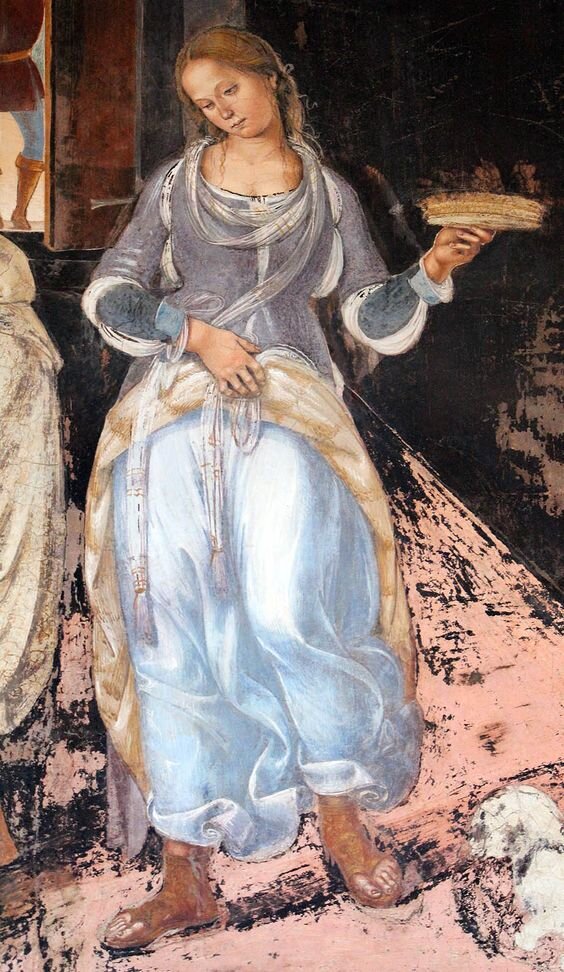
As the exhibition moves towards its conclusion, the only testimonies of the artist's two successive presences in Rome are quickly touched upon: the first is in 1507, the year in which, according to the story of the painter Giovanni Battista Caporali (Perugia, 1475 - 1560 approx.), Signorelli participated in a dinner at Bramante's house with Perugino, Pinturicchio and Caporali himself, probably to discuss work, perhaps a project to be submitted to the new pontiff, Julius II (Albisola Superiore, 1443 - Rome, 1513), whose taste, however, would have taken, as is well known, other orientations (and this despite the fact that the pope was initially in favor of having his apartments decorated by the painters of the old generation, but then changing his mind after noticing the young Raphael).
The second, on the other hand, is the one mentioned in Michelangelo's letter referred to at the beginning, but is also known from another document, in which Signorelli is certified as the procurator of his daughter-in-law, Mattea di Domenico di Simone, in the context of a dispute that saw the woman opposite the nuns of the convent of San Michele Arcangelo in Cortona, in 1513 (the figure coincides with Michelangelo's story, which expressly recalls having met Signorelli in the first year of Leo X's pontificate, precisely in 1513). At the moment, no other information is known about Luca Signorelli's stay in Rome.
To be continued.