To avoid traction asymmetry, even the option of installing both engines in the fuselage was considered, but eventually, it was decided to give the problems of traction asymmetry and “non-starting” the air intake to the automatic air intake control system. The “non-start” of the air intakes remained the most vulnerable place of all A-12/YF-12/SR-71 series aircraft. Over time, these problems have been resolved only partially by selecting control coefficients in the control system and replacing the analog system with a digital one. Bill Weaver performed many risky flights under the air intake control system debugging program. In the flight, Weaver deliberately interrupted the state of “launch”: in his words, the feeling at the same time resembled the feelings of a passenger courier train rushing not on the rails, and on the sleepers.
By the end of 1967, Lockheed handed over the last, 31st, ordered SR-71 to the Air Force; the production line was shut down. Perhaps, it was not necessary to do it, as a series of accidents and incidents with scouts continued. Basically, the planes piloted by combat pilots were “killed” (by that time SR-71 had already been in service with the 9th Strategic Reconnaissance Wing). The training SR-71B crashed on January 11, 1968. The experienced pilot, the commander of the 99th Squadron, took the cadets on his third reconnaissance flight. On the way home, the power generator failed; the battery allowed the aircraft's systems to operate for 30 minutes, but it was not enough — the SR crashed 12 kilometers north of the base. Aircraft No. 11 suffered on July 29, 1968, from the fire of the right engine, which occurred in flight at the speed of Ì=2.88 and height of 29,732 m. An experienced pilot noticed the burning alarm lamp in time, immediately turned off the engine and managed to return to the airfield. In October 1968, the tires of the wheels burst at the takeoff, pieces of the disc broke through the fuel tank, and a fire broke out. The uncontrolled plane rolled out of the runway, the crew ejected, but only the operator managed to survive. On April 11, 1969, another fire occurred on the fifth SR-71. All three of these aircraft had to be decommissioned, although they remained repairable, but they were not rebuilt because of the extremely high cost of repair. Finally, on June 17, 1970, the SR-71 collided with a KC-135Q gas tanker over the state of New Mexico, the scout crashed and Boeing was able to dock to his base.
Category 1 and II flight tests were officially completed in May 1972. Lou Shall, Bill Perk, Jim East ham and Bob Gilligan were awarded by the Society of Test Pilots for their tremendous contribution to the A-12, YF-12 and SR-71 program.
SR-71B/C “Blackbird” Strategic Intelligence Training Variant.
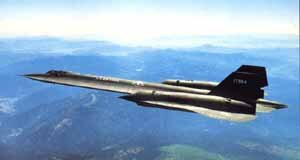
To train the SR-71 pilots and conduct training!
Of the flights were built by two SR-71B twins. Externally, the plane was almost identical to the “Titan goose” — an A-12. The instructor's cabin, located behind the cadets' cabin, provided the necessary visibility with a slight excess. To improve the track stability of the training modification under the nacelles, additional keels were installed.
The first training SR #956 took off on November 18, 1965. It was piloted by Bob Gilligan and Steven Belau. On December 18th Bill Weaver and Jim East ham raised the second SR-71B — #957.
The SR-71B #956 was the first Blackbird to be adopted by the 4200-th Strategic Air Reconnaissance Wing. On January 7, 1966, he was transferred to Bale from Edwards Air Force Base personally by the unit's commander, Colonel D. Nelson.
Training SR-71B #957 crashed on January 11, 1968. An experienced pilot, the commander of the 99th Squadron, took the cadets to his third reconnaissance flight. On the way home, the power generator failed; the battery allowed the aircraft's systems to operate for 30 minutes, but that was not enough — the SR crashed 12 kilometers north of the base. Robert Sowers and David Freehand ejected successfully.
To replace the crashed vehicle made a SR-71C S/N 64-17981, almost no different from its predecessor: docked to a severely damaged landing YF-12A (S/N 60-6934) nose fuselage SR-71, intended for static testing.
The SR-71B (17956) and 2 SR-71A (971 and 980) were handed over to NASA in 1990 with numbers 831, 832 and #844 respectively, and are used as flying laboratories.