In 514 BC, the ruler of the ancient kingdom of Wu ordered his minister to build a city that would have no equal beauty. The governor's command was fulfilled. Thus, the city of Suzhou, a city of parks, gardens, and pagodas, appeared in China. Suzhou is the oldest city in the basin of the Yangtze River, older than Shanghai, which is only eighty kilometers away. Pagoda here is a lot. The one in the center has a romantic name - the Pagoda of the Burning Rays. A small fragment of the fortress wall and the Pan-Men gate have survived from the old town. Pan-Men is the oldest but well-preserved gate in China. Their distinctive feature is that it is the so-called double gate, that is, one part of it is on the water, and the other - on land. They were created in the VI century BC. The part of the gate that is on land is a secret. In times of all sorts of wars and strife, when the enemy wanted to storm Suzhou, this gate was opened, and the small secret gates, which led to the city, were closed. Th
In 514 BC, the ruler of the ancient kingdom of Wu ordered his minister to build a city that would have no equal beauty. The governor's command was fulfilled. Thus, the city of Suzhou, a city of parks, gardens, and pagodas, appeared in China.
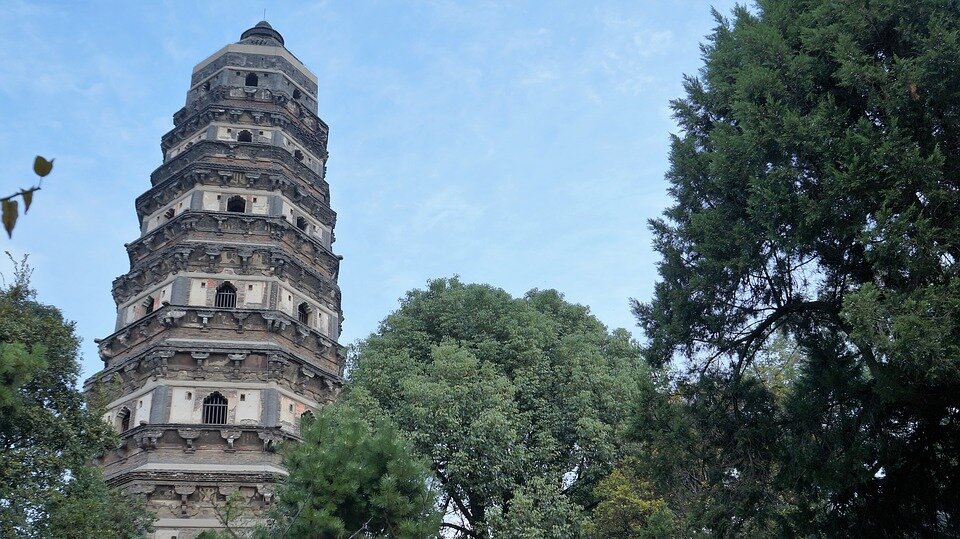
Suzhou is the oldest city in the basin of the Yangtze River, older than Shanghai, which is only eighty kilometers away. Pagoda here is a lot. The one in the center has a romantic name - the Pagoda of the Burning Rays.
A small fragment of the fortress wall and the Pan-Men gate have survived from the old town. Pan-Men is the oldest but well-preserved gate in China. Their distinctive feature is that it is the so-called double gate, that is, one part of it is on the water, and the other - on land. They were created in the VI century BC.
The part of the gate that is on land is a secret. In times of all sorts of wars and strife, when the enemy wanted to storm Suzhou, this gate was opened, and the small secret gates, which led to the city, were closed. The enemy broke into the fortress, but found himself in a completely enclosed space, becoming an easy prey of archers standing on the walls of the fortress.
You can still shoot with archery in the city today. It costs only 2 yuan, i.e. 8 rubles to check your accuracy. Entertainment is mainly for tourists from Europe, America, and China. Suzhou is permeated with channels, many of which act as streets, and this attracts travelers here. Once the local population used to move around the city mainly on junks, but now it is a pure tourist attraction.
There are shacks on the banks of the canals, covered with tiles. In the center of the canals, they are being demolished quite actively. On the place of old houses grow luxurious mansions.
- The canal system, which crosses almost the entire city, was originally designed to regulate river flows. Floods in Suzhou were unfortunately frequent. This system was built for three centuries - from VIII to V centuries BC. e. The information that already in our era, in the XVII century, in Suzhou was 1000 bridges. Of these, 300 were within the city walls. That is, it turns out that there were up to 15 bridges per 1 square kilometer.
- Old wooden bridges, of course, have not survived, and many stone bridges are still standing.
- In the southeastern part of the city, a bridge of a precious belt built in the IX century is thrown across the great Chinese canal. According to legend, the official in charge of the bridge construction was forced to sell his precious belt made of jade to finish the work. The length of the bridge is 317 meters. Movement on it now, of course, closed, transport was allowed to run on the new bridge, which is located behind my back. And here it is possible to take walks on foot.
- The Bridge of the Precious Belt is thrown over the Great Chinese Channel. This is the main canal in the country. Thanks to it, the once quiet Suzhou has become a major industrial center.
- This is the Great Chinese Canal. It was dug at the beginning of the 7th century but is still considered to be the longest navigable canal in the world.
- Like the Great Wall of China, the Great Canal is a cyclopean construction. Its length is almost two thousand kilometers. The canal was built by five million people. Once upon a time, it was possible to pass through the whole country - from Beijing to Hangzhou. But over time, its central section became desolate. Now the government plans to restore shipping along the entire length of the canal.
- In the lower, eastern part of the canal, it is still working properly. Barges are sailing one by one. To avoid a collision, every person with a signal flag is standing on his nose.
- In recent years Suzhou has become a major center of the paper, chemical, mining, and processing industries. Numerous companies are concentrated in the industrial zone. Nearby new areas where workers live have grown.
- Skyscrapers are also being built in the city, though not yet on the same scale or as luxurious as in Shanghai or Hong Kong. Looking at this realm of glass and concrete, it is hard to believe that Suzhou was once a favorite destination for Chinese nobles. Court and major officials built houses and palaces here and laid out luxurious gardens around them. In the XV century, there were more than 200 of them in the city. A little more than 50 have survived to this day. They are concentrated in the central part of the old city. In 1997, many Suzhou gardens were included in the UNESCO World Heritage List
- Japanese and Korean garden art, which is so admired in Europe, is Chinese. It came from China to these countries. There must be three elements in the Chinese garden: water, plants, and stone.
Continuation in the second part: https://zen.yandex.ru/media/id/5d92c9ebba281e00b14f36bd/suzhou-part-2-5d94b0a5e3062c00b016c4cf