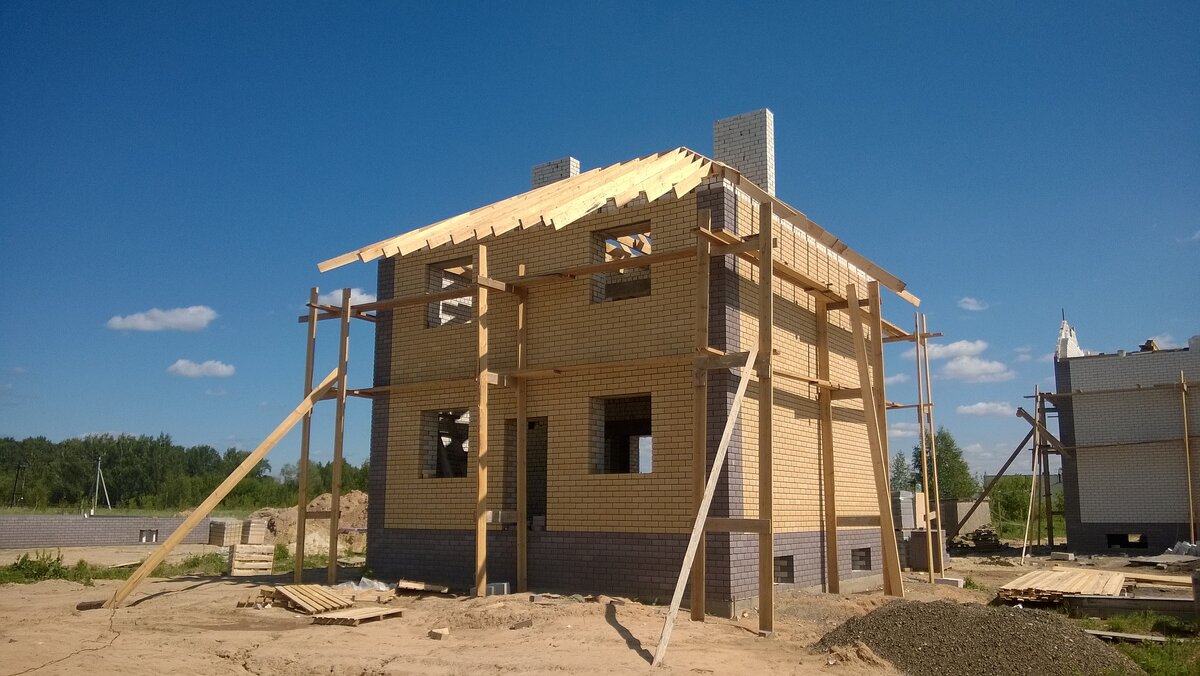
Part 1
There is a strong myth that the foundation is difficult, expensive, easy to mow, and the slightest mistake at once all bad. The house will crack, the roads will be repaired, and in general the horror, horror, horror, horror... In general, only the highest professionals from Central Asia can make it qualitatively. :)
So, meet the universal foundation! Under any low-rise house, and almost for any ground. Exception: swamps. It has a huge number of advantages.
He:
-Deepened,
-It's done quickly (in two days.)
-Does not require qualification. Suitable for almost any weight and configuration of a low-rise building.
- can be made on almost any ground.
- Cheap.
Intrigued?
Then let's go. (I will consider on an example of the base under the house 10мх10м with an average wall)
Stage one.
An excavator with a 50 cm bucket digs a trench below the freezing level for the future foundation. Dig the middle load-bearing wall with a +10 cm bucket. Total 60 cm. This is a rough empirical solution. Compensating for the difference between the external and internal wall loads. It can also be done manually, of course, but it is much more expensive. The base level is not very even, dug like a dug. You don't bother with corners either, then clean them up. This stage takes 4-6 hours.
Stage two.
1. take a bayonet shovel, and level the corners and other irregularities of the vertical walls of the trench. You don't have to bother especially, no level and perfect evenness. Error of 3-5 cm is not a problem.
2. take a shovel and choose from the trench all the crumbled and loose soil. You don't have to level the ground! Just remove the excess.
On average, the stage takes 3-4 hours by 2 people.
Stage three.
Order concrete. Usually it is difficult to approach, so provide unloading or access to any two corners, you can even adjacent. You order the most inexpensive concrete on limestone B7,5-B12,5 (M100-M150) filler can be larger than 20-40 or even 50-70. But it is obligatory with plasticity P5. It is much more "liquid" and it will be easily dispersed on a trench. It is not necessary to dilute with water! And directly from the mixers you pour into the trench, dispersing with spades or forks. Is there a vibrator for concrete? "Re-vibrate". No? It's okay for P5 to sit down pretty good enough on its own.
Pour it along the top of the trench.
Everything! Congratulations, you have made the qualitative reliable base which will sustain any your loadings and will stand one hundred years.
No: formwork, sand dumping and ramming of the soles, concrete, armature, waterproofing, and other protection from any loss of cement milk and other things you do not need.
Financial question. And how much does such a foundation cost?
1. renting an excavator 6 hours x 1500 p / h = 9K
2. Uzbeks' work on clearing trenches and paving concrete =3-4K (two normal days)
3. Concrete (depth 1.5 m) = 35.25 m3*3K≈105.75K Total: foundation (material with work) =105.75+3+9=117 K I'll add a brick base/plinth.
4. Brick base of 3573 bricks*10=36K.
5. Bricklaying 9.06*1K=9.06K. Total Foundation + brick base (material with work): 117K+36+9=162K.
And now the most interesting thing. Justification why. Will the ground survive, will the house settle down? Private housing construction is easy. That is you are sure that your house in two floors in height, and a brick, with concrete overlappings, etc. The piece certainly heavy, but in fact ... Even easy, from the point of view of the big building, khrushchevka in 5 floors provides loading on the base around 30-34 t/meter. Certainly there and a support is wider there but anyway it in minimum in 2,5 times "it is heavier" the most "heavy" private house. Sorry about the tautology.
To receive the private house with loading more than 7 t/meter of the base actually is not real. Typical value is 2-5 t/meter. In order not to be unfounded and not to refer to myself, here is an example of the load on the foundation tape made not by me. As you can see, there is very little. This is a two-storey house made of blocks and concrete slabs.
To understand what soil is, imagine a sheet of ordinary foam. If you press it with your hand, it will bend slightly, but if you take your hand away, it will not leave any traces. (This is the sediment of the foundation.) If you step on it with a heel, it will have a clear heel mark on it that will not disappear. And it will become more dense in this place. (It's a foundation subsidence) It's a rough but clear model, it explains how the earth behaves under load.
Continuation in Part 2