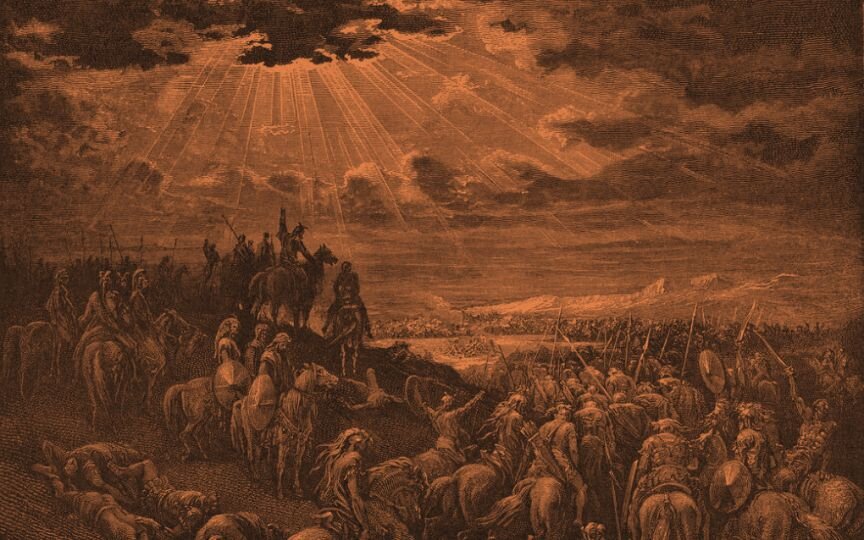
None of the bold attempts to explain "long day" Joshua's Bible text does not look convincing. But before sending them to the landfill of history, it is necessary to consider a number of even more striking possibilities.
Believing Bible readers in the 19th century might simply have noticed that God somehow stopped the Earth's rotation to keep the sun frozen in place, but what can modern science say about the possibility - and plausibility - of such a phenomenon? At first glance, the idea of slowing or stopping the Earth's rotation seems unacceptable and simply frightening. Day and night follow each other with the same accuracy, and the duration of the day is 23 hours 56 minutes and 4.1 seconds. If that were not the case, we would have to rearrange the clock time and again. So we tend to think that the length of the day is constant, but is it really?
One of the curious, though little-known, discoveries of the last few decades is that the length of the day can change. In I960, Antoine Donjon, director of the Paris Observatory, reported that the length of the day temporarily increased by 0.85 milliseconds after strong solar flares. For some time Donjon's statement was mistrusted, but later his measurements were confirmed. Since the 1970s, scientists have been seriously discussing the idea that powerful solar storms can lead to periods of temporary acceleration or deceleration of the Earth's rotation, known as "rotation failures". It soon became clear that the Earth's speed of rotation is constantly decreasing by an extremely small value, determined only by the most accurate instruments.
However, although it has been proven that the Earth's speed of rotation can vary, these changes are limited to a few milliseconds, which is not in any comparison with the "long day" described in Joshua's book.
A solar flare has enormous power, but its intensity is inevitably reduced by the long distance. In order to perform a "miracle" lasting several hours, the sun might have to explode, but then no one would have survived to tell the story.
Is it possible to provide energy that can affect the rotation of the Earth without destroying it? The only explanation is that the celestial body of almost the same size as the Earth had to pass close enough to our planet and affect it with its gravitational field. From an astronomical point of view, such an event is considered, to put it mildly, unlikely. However, the details of the phenomenon described in the book of Joshua really indicate an unusual astronomical phenomenon.
The interpretations of the "long day" proposed by Holladay and Sawyer completely overlook an event that occurred shortly before the sun "stopped". The stone rain that hit the amorites almost destroyed their army, the remnants of which were destroyed by the victorious Israelis. What were these stones? Some modern translations of the Old Testament, often far from the original, such as the New English Bible, give the impression that it is a hail - a well-known weather phenomenon. However, in the Hebrew text the deadly rain consists of "big stones", or "barad stones". This word is also mentioned in the description of one of the ten Egyptian Executions that forced Pharaoh to free Israelis from the bondage of slavery. The rabbinical tradition makes it clear that barad was not an ordinary hail. In the days of Exodus barad fell, mixed with fire, and the stones themselves, according to the author, were hot. Therefore, ice is excluded and only one possibility remains - meteorites (volcanic eruptions are unlikely: there are no volcanoes nearby, the stones from the eruption of which could reach Palestine).
Meteorites are the most tangible element of the history of the "long day" and can give the key to understanding the rest of it. The most realistic explanation of the biblical legend should take into account both unusual phenomena - deadly stone rain and unnaturally long day with the sun stopped in the sky. Is it possible to find a reasonable explanation linking these two events?