The atmosphere is composed of about 21% of oxygen, vital for humans and animals. This amount of oxygen is maintained as a result of the photosynthesis process that occurs under the influence of sunlight in the green leaf of plants and algae, as well as due to the vital activity of certain types of bacteria and germs.
In the Earth's atmosphere, there is a layer of ozone, which plays an extremely important role in all living things because it delays the life-threatening ultraviolet radiation of the sun.
The atmosphere plays a significant role in maintaining the thermal balance of the planet, because it absorbs a large part of the radiation of the Earth, preventing it from entering outer space.
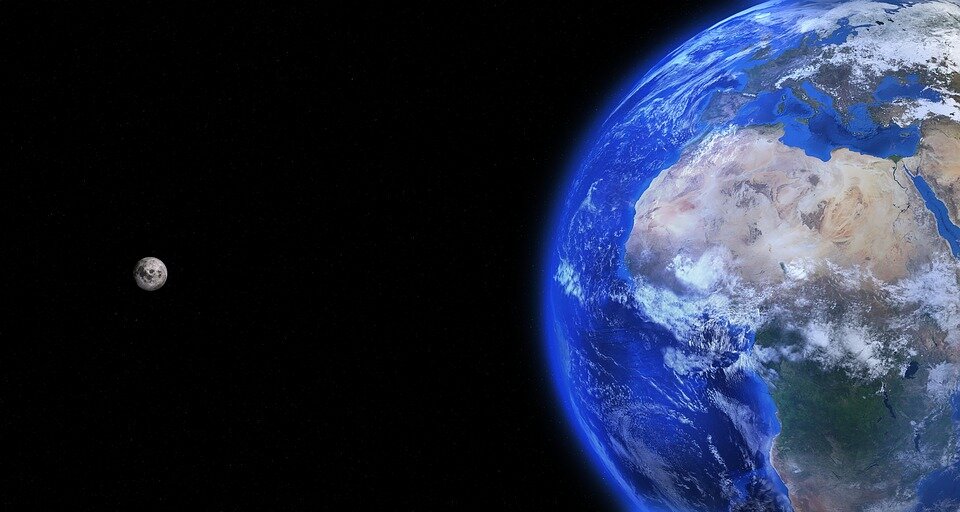
The hydrosphere, the water shell of our planet, is also extremely important for the existence of life on Earth. Water is a part of a living cell, a living substance. It is in the aquatic environment that the biochemical reactions that make up the essence of life occur.
Due to the constant inclination of the axis of rotation of the Earth to the plane of its orbit on our planet, there are different climatic zones and changing seasons. The presence of a sufficiently strong magnetic field in the Earth is also associated with the day-to-day rotation, which creates an insurmountable barrier for charged particles of various cosmic rays that have a negative biological effect.
These are the basic physical conditions against which the development and formation of life on Earth, the formation of man. The struggle for existence and the natural selection caused the external conditions to be reflected in the structure and structure of living organisms.
In other words, there is a close relationship between the properties of living organisms and the environment. In particular, most features of humans and animals are determined by such physical conditions of the cosmic order as gravity, the Earth's daily rotation rate, the composition of the sun's radiation, and the like.
The effect of all these factors affects the structure of the human and animal skeleton, respiratory apparatus and circulatory system, the structure of the sense organs and the central nervous system.
For example, the effect of the gravity of the earth led to the optimal size of living creatures that inhabit the land. In water, however, where the action of gravity is offset to some extent by the ejection force, larger animals also live. For example, some specimens of whales reach about 33 m in length and weigh more than 1600 kN. On land, such monsters would be too irreversible and unlikely to exist.
Another example: in sunlight, the highest energy is known to be radiation with a wavelength of 555 nm (yellow-green part of the spectrum). And accordingly, the human eye is most sensitive to the yellow-green color.
Space "circumstances" also defined "rhythms" in the life of living organisms. For example, the life cycle of the simplest unicellular organism - amoeba - lasts 24 hours, that is, a day. From now on, the amoeba is 20 hours. grows, and 4 years. account for the preparation of the cell for division and division itself.
Migratory birds fly in strictly defined seasons.
We can also assume that the human psyche and its viability are to some extent formed under the influence of those physical and astronomical conditions that exist on our planet.
Land and environmental conservation
One of the main reasons that gave rise to religious beliefs about the world was the impotence of our ancestors before nature. And in the modern era, one of the factors contributing to the reproduction of religious views is the fear of possible dangers and all kinds of crisis situations that threaten humanity. Disbelief in the possibilities of human society, in the possibilities of science, gives rise to some people, especially in the countries of capitalism, the illusory hopes of interfering with non-existent supernatural forces, allegedly capable of averting such dangers.
One of the problems facing modern man is an environmental problem.
The natural resources of our planet are limited, and the possibilities of the natural environment are not endless. Meanwhile, the practical needs of mankind are growing rapidly, productive forces are rapidly evolving, and hence the scale of the use of terrestrial riches is expanding. This raises a number of pressing problems that are of paramount importance to all of humanity: will there be enough food resources to feed the ever-increasing population of our planet?
Can humankind successfully combat pollution and environmental degradation in the face of continued growth in productive forces and population? How to replace oil, gas, coal and other minerals that are limited and sooner or later run out? How can global warming and carbon dioxide being released by industrial enterprises to possible global climate change? How, finally, to meet the ever-growing energy needs of mankind?
To be continued in the next part https://zen.yandex.ru/media/id/5d92f1673d873600b11d9f29/earth-our-space-house-part-3-5d947135df944400b0e4ed74