Long centuries have gone by to find out what shape our planet is, and from naive biblical ideas to come to a conclusion about the sphericity of the Earth.
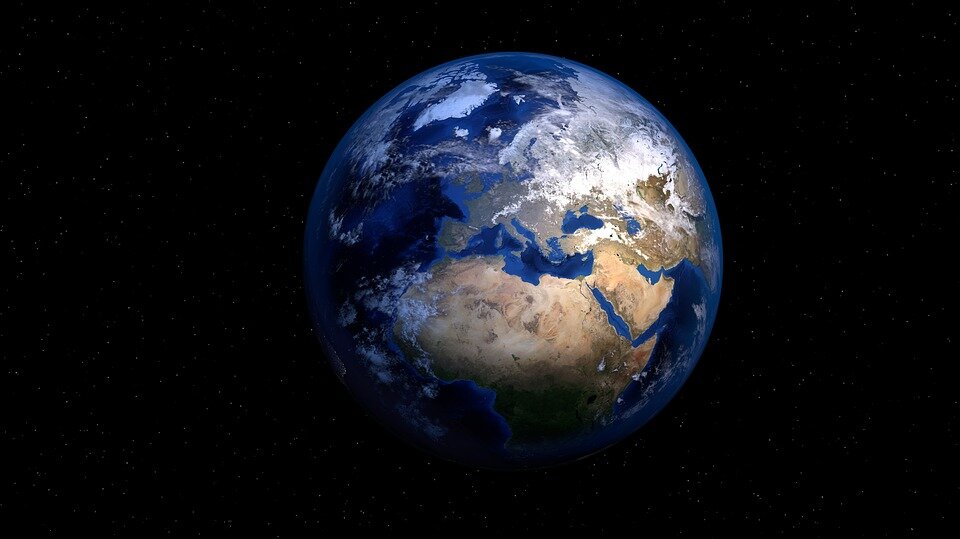
But if this problem were to come before science for the first time today, it would be solved in just a few hours. To do this, it would be sufficient to photograph the Earth from the spacecraft from different points of space and compare the images obtained with each other. This example, among other things, shows how the emergence of new research methods greatly speeds up the process of knowing the world.
Astronomy on the contrary
Astronomy has accumulated a vast experience of remote study of different objects. And it came in handy when one of these objects became our own planet. A similar way of studying Earth from space can be called "astronomy on the contrary." Thanks to this method of exploration, our knowledge of the Earth has greatly expanded, in particular, when observing from space, certain general patterns were discovered that could not be discovered while remaining on Earth.
If you are looking at a theatrical scenery or a large canvas from a very close distance, it is at best possible to recognize the individual details - the overall impression will not be. To do this, go some distance. So is the study of the Earth.
In space photography, there was one interesting phenomenon. As you know, the Earth's atmosphere is a serious obstacle to astronomical observations. It prevents the study of space objects, distinguish their individual details. Something similar happens when observing the Earth's surface from the spacecraft. Thicker air prevents individual parts from being considered.
However, in large-scale photography, the purpose of which is to identify global geophysical patterns, this phenomenon plays a positive role. The atmosphere, in this case, turns into a kind of filter, which eliminates the minor details and thus allows to identify the most important features of geological structures, vegetation, soil, etc.
The high-altitude images also show the features of the Earth's deep structure. Through the layers of loose deposits, the structure of the deeper horizons of the earth's crust shines through.
These images contain fundamentally new information that facilitates the discovery of new mineral deposits. These snapshots can also study the patterns of large-scale geological processes.
For example, a large number of annular structures with a diameter of hundreds of meters to 700 km were discovered. They are especially widespread on the boards of ancient platforms. It can be assumed that large annular structures are the most ancient faults that emerged at the earliest stages of the crust, a kind of gaskets that connect the surface of the Earth to the sole of the lithosphere, which mainly stores the internal energy of our planet.
There is no doubt that further Earth exploration will require a combination of terrestrial and space exploration methods.
Somewhat in advance, we note that in the study of the Earth and other planets of the solar system, science went the opposite way. We first studied the Earth "closely" and then went to its remote exploration using spacecraft. The planets, on the contrary, were first studied by remote astronomical methods, and in recent years, due to the development of space technology, the possibility of their direct study.
In both cases, the use of a new method of study made it possible to obtain extremely valuable additional information, expanded the understanding of these celestial bodies.
Man and nature. The interdependence of the properties of the human body and animals and the environment, defenders of religion explain the existence of a reasonable "divine plan", the divine harmony of all that exists. In fact, the observed coherence between the properties of nature and life may well be explained without the help of supernatural forces. This consistency is the result of the long-term interaction of various processes occurring in inanimate nature and in living organisms.
Man is a part of nature, its origin. As an intelligent being, it has been formed over many generations, under certain external conditions. In these conditions, its practical activity was developing and developing.
What are the physical conditions that mankind inherited from nature? These conditions are well known, but we will briefly recall them.
Our cosmic home, Earth, is the third planet in the distance from the Sun. It moves in an almost circular orbit around daylight at an average distance of about 150 million km from it. Earth is a giant spherical body with a diameter of about 12800 km and a mass of about 6 • 1024 kg. Due to gravity, the Earth retains an atmospheric shell around it, reaching an altitude of about 1,000 km and gradually moving into airless outer space.
To be continued in the next part https://zen.yandex.ru/media/id/5d92f1673d873600b11d9f29/earth-our-space-house-part-2-5d94702a1febd400ad8bef30