From time to time it has been suggested that science fiction is a specific form of modern mythology. In fact, it has its own established tradition and a set of characteristic archetypes and images. Space travel, time travel, alien invasion, robot uprising, destructive scientific experiment, radical change of human nature - all these are easily recognizable fantastic stories, each of which gave rise to a whole direction.
However, I wanted to talk about myths of a very different kind. This article is devoted to myths in their negative sense, emerging around the genre of science fiction, and, of course, their exposure. Alas, this genre is often perceived fundamentally wrong by people who have formed their opinion on the basis of two or three representatives of the genre, sometimes not the best. Often they spread their vision among others, pushing away from science fiction potential readers. Let's talk about the most common misconceptions about science fiction, prevailing among readers.
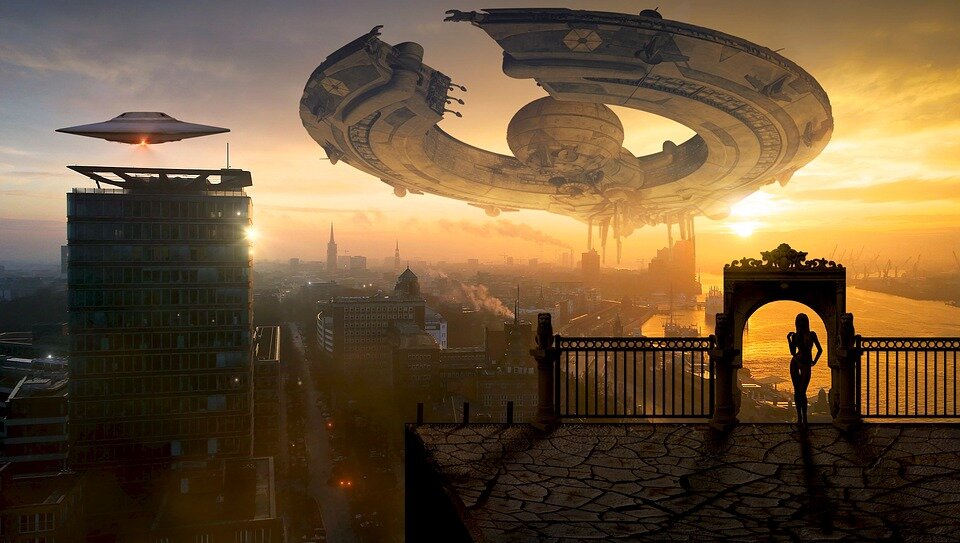
Myth 1. It's hopelessly outdated genre of the times of socialist realism

Origin. Probably due to the fact that the most prominent representatives of the genre in Russian literature received the greatest fame in the Soviet period.
Refutation. In spite of the fact that modern Russian-speaking authors from among the most read most often work in a fantasy genre, in many cases it not so-to take at least Yury Nikitin writing a sound transhumanistic fantasy.
But most importantly, right before our eyes, after a period of relative stagnation and postmodern wanderings, a whole new era in science fiction is being born — mostly abroad. The distinctive features of this stage are depth, psychologism, thoughtfulness, attention to detail, revision of old canons and constant search for new ideas. Many things have already been translated into Russian and managed to become widely known in the post-Soviet space: the books of Robert Wilson, Peter watts or Greg Egan are examples of this.
Myth 2. It's the same as fantasy, but in a scientific wrapper
Origin. Just the inability to highlight the most significant features of both genres, or a bad encounter with them.
Refutation. Scientology is not a criterion that the work belongs to the genre of science fiction — with equal success it may be, for example, a space Opera. In fact, the difference between science fiction is the role of the actual elements of the unusual, underlying both genres.
If in fantasy there is no restrictions on use such elements, then in science fiction they are used only under acute need and extremely rarely directly contradict firmly established on moment write facts. We can assume that science fiction follows one of the variants of Occam's razor: it does not produce unnecessary entities in vain.
Does this mean that in describing civilization two hundred years later, science fiction should use the current image of society and technology that is used today? Of course not — precisely because two hundred years of stagnation in social and technological progress is unusual and illogical.
What, then, is this minimization of the unusual in science fiction? Let me show you an example. Let's say you're describing a new kind of supersonic transport. If your transport will violate the law of conservation of energy, working without external sources indefinitely, it is-a typical example of extra essence, unless the possibility of violation of this law is not the Central idea of the work. But if you use the energy of the vacuum, it is well within the limits of the genre as it does not contradict already established facts.
Myth 3. This the same, that and fantasy, but in our world
Origin. This myth can be invented again and again by those readers who are familiar mainly with works in the genre of fantasy, and science fiction is judged by one or two works that may not even be science fiction in the full sense of the word.
Refutation. In fact, the place of action of fantasy works most often-the fictional world of "sword and magic", although for a number of subgenres it is not necessary. However, science fiction does not impose any restrictions on the world in which events occur. Often it is indeed a familiar world to us, albeit containing fantastic elements. But it may as well be the distant future or the past ("time Machine jokes" by Keith Laumer), another planet ("Nightfall" by Isaac Asimov), interstellar space ("Stepchildren of the Universe" by Robert Heinlein), microcosm ("Fantastic journey" by Isaac Asimov), a parallel world ("Raft" by Stephen Baxter), virtuality ("city of permutations" by Greg Egan) or the depths of the human psyche ("Master of dreams" by Roger Zelazny).
Myth 4. This genre is mostly about space, aliens and robots
Origin. Due to the popularity of typical representatives of the "Golden wave"in science fiction, which fell on the era of the rise of universal interest in these areas.
Refutation. The genre of science fiction does not impose any restrictions on the subject matter of the work. That is, none at all. And if for some time the mainstream in science fiction were really works describing the exploration of space or the invasion of aliens, then, for example, now in the fantastic literature begin to dominate stories on the nature of reality and the man himself ("False blindness", "Echopraxia" and "starfish" Peter watts, "Despair" And "city of permutations" Greg Egan, etc.).
At the same time, former space stories also often emerge, but the problems in them, as a rule, rise completely different than in the brilliant era of Isaac Asimov and Clifford Simak — take, for example, the trilogy "Spin" by Robert Wilson or the novel "the Story of your life" by Ted Chan.
Myth 5. From science there-one name
Origin. Alas, this stereotype is partly true: a number of authors, including popular ones, do not pay enough attention to the materiel when writing works of science fiction subjects, and this can cast a shadow on the genre as a whole.
Refutation. In fact, among the science fiction prose there is a huge number of works, so literate from the point of view of science, as far as possible. Sometimes with this purpose the author attracts scientifically-technical consultant, that allows avoid glaring mistakes in subject area art: so was sent Harry Harrison under writing novel "Choice on Turing", by taking over in collaborators Mervyn Minsky — classic artificial intelligence.
In other cases, the author himself may be well versed in the relevant fields of science, even if formally does not have the necessary education. This applied, for example, to Stanislav LEM, who constantly studied scientific periodicals and was always aware of the achievements of science and technology. If the author is a professional scientist (Isaac Asimov, Arthur Clarke, Ivan Efremov and many others), the result of scientific rigor exceeds other scientific publications. The previously mentioned Peter watts, with his tendency to publish at the end of the book a list of references from hundreds of sources, is generally out of competition.
The continuation of the article in the following publication.