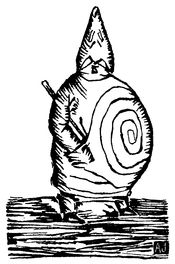
Pataphysics is a science, so it does not need its logo, which is usually used as a trademark. Nevertheless, pataphysics has such a sign. It was created by Alfred Jarry himself - he was also an artist, as it was supposed to be for people who were overprotected, which did not interfere with his literary and philosophical hobbies. And even on the contrary - it helped a lot. When in the mid-90s of the XIX century, Jarry depicted Ubi's father, he hardly realized that he is not just an engraving, and the canon and even an icon.
Canonical image came out of the whole image - from the moment of his appearance, Daddy Uby and no one tried to imagine others. But everyone agreed that the artist was particularly successful in the spiral that adorns the vast belly.
It was this spiral (Grande Gidouille) that later became a universally recognized symbol of the whole pataphysics and gave rise to philosophical debates, treatises, and scientific works. It comes from the word "Gidouille", which in French means both the spiral and the belly, and from the duality of the spiral itself: the one drawn and the one that appears between the lines of the drawing.
The spiral of Jarry, coming from Ubi's belly button, immediately seemed to contemporaries extremely ambiguous, and even more so to the descendants. Maybe it happened because his contemporaries were not a bastard of sewing, and maybe because the idea of the spiral itself became extremely fruitful in the twentieth century.
It can be understood as anything. It is a labyrinth, a galaxy, a "garden of divergent paths" and, if you like, one of Hegel's laws. Someone who only had a hand in the spiral: Borges, Cortazar, Faulkner, up to Roger Zelazny and Garth Knicks. Start - do not end.
And about contemporaries and acquaintances of Jarry to it is possible to develop a long narration. Not everyone wrote the obituary, Guillaume Apollinaire, not everyone talked to Octave Mirbo and Paul Valerie. These people surrounded Alfred Jarry and probably guessed about what kind of person he was.
Therefore, it is not surprising that the first illustrator of "King Uby" was not someone, but Pierre Bonnard (Pierre Bonnard). This was Paris of those years: accidentally missed Renoir, will certainly face to face with Picasso. But back to Bonnard.
On the theatrical program, Bonnard depicted Ubu's father not as a planetary, but as a universal phenomenon. The hero stands with an umbrella closed in the sunrise rays and the rain at the same time. He doesn't care much, because his belly is bigger than the natural phenomena. This is at least a galaxy. The navel resembles a supermassive black hole, and along the spiral, there are giant stars. This is how they depict the Creator. Perhaps it was with Bonnar's easy hand that Ubi was first talked about as an icon.
No less expressive is the "Alphabet of Uby's Father" by Bonnard.
The two upper drawings amaze the imagination. On the left is Dad's belly button and on the right is a navel. They are mutually convertible. The bellybutton is inscribed in the belly button, the belly button in the bellybutton. Just below the Eiffel Tower on the background of the belly. Here you can remember the ableness, but the new type - as Chronos devours his children, Uby is ready to eat both Gargantua and Pantagruel. He is not a Renaissance giant, but a black hole.
Such a character on the streets of Paris and with Renoir would hardly miss him, and with Pablo Picasso, he just had to meet.
Here, however, the researchers disagree. Picasso knew about Jarry undoubtedly, but whether they knew each other or not, it remains to be seen. Although, there are memories of their meeting, which took place under very spicy circumstances, which we just have to remember.
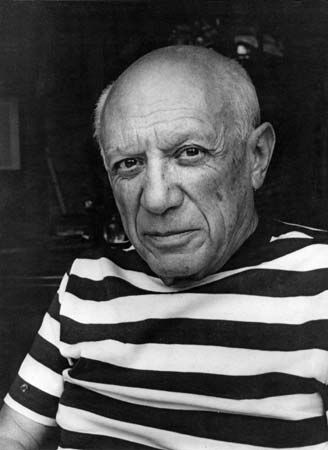
Unlike Uby, Jarry wasn't a giant - he was only 161 centimeters tall. But he was armed and dangerous and never broke up with his gun. He also wanted to shoot, although it is not known about the cases when he fell into something alive. It is said that one day, in the presence of Picasso, Jarry shot the Spanish sculptor Manolo in a restaurant, as if he had insulted him. The sculptor was not hit by the gun, but it was disarmed, and the gun was taken over by Pablo Picasso. Look at the photo. Picasso is wearing the same Jarry revolver.
However, they say that the artist bought it after the death of the writer. But the gun inspires respect, and the striped T-shirt is very similar to a spiral.
By the way, in his portrait, Jarry Picasso depicted the spiral in the form of folds on the neck. Fever was, as you know, a modest build, so the folds here are not of physiological origin. They continue the vest of the artist himself and the apotheosis of Ubi's belly, suffocating a very optimistic own creator.
The question of the influence of Alfred Jarry on Picasso is open. By generally walked its entire mass on the twentieth century. It is supermassive, like a black hole (remember the famous hit Muse?). And he seemed to be pushing Picasso too, at least he was trying to find a counterweight. Look at two strangely similar works: Horseback Uby Jarry and Don Quixote Picasso.
Their kinship is obvious, only at Zharry the poor horse of sedges practically tramples on the ground, and Rosinant Picasso aspires to fly in the sky. Jarry's horizon is heavy, and Picasso's vertical tries to balance it out.
Finally, Picasso seems to have accepted the spiral as a symbol of "human comedy". Let's look at this work of the great Spaniard...
No, this isn't another portrait of Ubi's father, Honoré de Balzac. With his image as soon as not experimenting. Rodin originally wanted to install Balzac naked in Paris Square and only at the very end "draped" the figure. Picasso depicted the author of the "Human Comedy" as an orator. He denounces vices, and the right to be the highest judge gives him the same spiral, directly from Uby's belly-crawling on the vast body of the classic French literature.
You may ask: what does "Sunday life of bees" have to do with it? At the same time, a few minutes ago, when you started reading this text, you thought about the spiral of Fry no more than about the Sunday life of bees. And it's worth thinking about.
By the way, Marcel Duchamp, a notebook pathaphysicist, counted it. Duchamp said: "Rabbi and Jarry are my gods. And beside him to the immortal iconography of Daddy Uby had his hands and Georges Ruo, and Max Ernst, and Joan Miro. We are talking about them in the next article.
And we will finish today's excursion with a wonderful quote from André Breton's article "Alfred Jarry": "....armed with two revolvers, with a cane filled with lead in addition, in a fur hat and slippers, he came in the evenings, at the end of his life, to Dr. Saltas (who, having asked him before his death, which would have alleviated his suffering, heard: toothpick)".