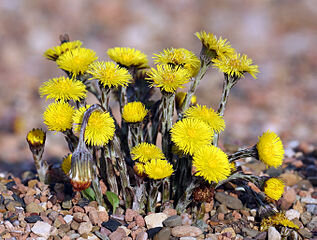
Folk names: fire salad, male flower, March flower, sand flower, tobacco grass, uncle's leaves.
Parts used: leaves, less often inflorescences.
Pharmacy name: mother-and-mother leaves - Farfarae folium (formerly: Folia Farfarae), mother-and-mother flowers - Farfarae flos (formerly: Flores Farfarae).
Botanical description. This perennial plant pleases us in early spring with its bright yellow blossoms with a smell of honey. Long before the leaves appear, the creeping rhizome throws out the erect floral noses with reddish scales and bright yellow blossoms, which have already begun to appear in the autumn. Only much later do the petiolate leaves develop in a round-heart-shaped palm-sized shape, slightly emarginate at the edges, with coarse denticles. Leaves are dark green from above and white loci from below due to strong pubescence. Blossoms from February to March (April). Mother and stepmother prefer clayey soils. It is most often found in wastelands, brickworks, in crushed rock, on slopes and railway embankments, on the edges of fields and roadsides.
Collection and preparation. Flowers are harvested in good weather, when the flowers have completely blossomed. They need to be dried quickly in order to retain their commercial appearance. However, much more than inflorescences, leaves are used for medicinal purposes. They are harvested in May-June, preferably young, half palm-sized and only clean, not soiled; because of the presence of mucus, it is not advisable to wash them. Studies have shown that the leaves of mother-and-mother plants that grow in the sun are richer in components and better than those that grow in the shade. This is worth paying attention to when collecting. Slice fresh leaves immediately after collection to speed up the drying process. Only quick-dried leaves are well stored.
Active ingredients. The most important substances are plant mucus, tannins and bitterness, as well as flavonoids, which complement each other perfectly when acting on sick lungs and bronchi. However, the pyrrolysis-alkaloids are also worth mentioning. They are practically absent in flowers.
Healing effect and application. Mother and stepmother - a valuable remedy for coughing, especially for whooping cough, as well as mucous membranes. Tea from it can be used to facilitate coughing, to make the viscous bronchial mucus more liquid, and thus bring real relief to patients with chronic bronchitis, pneumonia and emphysema of the lungs. o Mother-and-mother tea: 2 teaspoons with the top of the sliced leaves fill in 1/4 litre of boiling water, allow to infuse and then strain. Patients suffering from coughing should drink 1 cup of tea 3 times a day. It is advisable (but not for diabetics!) to sweeten with honey. R.F. Weiss in his writings recommends those suffering from chronic bronchitis, pneumoconiosis or emphysema to drink a cup of this tea in the morning before getting out of bed, as it makes it easier to expectorate sputum accumulated overnight. In addition to its use against lung diseases, the mother-and-mother tea provides relief for gastric and intestinal mucosa irritations (but then it should be drunk unsweetened), as well as rinsing for oral irritations. The German Public Health Service recommends mother-and-mother tea for oral and throat mucous membrane inflammations, to soften dry coughs in bronchial catarrh. The use of mother-and-mother tea should be limited to a maximum of 6 weeks per year. Do not use during pregnancy and in case of delayed menstruation!
Use in folk medicine. What has been said so far about the use of mother-and-mother leaves is also valid for folk medicine. However, here in the same honor and inflorescence. In addition, mother-and-mother tea is also used to treat wounds and skin inflammation, skin rashes and blood purification.
Side effects. According to recent studies, adverse effects on the liver are possible. Carcinogenic effects are also possible with prolonged use.