Organic architecture designed by Frank Lloyd Wright.
It is a type of architecture that is considered part of nature. An architecture that must be integrated with the surrounding nature. The details of the architecture are made of natural materials: wood, stone and reinforced concrete. It is confused with nature. Explicit integration of anthropogenic and environmental factors. Not economic. By order of rich people.
Houses on the prairie are small houses that develop on one floor.
For example, the Kaufmann House, a house on a waterfall.
This single-family villa, built on a waterfall overlooking a creek in Pennsylvania, is located on three floors, completely immersed in the forest. Built of local stone or reinforced concrete. The central stone pillar is the support from which the horizontal planes begin, creating terrace slabs.
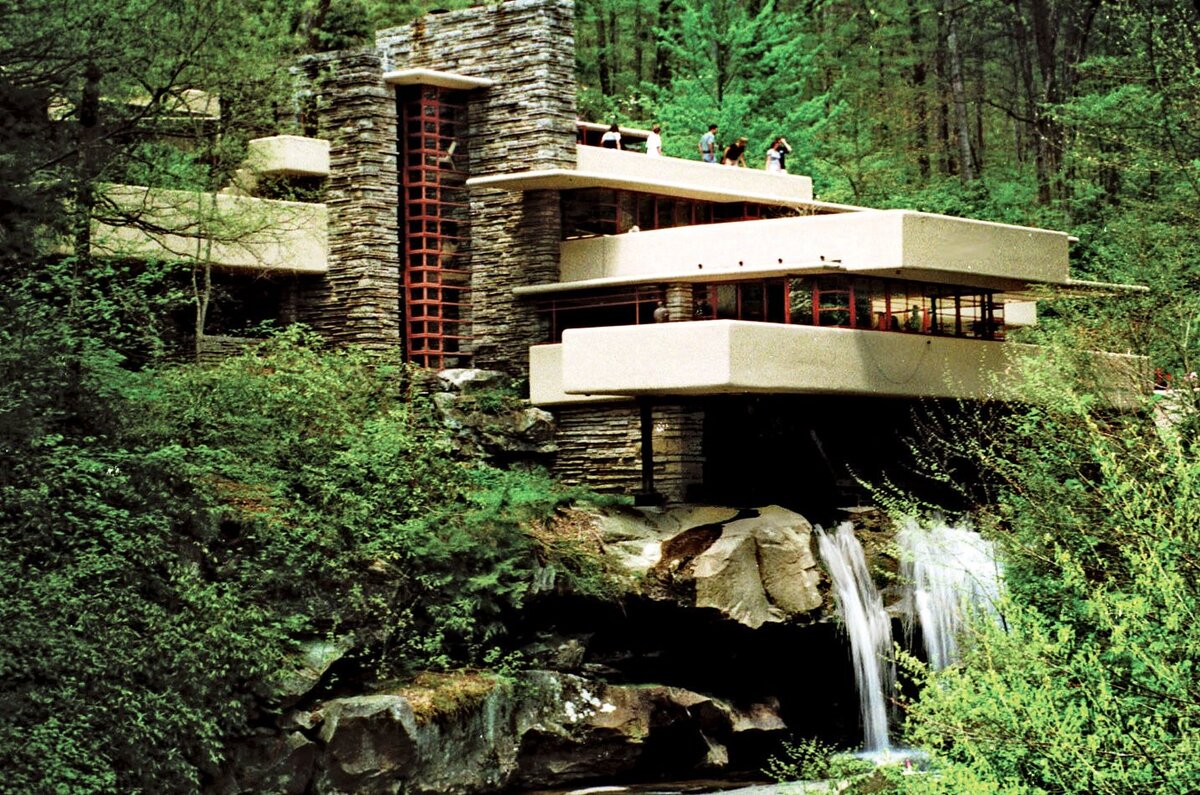
Reinforced concrete for horizontal load-bearing elements and stone for vertical ones. Very protruding terraces.
It starts with the element that is next to the stone fireplace. The architecture extends outward and fits into nature.
Some elements of the forest are not erased, in fact, there are tree trunks inside the house. A stone fireplace built from a group of pre-existing stones.
A simple plant in a free plan. Three different floors. It starts with the core and extends outward. Underneath the villa is a brook and a small bridge on the right, connecting the villa to the opposite bank of the river. There is a staircase that reaches the water level, which serves to connect the inside with the outside. Harmonious connection between the external and internal environment.
Wright's furniture is always made of local materials. The stone floor is irregular. Therefore, he designs three-foot (tripod) wooden chairs, because they are designed for those parts of the house where there are irregularities in the floor.
Guggenheim Museum, New York
By order of the Guggenheim family on fifth street in front of the Moma building. Made for one family from their family collections.
He wanted to build an architectural object that would be different from the surrounding buildings.
A museum was built on a limited area. It creates an architecture that narrows from bottom to top and expands from bottom to top. Spiral shape. It consists of a large spiral ramp that rises from the ground floor to the top, increasing the diameter of the base circle. The light comes from the very large roof window, the dome, which gives the highest brightness. Inspired by the Italian domes. Even the ribbon windows along the walls give brightness.
This large body is caused by another convex building in which elevators and stairs are concentrated. Externally, everything is connected to the lower part of the building, designed for offices, bookstores and ticket offices.
It creates the shape of the building according to its function.
The shape follows the function, as Wright's owner, Sullivan, said.
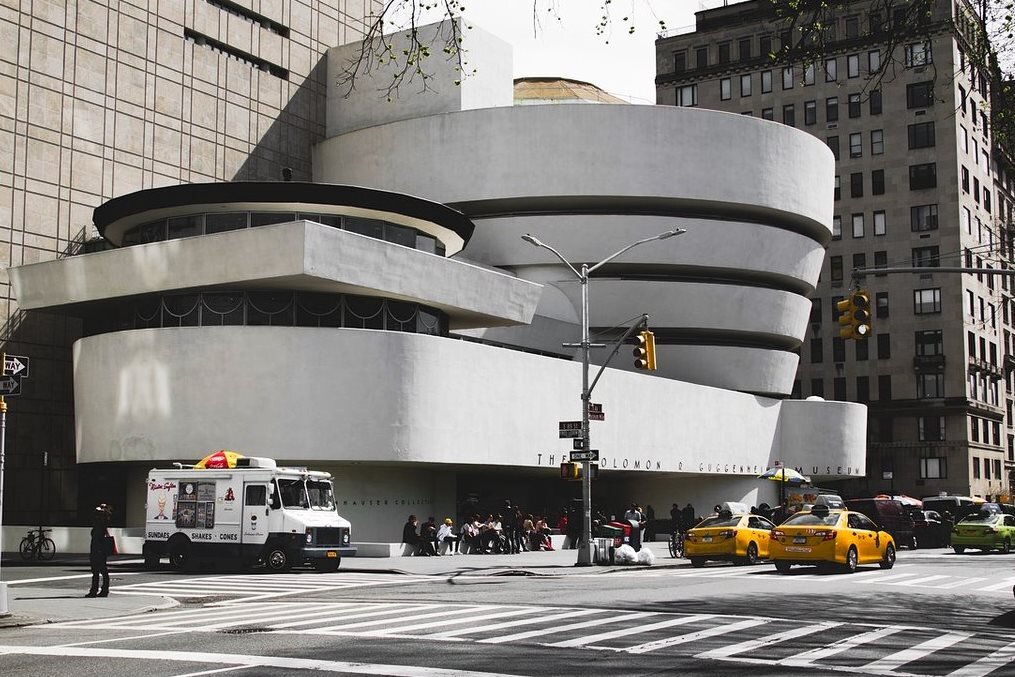
Along the spiral perimeter walls is a series of walls perpendicular to the vertical walls. These are elongated columns that perform a structural function, but on which there are also paintings.
The perimeter of the wall is orthogonal to be placed on top of the paintings to better see the painting, because it restores the position of the painting when it is tilted on an easel. Simplify vision and give an original viewpoint. Solving various tasks, primarily space tasks. It has a certain shape, but takes up points of rationalistic architecture: ribbon windows and a free plan.
Thus, we observe two significant objects of organic architecture, created by the great architect Frank Loyd Wright. These objects are similar in their significance, they are aimed at maximizing the unity of the building with nature, ranging from the materials of buildings to the presence of nature itself in the buildings. Wright has thought through his designs to the smallest detail, and even the furniture is custom-made. These objects in architecture remind us of the importance of conserving the environment.
It is important to remember that in the age of the "stone jungle", people need a green corner. And how wonderful it is when these two concepts are compatible, when you can be in your home and enjoy nature. Nowadays, the question of replenishing the environment, ecological innovations in the trend is very acute, many architects and builders prefer natural materials.
It is worth relying on Wright's experience of creating such architectural landmarks for practical application in architectural construction. Frank Lloyd Wright has made an invaluable contribution to modern architecture by combining an organic corner with a stone building.