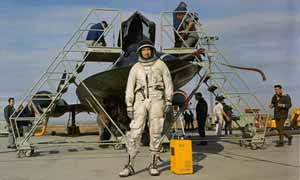
The first engine races on the assembled plane were carried out on December 18, 1964, three days later the first high-speed taxi with a separation from the ground to a height of 12 m took place. Bob Gilligan, the “branded” Skunk Works pilot, was appointed as the leading test pilot of the SR-71.[BR]The next day, December 22, everything was ready for the first flight. Gilligan took its place in the SR cockpit, with three F-104 escorts preparing for takeoff, one of which was occupied by James East ham, also appointed test pilot for the SR-71. The first flight was a success and Gilligan released a huge circle in the continental U.S. skies, reaching a speed of M=1.5 and a height of 15244 m.[BR][BR]With the arrival of new aircraft from Burbank, the testing program was extended to include Bill Weaver and Art Peterson as well as other Lockheed pilots, in addition to Gill and East ham. At first, the engineers were particularly annoyed with the leakage of hydraulic and fuel system lines. However, in the summer of 1965, most of the Category I program was completed. In general, the test results satisfied the customer, except for the flight range, which was 25% less than required.[BR]In January 1966, tests of the SR-71B training modification began.[BR]In the winter of 1965-66, the SR-71 program suffered its first loss: on January 25, a third experienced reconnaissance team crashed. Due to the failure of the air intake control system, the aircraft lost control in flight at M=3.0 and 24,390 m altitude. Pilot Bill Weaver managed to escape, and Weaver lost consciousness and did not remember how he found himself under the slings of the parachute because the ejector seat of Weaver remained in the plane.
Apparently, because of the high overload, the cockpit lantern blew the airflow and literally ripped the pilot out of his chair. The second crew member, Jim Safer, died in the ejection.[BR]Failures awaited SK-71 only in the air, but also on the ground. A year after the January catastrophe of 1966, on January 10, 1967, the first SR-71 prototype had to be decommissioned. Almost the entire program of research on the process of braking on the ground was carried out by Bill Weaver; several points of the program, including braking with maximum flight weight, were not closed. Completing the program Art Peterson, Weaver was at the funeral of his friend Walt Ray, who crashed into an A-12. Speed jogging took place at Edwards Air Force Base on an especially wet strip. At 370 km/h there was no brake parachute. On wet surfaces, conventional brakes were ineffective, but as soon as SR jumped out to the dry area with the braked wheels, all six tires of the main chassis support wheels burst simultaneously. The wheel rims, cutting spark sheaves, were traced along the runway, and the sparks ignited the wheel bushings made of magnesium alloy. The plane stopped only when the whole runway was skipped and the landing gear's nose piece was buried in the soil of a dried lake. Peterson was badly burned and could not take part in the flights for several weeks.[BR]In In the summer of 1966, the fifth prototype took off in the takeoff: as in the January case, the sparks ignited the wheel bushings, and then the plane itself. A crew of pilots — Air Force Lieutenant Colonel Bill Solar and Major Noel Warner — safely left the burning car, jumping out of the cockpit. After this case, the magnesium wheel bushings were replaced by aluminum wheel bushings and the new Zurich pneumatic were supplied.[BR][BR]Another heavy incident occurred on April 13, 1967: the SR-71 with the number “17” crashed not far from Las Vegas, both crew members (officers of the 9th wing) successfully ejected. The reason was again related to the operation of the propulsion system.[BR]On November 25, 1967, the 16th aircraft, also piloted by the Air Force crew, crashed in Nevada. The crew in the night flight miscalculated the readings of the air horizon and lost its spatial orientation. Pilots survived, but the next scout had to write off.[BR]The last accident during the flight tests occurred on December 18, 1969, the plane was piloted by Lieutenant Colonels Joe Rogers and Gary Heidelberg. Flight was conducted within the framework of testing the on-board system of the EPR. After refueling from KS-135, soon after the supersonic flight, the crew heard a strong clap, after which there was a sharp drop in engine thrust and loss of control of the aircraft. The scout came to large angles of attack and fell on the wing. Eleven seconds after the cotton, Rogers commanded, “Let's go” — let's go! The ejection was a success as the officers landed on the southern tip of the Death Valley, PCs. California. The cause of the cotton or explosion remained unclear. The probable cause of the disaster is likely to be related to the work of the air intake again. If the air intake does not startup, there is a very large traction asymmetry of the engines. The plane tilts and falls on the wing. This problem was “drawn up” at the design stage of A-12.