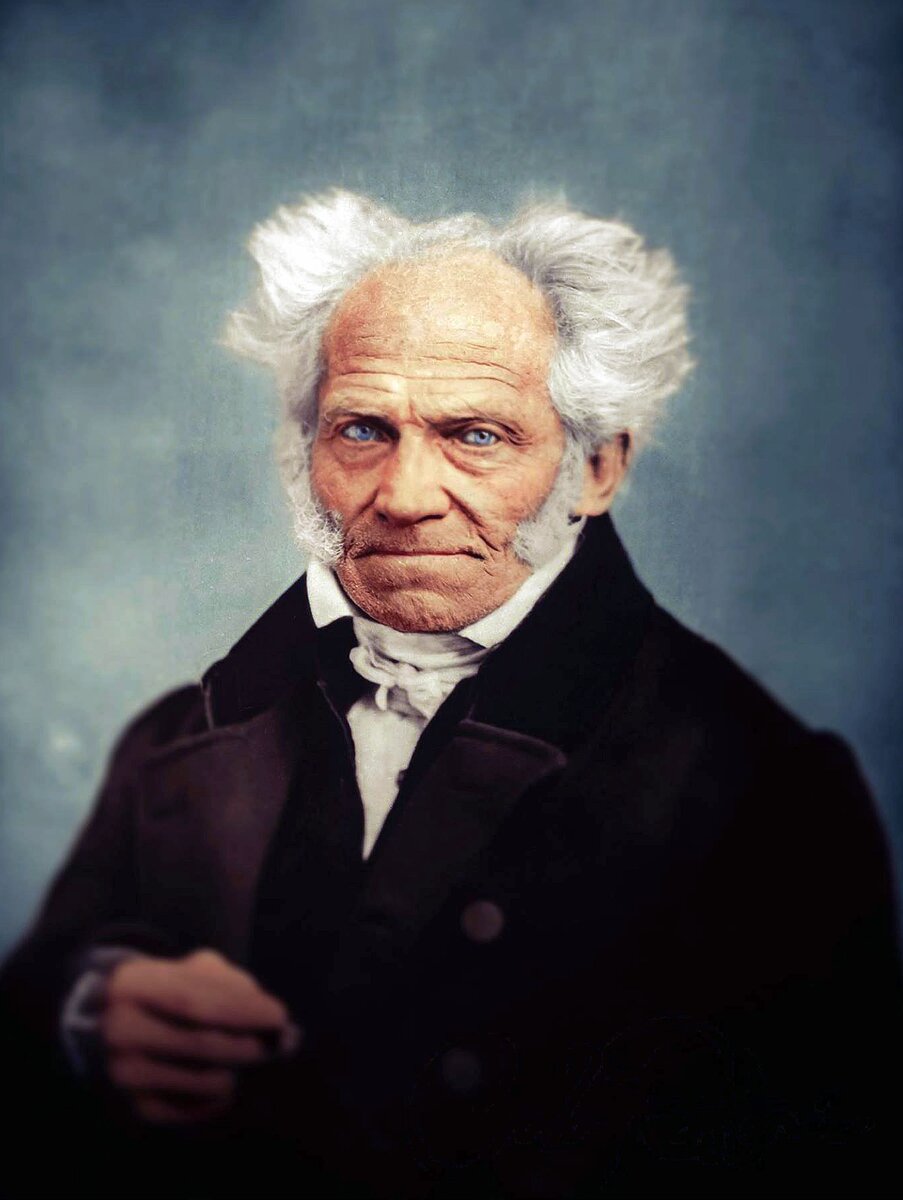
Arthur Schopenhauer, one of the most original and remarkable thinkers of the nineteenth century, became famous and famous, actually, only after his death. During his lifetime, professional scientists and philosophers deliberately kept him silent, and the masses of the public, by the very nature and nature of Schopenhauer's work, could not feed a special interest in his creations.
Only a few years after his death, from the end of the sixties, interest in his creations and his teachings began to appear not only in his homeland, Germany, but also in France and in Russia.
We consider it useful to give here an interesting extract from the letter of L.N. Tolstoy to A.A. Fetu dated August 30, 1869, which appeared only a few months ago in the press (published in "Russian Review", May 1890, in the article "B. P. Botkin, I. Turgenev and Mr. L. Tolstoy. From the memoirs of A. A. Feta"). Here's what Leo Tolstoy wrote:
"Do you know what the real summer was for me? - Unceasing delight in front of Schopenhauer and a number of spiritual pleasures, which I have never experienced. I wrote all of his writings, and I read and I read (I read Kanta too). And, indeed, no student in his course has studied so much and learned so much as I did this summer. I don't know if I'll ever change my mind, but now I'm sure Schopenhauer is the most brilliant person I've ever met. You say he wasn't himself, you know, writing something about philosophical subjects. How about something? It's the whole world in an incredibly clear and beautiful reflection. I started translating it. Wouldn't you like to translate it, too? We would have been together from afar. When I read it, I cannot understand how his name might remain unknown. The only explanation, the one he so often repeats, is that there is almost no one but idiots in the world..."
- On February 14, 1888, the Moscow Psychological Society celebrated the centenary of the birth of "one of the greatest German thinkers of the present century, Arthur Schopenhauer" in a solemn meeting in the auditorium of the Moscow University, and a comrade of the chairman of the society, Professor N. A. Zverev, reported the most important data about the life of Schopenhauer, and three other speakers, members of society, made speeches about the importance of his philosophy. Subsequently, these speeches were published in one general collection, with the addition of a more detailed biographical sketch here of Schopenhauer, compiled by a member of the said society, W. I. Stein.
In general, with the widespread dissemination of pessimistic philosophy in the late seventies, both in Western Europe and here, began a closer acquaintance with Schopenhauer and his teachings. In 1881 the main work of Schopenhauer "The World as a Will and Presentation" was translated into Russian, and in 1886 - his own works "On the Four Roots of the Law of Sufficient Basis" and "The Will in Nature" (both translations belong to A.A. Fetu, who, thus, fulfilled the advice given to him, as we saw, in 1869 by Count L.N. Tolstoy; the first of these translations was accompanied by a foreword by N.N. Strakhov). Also translated are Schopenhauer's Aphorisms and Maxims and Key Ethical Challenges, which have become more popular in society in terms of their comparative popularity.
Until recently, very little was known about Schopenhauer's life. All his biographers unanimously admit that it is extremely difficult, even almost impossible, to write any detailed biography of him, firstly, because he, like, for example, Decarte, led a very closed and secluded life, and secondly, because until recently there were almost no suitable sources for his biography. Schopenhauer himself was extremely insensitive to the efforts of biographers to collect materials for future biographies of remarkable people in any respect, and he had a positive antipathy towards autobiographies.
The autobiographical note sent by him at the request of the editorial office of Meyer's Conversations-Lexicon published in the 1st issue of the Moscow Psychological Society and marked on May 28, 1851, occupies literally no more than 64 lines of the overclocking font.