Main building and Olympic pool
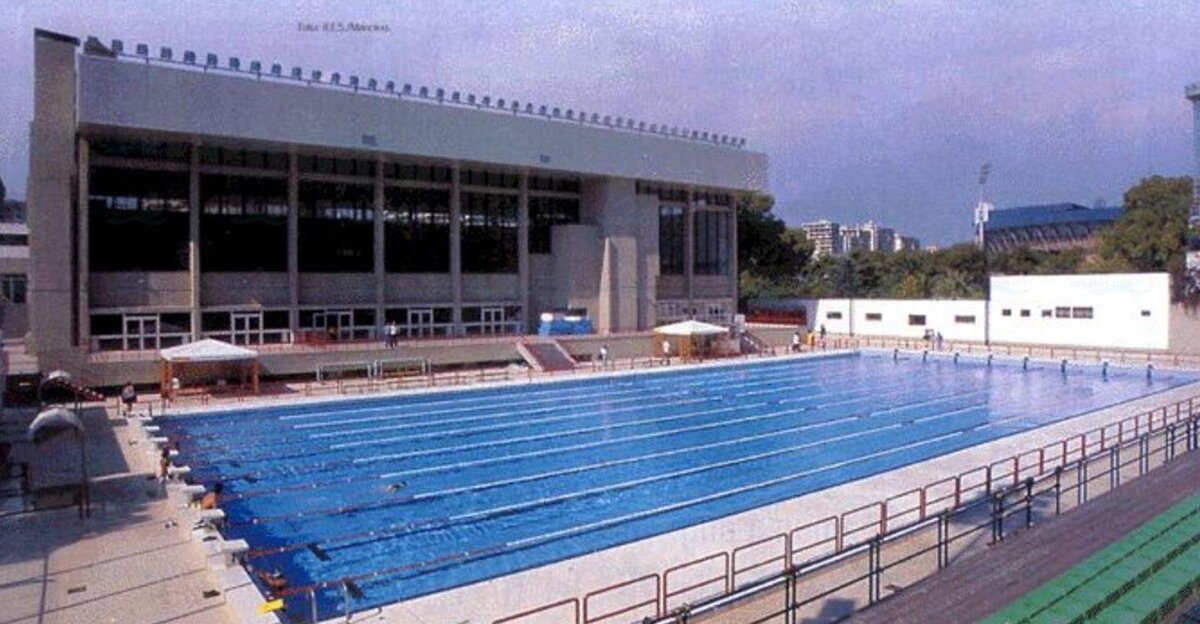
Built immediately before the "Marzari" stadium (now "Braglia"), the "Dogali" municipal swimming pool was designed by the Municipality's Technical Office and the Bolognese engineer Arturo Manaresi, who was later also involved in the design of the stadium by his colleague Umberto Costanzini.
The main body consists of two volumes: the first, lower and longer, and Piscina Dogali, an epoch-making photo-gallery with simple ribbon windows on both floors, houses the changing rooms, the offices and, on top of the flat roof, a large terrace/solarium; the second, more compact and higher, houses the service areas, the plant rooms and a bar/restaurant directly overlooking the outdoor Olympic pool, on the north side of which the valuable reinforced concrete trampolines, now unfortunately demolished, were placed.
The front towards the pool, calibrated and linear, is dominated by a monumental tower with a square base. Vertically engraved by an elegant glazed slit and embellished by the graphic clock on the top, the tower ends with a nimble flagpole that accentuates the character of urban signal recognizable from a distance.
Piscina Dogali Assonometria a new volume was built between 1964 and 1968 in the remaining portion of the lot at the back of the dressing room building, designed to house a 25-metre indoor pool. The project, curated by the Public Works Department of the Municipality and carried out by the Cooperativa Muratori of Modena, presents the signature of Tullio Zini as a "draughtsman".
Oriented perpendicularly to the existing building and placed parallel to Viale Montecuccoli, this new body is characterized by the structural virtuosity and expressive coverage above the pool, a reticular beam with a single light that simulates the profile of a wave.
MEF - Enzo Ferrari Museum
In 2004, the invitation-only competition launched by the Fondazione Casa Natale di Enzo Ferrari - Museo kicks off the construction of the Casa Enzo Ferrari Museum, a further step in the great process of transforming the southern strip behind the railway, once occupied by steelworks and ironworks.
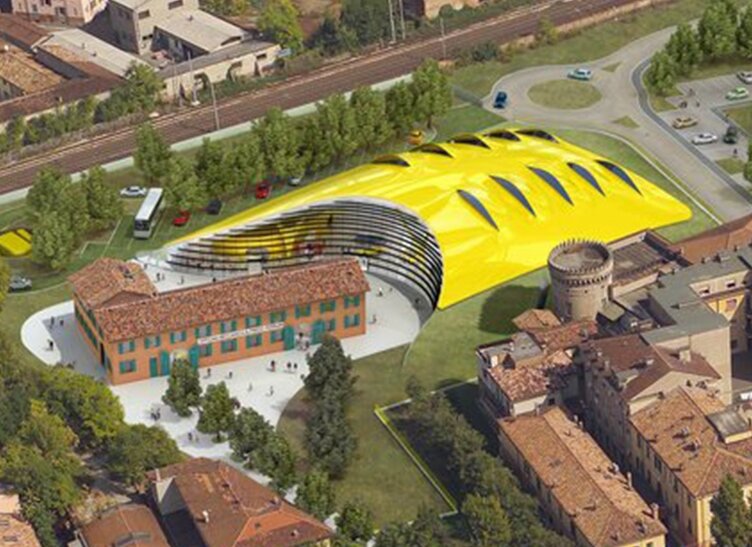
The call for proposals required the creation of new spaces for the exhibition of Modena's automotive history and for services such as a documentation centre, a cinema projection room, a conference room with a capacity of 150 seats, a store and a restaurant-cafeteria, to be built in a lot adjacent to the still existing workshop where Enzo Ferrari was born, which in turn needed to be renovated and used as a museum. The jury awarded the project by the English studio Future Systems by Jan Kaplicky, who imagined a building consisting of a continuous metal-covered surface, whose sloping main façade ideally embraces the pre-existing Ferrari workshop building, visible from the inside through a large glass surface, while clearly differing in the architectural language chosen.
The building conveys an idea of architecture that can be traced back to the design of the metal profiles of the bodies. At the same time, however, the designers' intention is to favour a personal poetics based on the elegance of the lines, the lucidity of the surfaces and the use of colour, through which to ennoble the space, at the level of an art gallery and not simply a "container" for cars.
Sculpture The Great Bunch
Via Vignolese, crossroads Nuova Estense - Modena - MO - 41100
Located at the center of the roundabout "Vignolese-Tangenziale", crossroads to Modena, located at the intersection of Via Vignolese and the New Estense, the work of the Modenese artist Erio Carnevali, depicts a bunch of Lambrusco grapes, twelve meters high and just over six meters wide.
The grapes, of different diameter and shape, are 240, all in blown glass, produced in the furnaces of Murano by a team chosen for skill and professionalism.
The leaves, of various sizes, are made of copper to recall, in particular, the colors of autumn. Most of them are placed "naturally" on the upper branch of the bunch, some of them also serve to protect it from the weather.