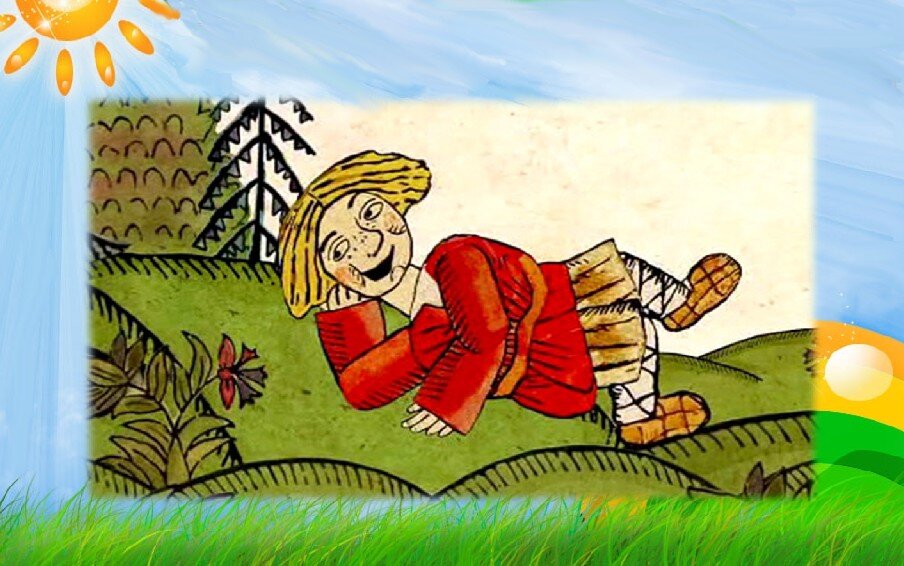
The great psychologist and philosopher Karl Jung said: a fairy tale is a code language, a cypher of a nation. And if she is stupid, then on purpose. Because it must be publicly available.
There were countless tales. But only those that have passed the thorough test of time have reached us. Judge for yourself: if a fairy tale has been passed down for centuries by word of mouth, from generation to generation and almost in its original form, has reached us, people of the 21st century, it means that it carries a certain deep knowledge. And this knowledge, paradoxically as it sounds, is embedded in a well-known character - Ivan the Fool. For some reason, he is always lucky. Everyone for some reason loves and helps him. And he gets all the main prizes. Including the beauties of the princess. Despite the seeming idleness and slight idiocy. Why?
Every fairy tale begins with the fact that the hero goes on a journey.
The western fairy-tale character goes next to take place in this life: to get a profession or find a treasure. This is a purposeful hero with a clear motion vector. If someone comes in his way, he quickly defeats him and moves on to the goal. The western hero is timed: all his time is designed so that he is at the top of fame and fortune. In these tales, the survival mechanism of the western nation is laid down - the idea of personal prosperity.
A hero from Russian fairy tales sets off on a journey with strange tasks, like going there, I don’t know where to bring something, I don’t know what. Or to find a person stupider than yourself. The impulse of his movement is self-knowledge. Our hero is always distracted along the way: either an apple tree will help to lose fruit, or an oven - to get rid of cakes. Lack of determination with maximum compassion is our cultural attitude.
In Russian fairy tales, the task of survival is not personal, but "bush". And so the hero helps everyone. And then a bear, then a fox, or an ant help him cope with a serious problem.
The deep meaning of our fairy tales is this: only by connecting can we solve the problem. Here is the mechanism of Russian collegiality: the Russian finds its “I” in someone else's fate.
Ivan is not a fool
A fool is not a characteristic of mental abilities, but, first of all, a common Russian folk name. Same as Man. And its characteristic feature is a risk appetite caused by a disregard for one's own person.
In many tales, brothers go to help someone out. And they fall at the crossroads of three roads. Smart brothers choose the most pleasant, the best for themselves - to marry. They meet lovely girls, they feed and water them. But in the end, they dump it into the basement.
Ivan has no idea that he is the smartest. And that he should get the best piece. Therefore, at the crossroads, he chooses "you will go to the right - you will lose a life." And it turns out to be the winner. The princess and the whole kingdom, in addition, are just side effects of his movement.
Moral: the one who wins the most wins.
As a rule, Ivan meets an old man on the way. He gives him wise advice, which Ivan implicitly follows. This suggests that Ivan the Fool has the gift of hearing. The smart one knows everything and therefore perishes. Knowledge and power in a fairy tale are split. Wisdom is inactive, it is accumulated either in the old man, or in the Frog Princess, or in the Humpbacked Horse. And they pass it on to Ivan. That which pretends to be the mind is just stupidity.
True power over a fairy tale is unsophisticated. Remember, the hero wins the battle, and when he is destroyed by cunning opponents and ascribe to himself his victories and receive his rewards. Why? According to the Russian fairy tale: strength and cunning do not combine. The one who accomplishes the feat is not cunning. This is the answer to the formula "why a fool is lucky."
Whatever the king is sick
Why do you think the king in fairy tales is always weak and stupid?
That's because this character raises the value of a person’s independence. Good means independent. And the king is dependent on his subjects, so everyone deceives him. Stupid king is infantile. Like a capricious child, he is cruel, not far off and commits ridiculous acts. He wants to marry a beautiful girl, but first, he will try Ivan in boiling water. Ivan comes out handsome, and the king is welded. Because Ivan went through all the difficulties that mentally tempered him. Therefore, boiling water does not matter to him. And the king dies because the tale does not like the infantile.
Or in another tale, the king is punished by the fact that his daughter is Princess Nesmeyana (the one who does not know how to laugh).
This depressed girl is a sign of hereditary degeneration of all the great royal families of the world. Why is Ivan curing such a princess? Here we get such an exchange - it’s not Ivan who receives the kingdom and the bride as a prize, but the king receives healthy folk genes as a prize. And this marriage saves the royal family from degeneration and the country from troubles. This is a hidden form of heroism.
About truth and falsehood
Today, as always, the tale of truth and falsehood is relevant, where two men argued about how to live right. First, as usual, a "sociological survey" on the road. The merchant so answers: "You will not deceive - you will not sell." Pop, in truth, cannot live either. Then the men went on a road-road. That man, who lives by falsehood, and even hunts for something - either bread or salsa. And the truth-seeker is hungry: "Give me a piece - I will give you everything you want."
The curvature finder gave me some food, but his friend knocked out his eye for it, later he also deprived the second eye of a companion. And then he laughed and left the man on the road. So he proved the truth of the lie - we are now at this point.
Further, an abandoned and disfigured man creeps into the forest, meets an old man who helps him to see clearly and points out the tree on which the spirits gather. Under this tree, the truth seeker will learn how to cure the royal daughter: you must bring the Smolensk Icon of the Mother of God, which hangs at the gate of a merchant. Our peasant goes to the merchant, honestly fulfils this icon in three years, cures his daughter, marries, becomes king. Once he goes in his royal carriage and sees his neighbour, a seeker. He is also poor and works in the same field. Our man tells him his story. He runs under the same tree where the spirits live, and they tear it to pieces.
Moral: one can survive through a lie, but at its own low level, and in order to receive a super prize, one must endure great suffering and remain faithful to one's beliefs.
In the tale, the hero is at a crossroads: if you go to the left — you will lose the horse, straight — you will lose your head, to the right — you will lose your horse and head. But with this choice we must not forget the folk wisdom of the tale: the more terrible the choice, the more you are ready to give, the greater the gain.