Hello everyone! In this article, we will continue to address questions to Higgs theory.
4. Why is the Higgs particle so difficult to capture?
As a source of quality, Higgs particles have already fulfilled its mission at the beginning of the Big Bang, which was 13.7 billion years ago. Now, physicists have to capture the traces of the Higgs particles again, only to build high-energy colliders, through the collision of high-energy particles, to simulate the moment of the origin of the universe, "resurrection" Higgs particles.
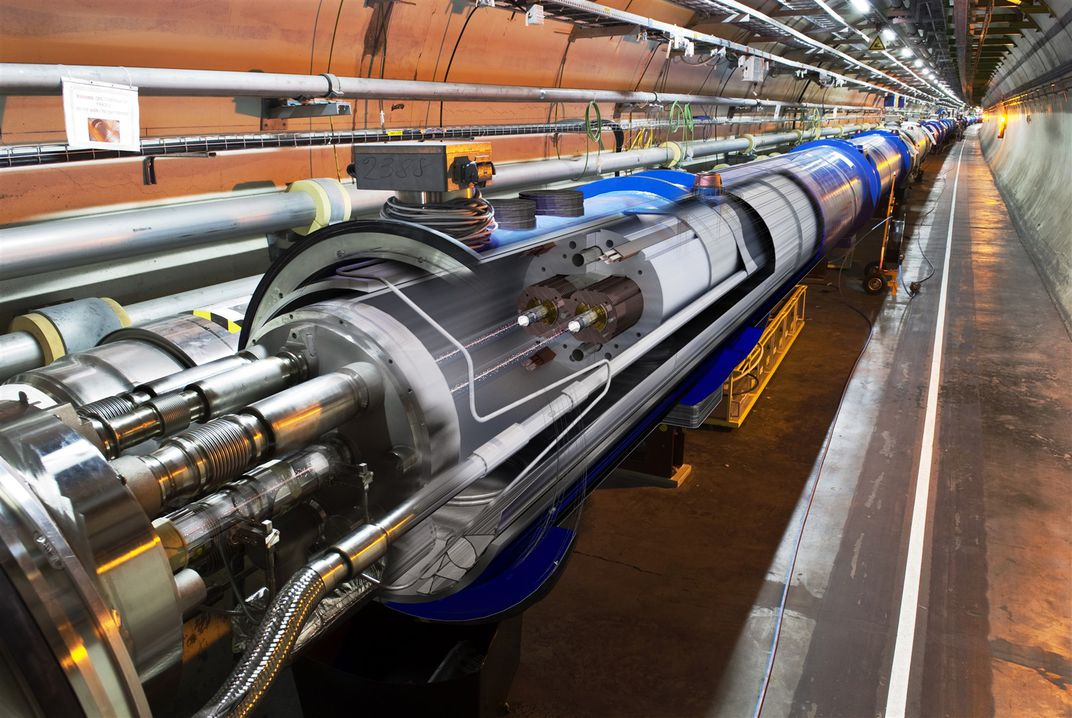
Large Hadron Collider LHC. Image Source and Copyright: CERN
Capturing Higgs particles is extremely difficult. The quality of the Higgs particle is hundreds of times the mass of the proton, which requires a very high energy collision to "crash" out. At the LHC in the Large Hadron Collider at the junction of Switzerland and France, Higgs particles can be produced every 1012 proton collisions. Just like in a lot of sand, there is only one sands, and the probability of finding it is very small. Even more troublesome is that the Higgs particle is extremely unstable, and once it is produced, it will be fleeting, and after a billionth of a second, it will decay into other particles such as photons, lepton pairs and hadrons.
In order to find the "cornerstone of the standard model", physicists around the world have worked hard for nearly 50 years. It was not until July 2012 that Higgs particles were discovered on the Large Hadron Collider at the European Nuclear Center.
5. What is the significance of Higgs particles for physics?
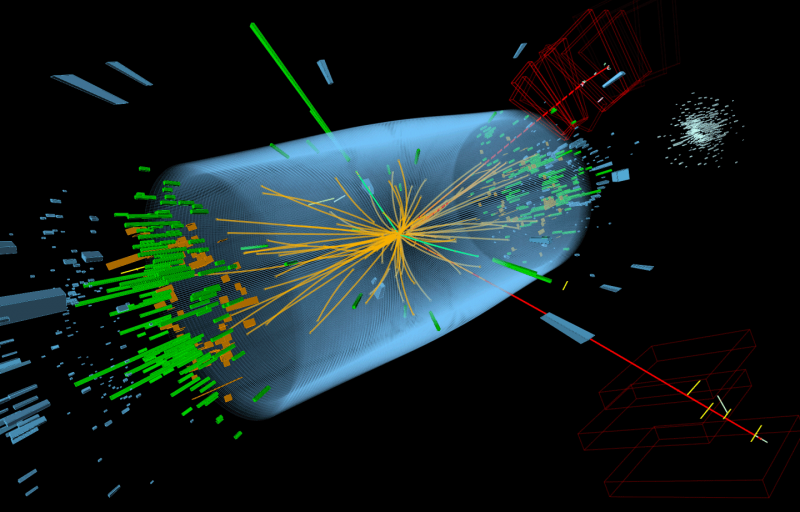
On July 4, 2012, the European Nuclear Research Center held a global press conference, announcing that in the ATLAS and CMS experiments of the Large Hadron Collider LHC, a mass of 125 GeV was observed with a statistical significance of nearly five times the standard deviation. New particles, consistent with the expectations of the standard model Higgs particles.
The CMS experiment captures a schematic of the Higgs particle. Image Source and Copyright: CERN
The discovery of Higgs particles fills the most important gap of the standard model, making the theoretical foundation of the standard model more solid and becoming a new roadmap for the next step in particle physics theory and experiment development. Basic physics therefore faces an important turning point and development opportunity. Therefore, this discovery is considered to be the most important discovery of physics in recent decades after the establishment of the standard model, and is a major milestone in the history of particle physics.
6. Why should we study the nature of the Higgs particle in depth?
The discovery of Higgs particles completes the standard model in a certain sense, but this is not the end of human exploration of elementary particles, but a new beginning.
It is found that Higgs particles can explain why some elementary particles have mass, but the current theory does not predict the mass values of Higgs particles and other elementary particles. Therefore, it is necessary to study the properties of Higgs particles in depth to explain the correlation quality. On the other hand, the standard model is not omnipotent and perfect, and the problems of neutrino mass, dark matter, dark energy, cosmic matter and antimatter asymmetry cannot be explained by it. Excavating the physical laws behind the standard model (also known as new physics), exploring new particles and new interactions beyond the standard model, has become the forefront of the current international particle physics experimental research, and the in-depth study of the Higgs particle Probably the best breakthrough.
7. Why should I study the Higgs particle to build an ultra-high energy electron-positron collider?
Studying the microstructure of the material composition requires the aid of a large collider. The smaller the scale of the study, the greater the energy required for the collider.
After the Higgs particle was discovered, scientists are eager to have the next generation of electron-positron colliders to produce a large number of clean Higgs particles, the "Higgs factory." The proton collision process on the LHC of the Large Hadron Collider has a very large background. The Higgs particle case is mixed with a lot of useless "noise", which brings interference and difficulty to the study of the properties of the Higgs particle. If a positive or negative electron pair collision is used, the background is very low and a more accurate measurement of the properties of the Higgs particle will be carried out.
Thanks for reading! Continued in the third part.