Part 1
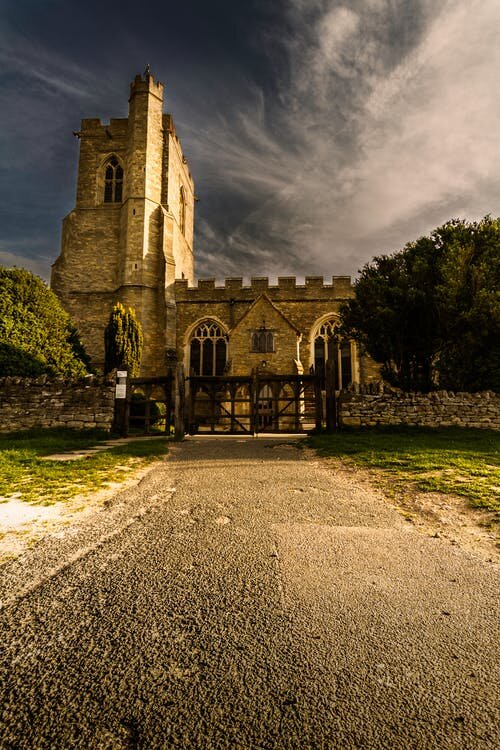
The development of English architecture in the XIV century was significantly influenced by the traditions of the Romanesque style. The development of Romanesque architecture in England takes place in the XI-XII centuries and is associated with the invasion of England in 1066, the Normans, who laid the foundation of a centralized feudal state. William the Conqueror began extensive construction of castles and large churches. The main purpose of this construction was to establish Norman rule in the conquered country. Cities in agricultural England were less developed in the 12th century than on the continent. As a rule, they grew on the site of former Roman settlements. The layout of these towns was based on a regular grid of Roman camps, the small territory of which was surrounded by a disordered and dense medieval building. The Romans inherited a scheme of intersecting axial arteries at right angles, but unlike cities on the continent, the centers were not accentuated. The town halls were an exception, and the cathedrals were often located away from the center. Fortification architecture developed slowly because the country was under political centralization and protected by the sea. At the end of the 12th century, a stable composition was formed A wooden manor house, less often a stone one, with a warehouse at the bottom and housing on the second floor, was built in early England. The new dynasty of Plantagenet, connected with France and patronizing more cities than monasteries, contributed to the establishment of a new style — Gothic. However, Romanesque traditions were still very strong. The Canterbury Cathedral Choir, built by French masters, was not imitated by local masters. Even at the end of XII century Romanesque cathedrals were still being built, moreover, with wooden ceiling, as in Peter borough. In addition, the need for new cathedrals was low, as the former were large enough. As a result, Gothic clothes often only covered the Romanesque core. Since the beginning of the XHI century, sheep breeding, trade and craft were rapidly developing, and the eastern coast cities were rich in wool export, and the influence of the commercial and industrial estate was growing. The construction initiative passed from monasteries to the townspeople”s hands. The cities competed by rebuilding Romanesque temples into imposing, palace-like Gothic cathedrals. In these cathedrals not only religious, but also all social life of the city concentrated. Handicraft skills flourished. In the XIII century, the local marble of Serbia, which could be easily cut, was widely introduced into the construction. It was extracted on the Perfect Peninsula in Dorset hire. Sculpture and lush floral ornament complemented the Gothic forms. English Gothic style is remarkable not so much for its constructive, but rather for its decorative features. He retained the simplicity of three-dimensional spatial solutions from the Romanesque style, the elongation and squareness of the main masses, the dominance of straight lines, the distinct rhythm of horizontal and vertical division, the powerful rectangular towers and the rectangular end of the chorus. The wall with the buttresses remained the basis of the construction, and the need for adjutant rarely arose, since the height of the vaults was relatively small shoo. The plan, which is easily perceived by its external volume, had the same shape as the Latin cross. Without breaking with the flat treatment of the wall, the builders dressed it with a rhythmically rich, diverse decor, as if living an independent life. The best western facades of English Gothic, such as the cathedral in York or the facade of the cathedral in Lincoln, are peculiar decorative screens that do not reflect the inner structure of the building. They are wider than on the continent, sometimes wider than the building itself, and are covered with a whimsical grid of plastic decor. The ornamental fantasy of the English masters manifested itself in a complex, sometimes purely decorative, intertwining of nerves. Therefore, it is natural to per iodize the English Gothic in the evolution of decorative elements: the shape of windows, drawing of window covers. It is customary to distinguish three main stylistic periods in the development of English Gothic architecture: “early English” — the period from the last quarter of the XII century to the second half of the XIII century, “decorated” — the period up to the second half of the XIV century, “perpendicular” — until the middle of the XVI century. The first period was dominated by Lancelot shaped outlines of arches and openings. Gradually complicated nervous vaults, as well as the forms of supports, as, for example, in the choir of the cathedral in Lincoln, where the column is surrounded by four free trunks. The sculpture displaces the geometric ornamentation. The best example of this period is Salisbury Cathedral. The second period is characterized by the disappearance of the sharpness of the forms. Windows become larger and wider, sometimes filling the facade. In complicated bindings geometric pattern prevails, but at the same time there is a passion for curved lines, curved “flaming” decor, which has penetrated into France in the second half of XIV century.
continuation should be.....
https://zen.yandex.ru/media/id/5d9347856d29c100b1d10d24/english-culture-xiv--xv-century-5d939f688f011100ad7d0f4c