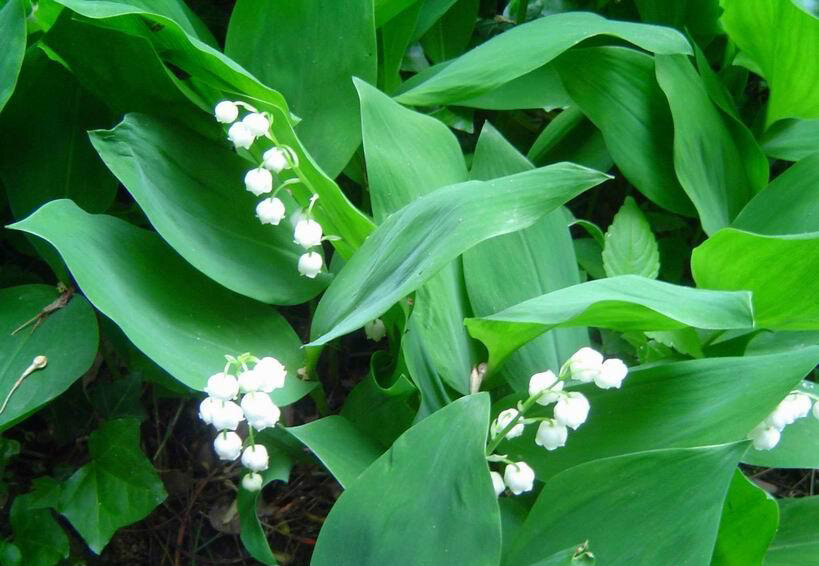
Poisonous! Guarded.
Lilyceae - Liliaceae.
Folk names: eye grass, May lily, bells of Maria, snow droplets.
Parts used: leaves.
Pharmacy name: lily of the valley grass - Convallariae herba (earlier: Herba Convallariae), lily of the valley tincture - Convallariae tinctura (earlier: Tinctura Convallariae).
Botanical description. In places of lily of the valley, large dark green oval (before lanceolate) leaves more than 10 cm long and almost 5 cm wide are striking. They depart from the light brown (up to whitish-gray) creeping rhizome. Leaves are characterized by arc veins with a strong main vein. Two root leaves are surrounded by a leafless peduncle with fragrant drooping white flowers in the form of bells with six teeth bent at the edge. The flowers are collected in a single-sided brush, and after maturation they form shiny, globular red berries. Blossoms in May-June. It grows mainly in deciduous (beech) forests, less often in valleys. It is found in Central, Southern and Eastern Europe, in North America.
Active ingredients: cardiac glycosides (up to 30 different, the main ones being convalatoxin and convallaxin, which are very close to the group of strophant glycosides).
Healing effect and application. The raw materials themselves are not currently used in medicine, but halene drugs are important drugs used to treat chronic heart disease, heart weakness after infectious diseases, disorders in the conductive system of the heart and other cardiovascular diseases, as well as a soothing nerve.
Use in homeopathy. Homeopathic preparation Convallaria is prepared from a whole fresh flowering plant. It is used mainly in diseases of the cardiovascular nervous system in the cultivation of D1 and is given regularly in a dosage of 5-10 drops 2-3 times a day. In case of heart weakness, especially in case of slow heartbeat, or the so-called heart water tincture is used.
Application in folk medicine. Lily's lily of the valley is a poisonous plant, and in no case it can be used independently! For information, it should be said that in folk medicine use tea from the leaves of the lily of the valley as a diuretic in edema and to a lesser extent - for blood purification. At one time it was believed that lily of the valley can treat all diseases. In folk medicine, this opinion is still preserved. Especially often they try to treat people suffering from paralysis and epilepsy with lily of the valley. It is also worth mentioning that dry lily of the valley flower is a part of the Schneeberger smell tobacco.
Side effects. There are no side effects if you use medication prescribed by a doctor from this plant and the correct dosage of side effects. But the active ingredients of lily of the valley contained in all parts of the plant are poisonous. And yet it should be said that the poisonous lilyfish is greatly exaggerated. Tall tales that allegedly died a child who drank water from the vase, where there were lilies of the valley, are not confirmed. Serious lily of the valley poisoning is hardly possible, even when eating berries. However, you should be careful.