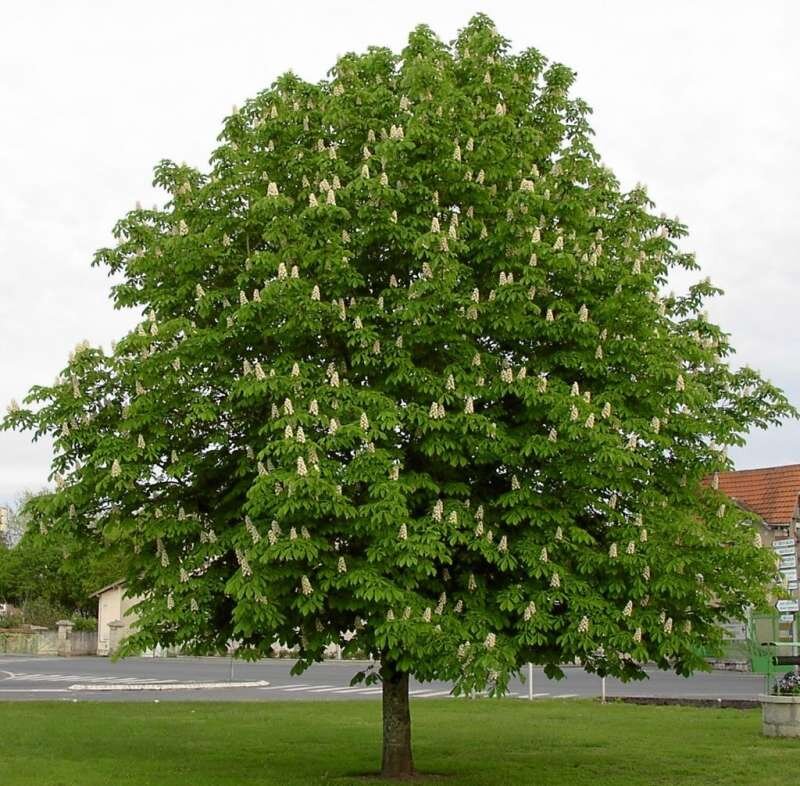
Folk names: gout tree, pork chestnut.
Parts used: seeds, but also flowers, leaves and bark.
Pharmacy name: horse chestnut seeds - Hippocastani semen (formerly: Semen Hippocastani), horse chestnut flowers - Hippocastani flos (formerly: Flores Hippocastani), horse chestnut leaves - Hippocastani folium (formerly: Folia Hippocastani), horse chestnut bark - ippocastani cortex (formerly: Cortex Hippocastani).
Botanical description. It is quite pointless to describe a chestnut tree, familiar to both children and adults, because it brings us joy three times a year: in early spring, when his large buds swell with the beginning of warm time, in May, when we are delighted by the amazing candles of his flowers, and finally, in autumn, when his shiny reddish-brown seeds - an interesting children's game - fall from the trees. Chestnut trees are found in almost every area. This ornamental tree can be found near houses, in gardens, near various buildings, in parks and alleys. However, horse chestnut first entered Central Europe in the second half of the 16th century from northern Greece. Its seeds, usually called chestnuts, from the very beginning found a very diverse application: as a feed raw material, as a source of starch, as a material for winter feeding cattle. In addition, in folk superstition, they were used to prevent various diseases, with three chestnuts in their pockets. The use of chestnuts for medical purposes is also known for a long time, but its medicinal effect was first discovered only in 1896. The active ingredients of the seeds are chestnut saponin (Escin), tannins, flavonglycosides. The bark, flowers and leaves also contain significant amounts of these substances. Many other substances that are not listed here are also involved in the overall medicinal effect.
Healing effect and application. One French doctor, interested in the use of chestnuts in folk medicine, prepared a tincture of them and successfully applied it in the treatment of hemorrhoids (1896). Later it was found out its effect on the entire vascular system, especially the venous one. Anti-inflammatory and anti-inflammatory effects of horse chestnut expanded its application. However, tea from the seeds of horse chestnut can not be drunk, for this use the bark, leaves or flowers. Numerous drugs in the form of ointments, drops, tablets, capsules, candles, even drugs for injection are now used as vascular drugs. The need for these drugs is high today, because of the general hypodynamics of vascular disease. Therefore, the medicines from this plant are of real value.
Use in homeopathy. Acsculus hippocastanum, a homeopathic preparation, is prepared from fresh, purified seeds. The product is used in breeding from D1 to D1 and is given 2-3 times a day for a few drops: dry cataracts of the nasopharynx, hemorrhoids and trophic ulcers of the shin.
Application in folk medicine. Tincture of flowers, bark or leaves, from time to time used in folk medicine, prepared on the basis of wheat vodka. It is used against vein diseases and in rheumatic complaints. Try to take it and in case of stomach and intestinal pain. In some cases, chestnuts fry, then crushed, mixed with flour and vinegar, and this mixture is put on a hardened breast nursing mothers to soften it. However, there is no serious need for this, since pharmacies have a lot of ready-made drugs from horse chestnut, which can be used, mainly for vein diseases.
Tea of horse chestnut leaves as a good remedy for coughing: 1 teaspoon with the top of the leaves is poured 1/4 litre of boiling water and insist on 10 minutes. Drink with honey (excluding diabetics!).
Side effects. If you take tea and other preparations from horse chestnut as prescribed by a doctor or as instructed on the packaging, no side effects should be feared.