What's the danger of garbage in space?
lm "Gravity" (2013) directed by Alfonso Cuarón, clearly shows what space debris can do. Rapidly rushing in the airless space fragments that are almost impossible to notice, sew everything in their path, from human bodies to space stations. A few seconds - and the construction, which took tens of years and billions of dollars to create - turns into a useless sieve.
The film is fantastic, of course, but it is also possible in reality. The fact is that the bodies in Earth orbit move along it with the first space velocity - almost 8 kilometers per second. For comparison: a bullet from a Kalashnikov assault rifle leaves the barrel at a rate of about 1 kilometer per second, and then slows down due to air resistance - unlike debris in a vacuum. Even a small piece of debris can cause serious damage to a satellite. Thus, in 2006, the connection with the Russian telecommunication satellite Express-AM11 was suddenly lost. The impact of a microparticle damaged the thermal management system, the satellite quickly overheated and failed.
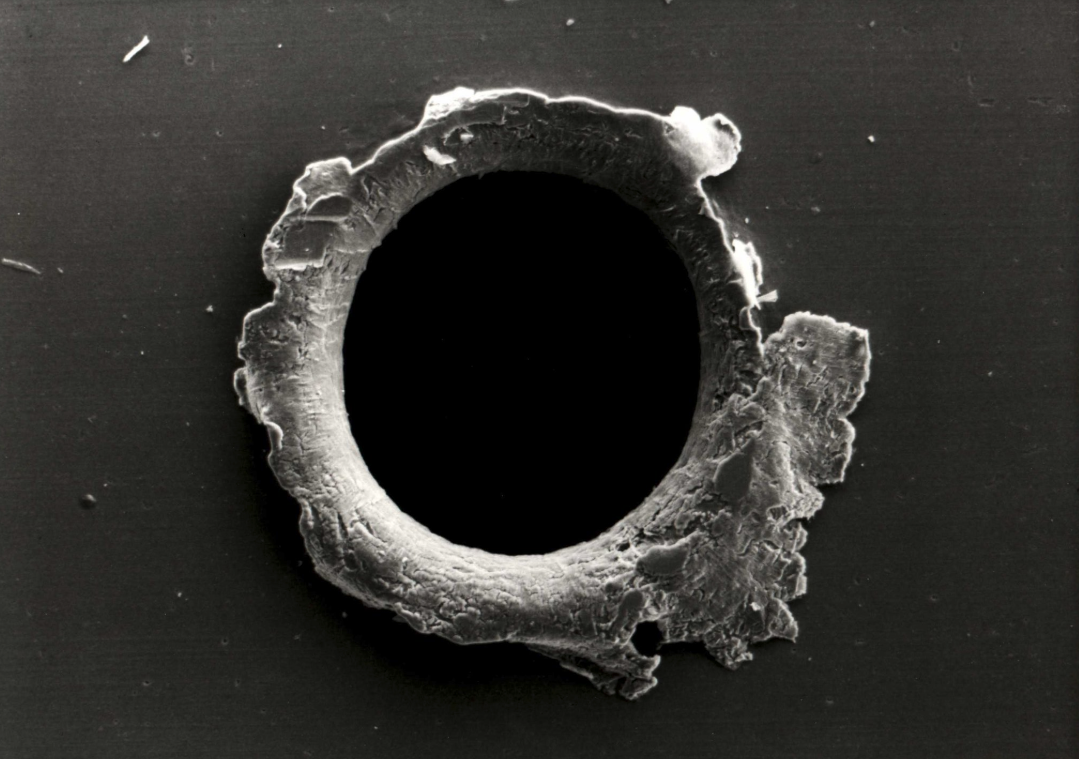
Now imagine what would happen if a chip were to fall into a manned spacecraft or orbital station. There have been a number of debris impact marks on the shuttle surface and the ISS hull. In 1983, a small grain of sand (less than 1 millimeter in diameter) left a serious crack on the windshield of the Challenger shuttle. In another case, the garbage punched through the radiator panel of the shuttle Endeavour. In recent years, debris evasion maneuvers have become a common routine for ISS crews.
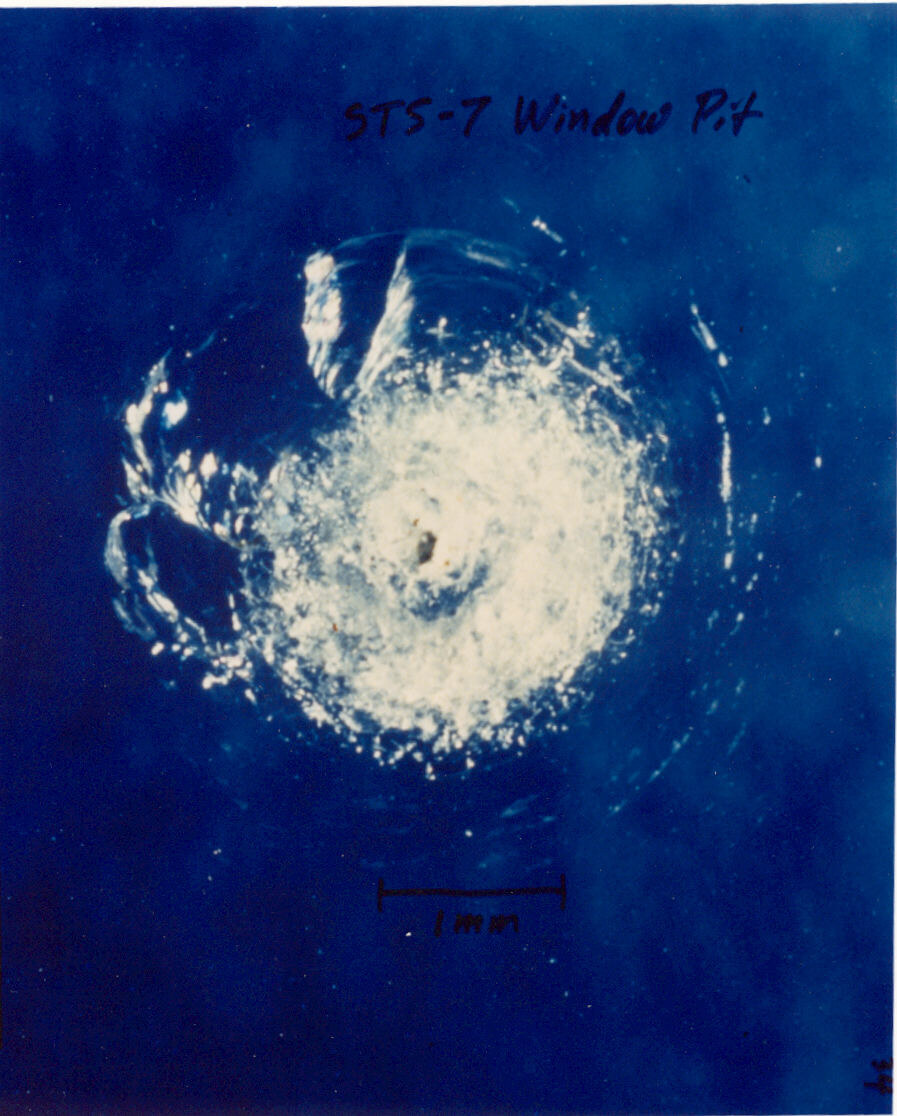
Now imagine what would happen if a chip were to fall into a manned spacecraft or orbital station. There have been a number of debris impact marks on the shuttle surface and the ISS hull. In 1983, a small grain of sand (less than 1 millimeter in diameter) left a serious crack on the windshield of the Challenger shuttle. In another case, the garbage punched through the radiator panel of the shuttle Endeavour. In recent years, debris evasion maneuvers have become a common routine for ISS crews.
There are also radioactive objects among the space debris. In due time, the USSR launched into space a large series of US-A marine reconnaissance satellites. Each spacecraft was equipped with a nuclear reactor with 30 kilograms of enriched uranium-235. A total of 33 apparatuses were launched, several of which have already "returned" to Earth. One of them, Cosmos-954, fell on Canadian territory in 1978. The satellite debris caused radioactive contamination (fortunately, sparsely populated), leading to a major international scandal. The rest of the vehicles have been relocated to a burial orbit of 700-1,000 kilometers in height, where they are expected to remain for 250 to 2,000 years. It is not a long time, but there will come a time when our descendants will have to decide something.
It is also known that the cooling systems of some satellites have given rise to leaks, which caused thousands of drops of the sodium-potassium cooler to enter the orbit, which now also rotates around the Earth. Unlike satellite reactors, they are not dangerous for the planet, but they can damage spacecraft.
The through-hole in the radiator panel of the shuttle Endeavour left after a collision with a piece of garbage.
The Kessler effect
The Kessler effect is a frightening scenario in which a collision of two large objects will result in a mass of new fragments. Each of these fragments can, in turn, collide with other debris, which will cause a chain reaction. If there are many affected satellites, avalanche-like fragments can make the near-Earth space completely unsuitable for the flight for several hundred years. Such a scenario was described by NASA specialist Donald Kessler.
It is known that in 2012 the connection with the eight-ton Envisat satellite was lost. It is in orbit, the height of which is 785 kilometers, and will exist there for about 150 years. Every year Envisat flies twice at a distance of 200 meters from several debris - and the chances are good that sooner or later their paths will intersect Many experts believe that such a collision will trigger a chain reaction, and then the Kessler scenario may become a reality.
Space cleaners
The fact that the orbit needs to be cleaned up is already being acknowledged by everyone. Even if mankind stops all space launches, the amount of debris in orbit will still grow due to collisions between already launched spacecraft. The only way out is to clean up after yourself.
So far it is possible only in fantasy. In Arthur Clarke's novel "Paradise Fountains", the construction of a grandiose space elevator required mankind to thoroughly clean the orbit. Because people have made great strides in space exploration, it does not become a big problem - with the help of lasers engineers quickly remove obstacles. In the process of cleaning, scavengers even make several archaeological discoveries and find an old spaceship.
Objects in low orbits (up to 400 kilometers) burn in the atmosphere in a few years. And if all the garbage was there, there wouldn't be a problem - the nature itself would clean up after us. But the problem is that most of the garbage is much higher. Fragments can hang there for centuries, millennia, and millions of years in geostationary orbit.
Various space debris organizations have been established under both spacefaring governments and at the international level, but their work has made little progress. Currently, the UN Committee on the Peaceful Uses of Outer Space is dealing with the issue of debris, as well as the Coordinating Committee on Space Debris established by several national space agencies.
Various methods of combating orbital contamination are being considered. Some are proposing to strengthen the protection of spacecraft against small particle impacts, others are proposing to control launches more closely, while others are proposing to lay additional fuel on satellites so that they can be deorbited. These measures can slow down the clogging of space or save ships, but still, do not solve problems. The only way to deal with space debris is to remove debris from orbit.