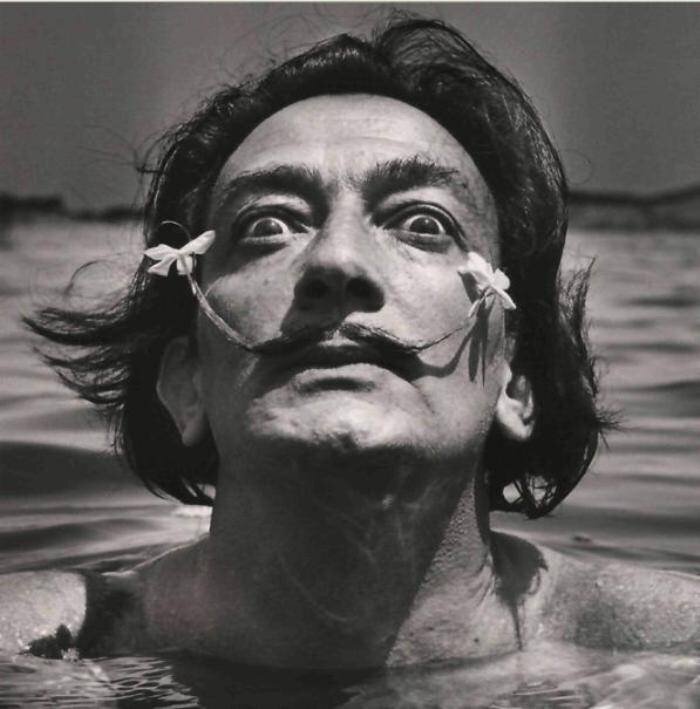
Isaac Newton, Friedrich Nietzsche, Vincent Van Gogh, Nikolai Gogol, Innokenty Smoktunowski... What do these people have in common? As you have noticed, the title of the article is devoted to mental illness - schizophrenia. Geniuses are always close to madness. And also - to the infinity of thinking, which is confirmed by a peculiar attitude to the world around us, a special vision and creativity. Not every schizophrenic is a genius, almost every genius is a little crazy.
Genius and schizophrenia
Vincent Van Gogh is a famous schizophrenic artist.
Why is it that creativity that goes beyond everyday life borders so much on madness? The great Spanish painter Salvador Dali said: "Great psychologists and they could not understand where the genius ends and begins madness. And both are difficult to analyze, and in both cases, the reasons remain a mystery until now.
Why does it still depend on the possibility to create new and extraordinary works of art, to build hypotheses, to make discoveries?
Scientists from Harvard University have recently conducted a curious study on this subject. Having chosen 163 subjects, neurobiologists offered them to pass a test for divergent thinking. Asked to solve the same problem in several different ways. The subjects were given ordinary objects with a request to invent an unusual format of use for them.
During the tests, MRI-scanning was carried out, which revealed that during the tests the following parts of the brain showed the greatest activity: the left anterior islet lobe, which is responsible for perception and self-consciousness; the right dorsal-lateral prefrontal cortex (its functions - self-control, selection of optimal thoughts); and the cortex of the posterior cingulate cortex, which is responsible for switching attention.
Genius and insanity - Friedrich Nietzsche
The German philosopher Friedrich Nietzsche, the author of the idea of a superman, was diagnosed with "nuclear mosaic schizophrenia". One of its manifestations is the delusions of greatness.
Scientists have concluded that creative thinking has one feature - these three brain areas can not function simultaneously. That is, when analyzing ideas and evaluating the situation, another area can no longer be responsible for the reproduction of something new.
This feature can be explained, sometimes, by the antisocial behavior of gifted people who make a discovery or finish a work on which they have been working for a long time. The mechanism responsible for self-supervision in this case turns off and, probably, that is why such persons are often unconstrained in expressing their emotions. Remember when Archimedes jumped out of the bathroom, discovering the law of hydrostatics, he ran out naked and shouted: "Eureka!
Is it possible for a person with a mental disorder to control himself at such moments and to coexist peacefully with society in general?
If Sergei Esenin's manic-depressive psychosis did not give him such an opportunity, the poet committed suicide, then Nobel Prize winner John Nash found a way to teach, lecture and write scientific articles. He succeeded in this when he learned to separate the grain from the chaff, i.e. to separate delusional ideas and reality and the first to ignore them.
John Nash
John Nash is an American mathematician, Nobel Prize winner. He had schizophrenia. On the basis of his biography he made an Oscar-winning film "Mind Games".
His focus on detail is another indirect sign of genius. According to one study, the higher the subject's IQ, the more attention he pays to detail. That's why the term "absent-minded professor" is familiar to everyone.
One day, Albert Einstein met his friend and invited him to visit: "Come and see me tonight, I'll have Professor Stimson. To which his friend replied puzzledly: "But I am Stimson! Einstein replied: "It doesn't matter, come anyway!
In any case, our psychic features are often those differences that give us the opportunity to express our unique individuality, even if it is expressed in non-standard behavior.
Alexei Geger, Development Director of the St. Petersburg Regional Branch of the All-Russian Public Organization for the Disabled "New Opportunities", PhD in Sociology: "Yes, indeed, many talented people suffered from Bipolar Affective Disorder, or as it was called Maniacally Depressive Psychosis (MDD). Thus, for actors, it is a constant training of acting skills in life itself. In the case of BAR, a person can move from a state of unrestrained fun to the deepest yearning up to several times a day. That is why such people, having, of course, acting skills is not a big deal to play these transformations in the frame or on stage. Arriving in such a constant unstable state, such people often resort to alcohol or even drugs to regulate their mood. How can you not remember the geniuses of Oleg Dahl or Vladimir Vysotsky?
John Nash
Nikolai Gogol. The famous writer suffered from typical manifestations of schizophrenia: frequent mood changes, apathy and psychosis, claustrophobia, hallucinations.
The brain functions quite differently, and the daily routine changes upside down. Such people create at night, and during the day they either sleep or are in unrestrained yearning. The lines from Aleksandr Vasiliev, the leader of the Spleen group, immediately come to mind: "I live at night, and I want to die during the day.
Indeed, the brain works differently, there is no stability. It is possible that from here comes the stable opinion that creativity ends when a person "calms down". And what does it mean to "calm down"? It means stability - stable work, stable family - on the one hand. On the other hand, it is the stable work of the brain, the brain no longer "twists out", there are no more steep drops from delight to wild sadness, up to suicidal thoughts, and creativity gradually fades away" - said the specialist.