Information about Jupiter
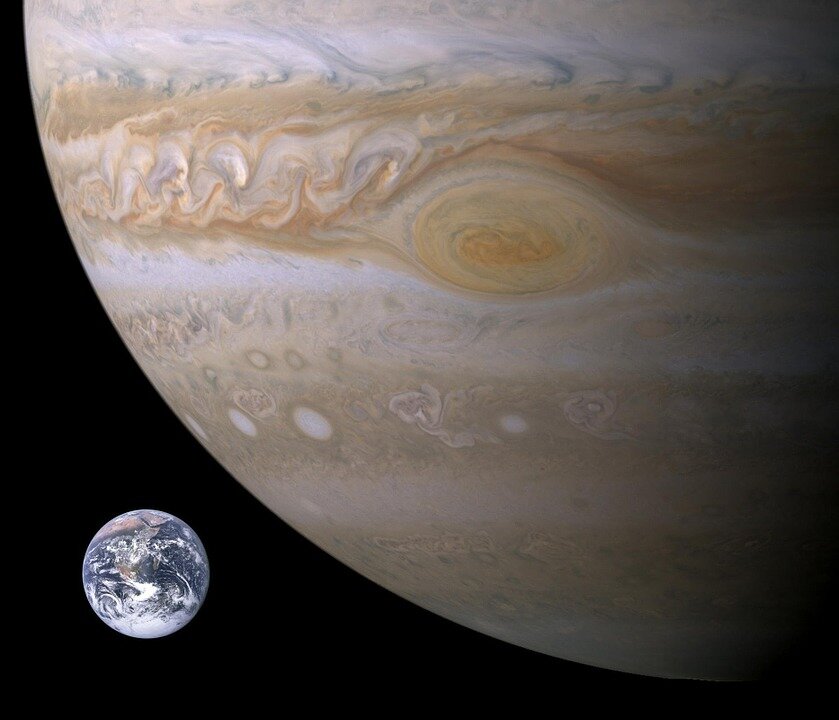
Its diameter is 11.2 times the diameter of the Earth, its volume is 1300 times larger and its mass is 317.8 times larger. The circulation period around the Sun is slightly less than 12 Earth years. Jupiter is a gas giant without a solid surface, its atmosphere consists of 90% hydrogen and 10% helium. Its core, the size of the Earth and constituting about 4% of the total volume of the planet, is solid.
The rotation period around the axis is the shortest among the planets of the solar system and is just under 10 hours. Because of the high speed of rotation, the gas giant will be flattened at the poles. Jupiter does not rotate as a solid body, the speed of rotation at different latitudes is different: at the equator, it is more, as the approach to the poles decreases. The plane of the equator of a planet is inclined to an orbital plane on 3 degrees, therefore a change of seasons is not present. For today 79 satellites of a planet and system of rings are opened. Jupiter was formed from the same gas nebula as the Sun, but for the launch of the thermonuclear reaction he does not have enough mass - it must be 75 - 80 times more. Therefore, the planet is sometimes called a "failed star".
When to observe
The most favorable time for Jupiter's observations is the moment of confrontation (the shortest distance from the planet to the Earth). It occurs every year and shifts about a month ahead of the past. During summer confrontations, Jupiter rises low above the horizon line (no higher than 30 degrees for Russian latitudes). It is more convenient to observe during winter confrontations when it rises high above the horizon and is visible all night long. In winter you can see the full rotation of the planet around the axis.
What you can see on Jupiter
Jupiter's atmosphere is unstable, with powerful whirlwinds raging in it, so the planet's appearance is constantly changing. But it is possible to single out regularities and stable formations in the structure of the atmosphere.
The upper clouds of Jupiter are stretched out in strips parallel to the equator. Bright bands are called zones, dark bands are called belts.
Slightly above and below the equator are visible, respectively, the Northern and Southern equatorial belts. The North and South temperate zones are located closer to the poles. Between the equatorial and temperate zones, the Northern and Southern tropical zones are visible, respectively. Dark polar caps are visible at the poles.
The Great Red Spot is a giant atmospheric vortex. It is located in the Southern Tropical Zone, has an oval shape and a bright pink color, contrasting on the disc.There are three white spots in the Southern temperate zone, which are accumulations of liquid gas. From - it is difficult to see them because of their white color.
Satellites, eclipses, and coverage
Next to Jupiter's disc, you can see four satellites that Galileo discovered. In order of distance from the planet, this: Io, Europe, Ganymede (the largest) and Callisto. The speed of their rotation around Jupiter is quite high, and after half an hour of observation, their location changes noticeably.One can observe the shadows from the satellites passing through the planet's disk and see that the shadows of the two nearest satellites have sharper outlines, and the two farther satellites cast shadows with less clear, blurred borders.
The telescope shows eclipses - the entry of satellites into the shadows of the planet, and coverings - when satellites go behind its disk. It is more difficult to observe the passage of satellites along Jupiter's disk, as they are not very prominent on the bright disk.
Observation equipment
Binoculars with magnification starting from 7 times will allow seeing a tiny disk of Jupiter, bigger magnification will give the chance to see Galilee satellites, but for observations, it is necessary to use a telescope.For observations of planets, including Jupiter, telescopes - refractors with an aperture (diameter of a collecting lens or a main mirror) from 120 to 150 millimeters are usually used.
Already in 60 - millimeter telescope it is possible to see stripes on Jupiter, and in 80 - millimeter to discern smaller details: light and dark spots, recesses in edges of stripes and ledges, cross-sectional connecting "bridges" between stripes and their branches, a red stain and shades of satellites on a disk of a planet.
150 - the millimeter telescope will give the chance to see smaller details and a difference in the sizes of shadows of satellites. The greatest quantity of details it is possible to observe in 300 - a millimetric telescope, but at a bigger diameter of a lens, the image will begin to "blur" from - for movements of terrestrial atmosphere.
To improve contrast and highlight some of the details from the background use filters. For example, the image of the Red Spot and belts with red-brown color improves the blue and blue filters, and red will highlight the details that have a blue color. You can experiment with the filters, achieving a more distinct image of the details.