Almost 3/4 centuries people did not suspect that not all asteroids move between the orbits of Mars and Jupiter. But in the early morning of June 14, 1873, James Watson opened the asteroid "Aerta" at the Ann Arbor Observatory (USA). This object was tracked for only three weeks, and then it was lost. However, the results of determining the orbit, although inaccurate, convincingly showed that Aerta is moving inside the orbit of Mars.
Asteroids, which would have been approaching the Earth"s orbit, remained unknown until the end of the XIX century. Now their number exceeds 80. The first asteroid near the Earth was discovered only on August 13, 1898. The high speed testified to its extraordinary proximity to the Earth, and the weak shine of a close object - the exceptionally small size. It was Eros, the first baby asteroid with a cross-section of less than 25 km. In the year of its opening, it was held at a distance of 22 million km from the Earth. Its orbit was not similar to any of them so far known ones.
Then Albert, Alinda, Gannimed, Ivar, and Amur asteroids were discovered, which were very close to the Earth by astronomical standards.
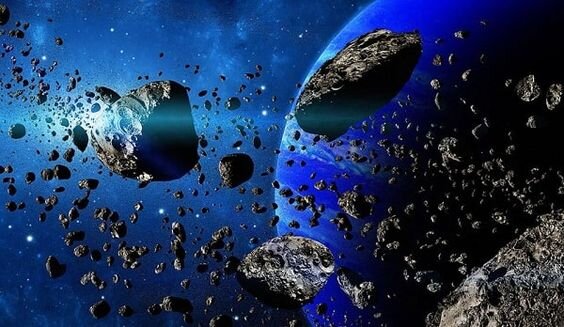
- Asteroid movement
All the asteroids that have been discovered so far have a direct movement: they move around the Sun in the same direction as the big planets. In the vast majority of asteroids orbit is not very different from each other: they are slightly eccentric and have a small or moderate slope. Therefore, almost all asteroids move within the toroidal ring. The boundaries of the ring are somewhat arbitrary: the spatial density of asteroids (the number of asteroids per unit volume) drops with distance from the central part. Few asteroids, because of the significant eccentricity and inclination of the orbit of the loop, go beyond this area or even lie entirely outside it. Therefore, asteroids are also found far away outside the ring.
The volume of space occupied by the ring-torus, where 98% of all asteroids move, is huge - about 1. 61026 km3. For comparison, the volume of the Earth is only 1012 km3. If to be strict, it is necessary to tell that the way of an asteroid in space represents not ellipses, and the open quasielliptic turns stacked near each other. Only occasionally - when approaching the planet - the turns noticeably deviate from each other. Of course, the planets resent not only the movement of asteroids but also each other. However, the perturbations experienced by the planets themselves are small and do not change the structures of the solar system. They cannot cause the planets to collide with each other. This is not the case with asteroids. Asteroids deviate from their path in one direction or the other. The further away, the more these deviations become: because the planets are constantly "pulling" the asteroid, each one to himself, but stronger than all of Jupiter. The observations of asteroids cover still too small intervals of time to be detected.
The asteroid orbits of the majority of asteroids should be significantly altered, except in some rare cases. Therefore, our ideas about the evolution of their orbits are based on theoretical considerations. In short, they are reduced to the following. The orbit of each asteroid oscillates near its average position, taking several tens or hundreds of years for each oscillation. Synchronously change with a small amplitude of its half-axis, eccentricity, and inclination. Perigee and swindle are either approaching the Sun or moving away from it.
These oscillations are included as a component of the oscillations of a longer period - thousands or tens of thousands of years. They have a slightly different character. The large axle axis does not experience any additional changes. But the amplitudes of eccentricity and inclination can be much greater. At such scales of time, it is possible not to consider instant positions of planets on orbits any more: as in the accelerated film, an asteroid and a planet appear as though smeared on the orbits. It becomes expedient to consider them as gravitating rings. The inclination of the asteroid ring to the plane of the ecliptic, where there are planetary rings - a source of disturbing forces - leads to the fact that the asteroid ring behaves like a wolf. Only the picture is more complex because the asteroid"s orbit is not rigid and its shape changes over time. Planetary disturbances lead to the continuous mixing of asteroid orbits, and thus to the mixing of moving objects. This makes it possible for asteroids to collide with each other with a friend. In the past 4. 5 billion years, since the asteroids have existed, they have experienced many collisions with each other.
The inclinations and eccentricities of the orbits lead to the non-parallelism of their mutual movements, and the speed at which asteroids pass each other is on average about 5 km/s. Collisions with such velocities lead to the destruction of bodies.