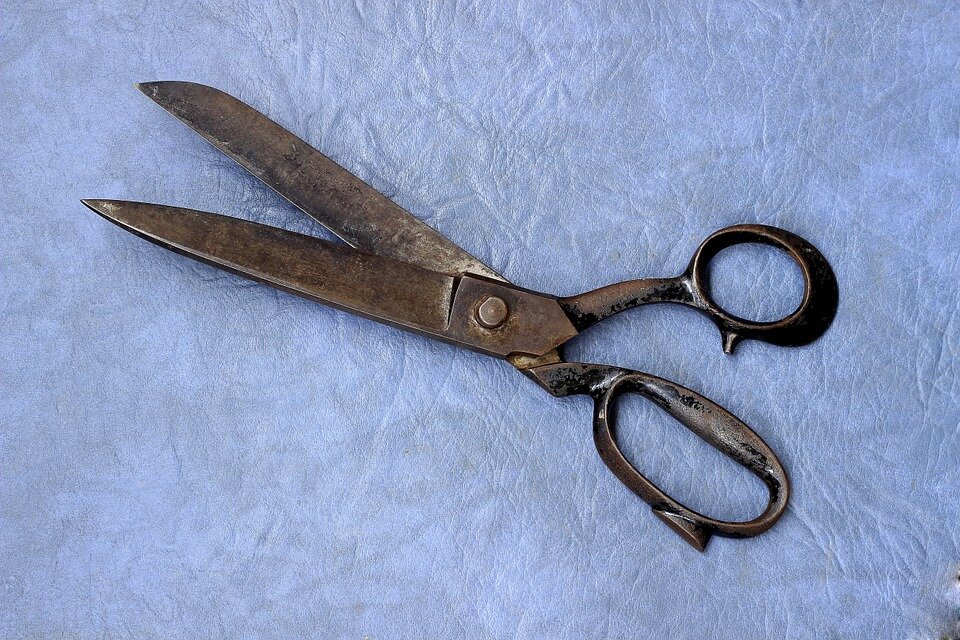
The very first scissors appeared in a man not because he had to serve himself somehow, but because he had to cut the sheep somehow. It happened three and a half thousand years ago when the scissors were two blades connected like tweezers.
This invention, though functioning, was not especially successful (in fact, the blades of "sheep's" scissors, which appeared for the first time in Ancient Rome, did not turn relative to the center, but just squeezed the hand as a big grab for a piece of cake), and therefore our great-grandfathers used it only before the "insulation woolen season", and the fingernails, it seems, for convenience, just chewed. But even though the design was very uncomfortable - it existed for more than two thousand years without any fundamental changes.
Approximately 8th century AD in the Middle East, some craftsmen came to mind to connect two knives with the help of carnations and bend their handles with rings. Then the handles of the scissors were decorated with artistic forging and "autographs" of the blacksmiths - with stamps. Perhaps in those days, there was a simple children's riddle: "Two rings, two ends, and in the middle of a carnation"...
The scissors came to Europe a little later, around the 10th century. The oldest scissors found in Russia belong to the same period. This happened during archeological excavations of the Gnezdov barrows 12 kilometers from Smolensk near the village of Gnezdovo.
Unfortunately, history has not preserved the name of the man who invented the idea of combining two disparate blades with carnations and bending the handles into a ring. After all, it is in this form that paper clippers, manicure clippers, clippers, and many other purposes are presented today.
The completed form of the instrument was given by none other than Leonardo da Vinci. In his manuscripts, he found a drawing of an instrument similar to a modern pair of scissors.
And then, as always, the invention began to live its own life: sometimes it was improved (becoming the working tools of hairdressers and doctors), and sometimes becoming a luxury item of gold and silver.They made scissors made of steel and iron (steel blades were welded on an iron base), silver, covered with gilt, and decorated richly. Fantasy of masters-manufacturers had no limits - sometimes there was a strange bird, whose beak cut the fabric, then rings for fingers wrapped grapevines with grapevine tassels, then suddenly there were no scissors, and a fairy-tale dragon, all in such intricate ornaments that they interfered with the use of this functional device.
Gradually more and more in the eastern and western worlds, there is a closer interest in the form and quality of scissors. Models with thin, smooth outlines, blades decorated with engraving and inlays begin to appear. The art of calligraphy, which has spread throughout the Islamic world, has especially contributed to this.
The scissors are becoming more attractive from an aesthetic point of view. They received various forms within the framework of the general idea, were decorated with openwork carving. At the same time, they remained functional and brought a bit of aesthetics into routine.In the Middle Ages, scissors became evidence of men's attention to the beautiful floor.So, in the fourteenth century, a fan who sent a gift to his lady, often put in it a pair of scissors in a leather case. It is in this century that the scissors become a truly female accessory, as they are, with rare exceptions, and remain to this day.And then the ideal prim Englishmen invented scissors for perfect prim English lawns, and then the French began to cut up geese carcasses with them (witch crafting over their famous "frua-gra") and cut the loops in the "prêt-a-port", and then the Germans invented giant steel scissors to help with accidents on the roads (this device can also break the glass in the car, open the jammed door, cut off the seat belts).
And then the person began to think more broadly and made scissors made of special ceramics, which were three times stronger than steel and more wear-resistant, and cut much thinner.
And then came up with scissors, which are completely no longer similar to their analogue of the progenitor and rather began to resemble a knife from a mincer (a disk with three teeth is planted on an ordinary electric drill - it is possible to cut rubber, thick leather, linoleum, and plastics at a rate of 20 meters per minute).And then the inventor broke through "to the stars" and designed the most modern scissors, adding to them the electronic machine that reproduces on the screen of clothing cuttings of any style invented by fashion designers. Cutting speed is one meter per second! And at this operation edges of a fabric burn out and do not blossom - as though are already cut down.
Today, the Industrial Revolution has returned the scissors to their original status of an exclusively functional object. The jewelry has gone completely unnoticed, and it has been abandoned in favor of the straightforward clarity of steel. Today, scissors have been created for everyone and everything. They are as irreplaceable as they were centuries ago. How simple it is genius!