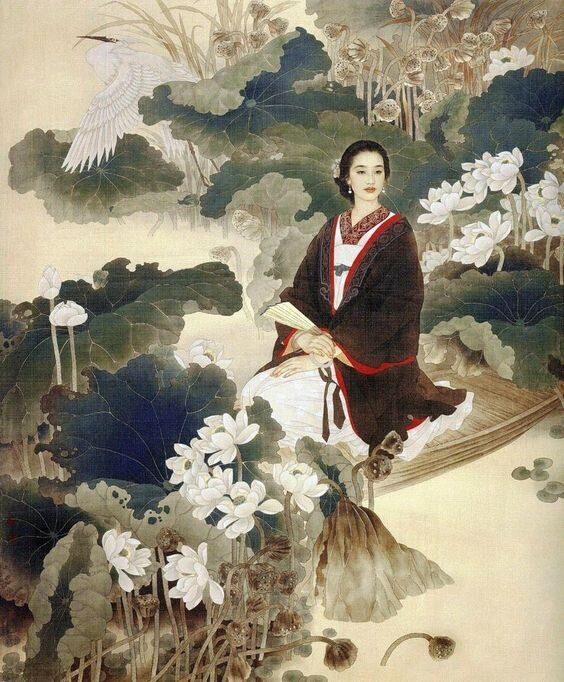
Yuan Dynasty
Created in the Yuan Dynasty, "Lugou Yunyun map." Depicting the scene of the construction of the Metropolitan Palace by the Xishan Stone in the vicinity of Lugou Bridge in Yuanshizu to Zhengzheng (1266)
The Yuan Dynasty has not been more than a hundred years old, but it has played a pivotal role in the development of Chinese painting. In terms of landscape painting, because the Mongolian court despised the Han people, many of them were depreciated.
The Han intellectuals were reluctant to leave the country, and they avoided the mountains and forests and interacted with friends and friends. Many of them exchanged ideas with calligraphy and painting. At this time, the painting was separated from the court atmosphere, and the literati painting gained outstanding development. Literati paintings draw more landscapes, flowers, and birds, so as to express "sexuality" and personal ambition.
The painter's morale is advocating, advocating the algae, paying attention to the taste of the pen and ink, distracting the shape, emphasizing the charm, and opening the literati conditions that attach importance to poetry and book cultivation. Such painters are represented by “Yuan Sijia” (Huang Gongwang, Wu Zhen, Ni Wei, Wang Meng) and opened the mainstream of Chinese landscape painting later.
The painters who entered the Yuan Dynasty also had an important influence on Chinese painting. For example, Zhao Mengfu, who was later married in Zhao Song, Gao Kong, who is a guest of the Shangshu, and such as Zhu Derun, Ke Jiu Si, Ren Renfa, Tang Yu and so on. Zhao Mengfu advocates retro, advocates green and color and quaint landscape composition. Because Taoist art was quite active in the Yuan Dynasty, many murals and export paintings were circulated. The Yongle Palace murals is a masterpiece of such paintings.
The Yuan Dynasty was a period in which Jingdezhen was truly famous. The most famous porcelains were blue and white porcelain and glazed red. At this time, the export of porcelain was extremely smooth, so some studies have suggested that the pattern of blue and white is a request of Islamic customers. The celadon of Longquan Kiln is also very famous. It is exported to Japan and the Korean Peninsula. It is also exported to Southeast Asia.
Qing Dynasty
The jade gold cans made in the Qing Dynasty were made during the Qianlong period. In the Qing Dynasty, the tradition of the Wu School was honored since the late Ming Dynasty. The so-called Four Kings appeared, calling it the style of the “Orthodox Painting School”. However, there has been a brand-new style of painting in the folk, and the composition is bold, and it is not known.
It was best known to the Eight Great Mountain People and Shi Tao. In the middle of the Qing Dynasty, the Jiangnan area was rich, and there were literati painters who lived in paintings in Yangzhou. The paintings and paintings were unconventional and novel, and later scholars called the eight important ones Yangzhou Eight.
The Qing Dynasty was also a period in which Western painting gradually entered. The most famous one was Lang Shining, who served in the court during the Qianlong period. However, this western trend did not affect people. However, in Guangzhou, China's only foreign port, there was a painter who painted paintings for European businessmen.
This is the beginning of Western paintings entering the Chinese folk. In the late Qing Dynasty, Shanghai was established as a trading port. Due to its geographical location, it became an important port and also promoted the demand and development of oil painting. Chinese painters gradually learned Western painting methods such as perspective and used imported pigments to paint and influence the style of traditional painting.
In the late Qing Dynasty, Shanghai replaced Yangzhou as a commercial center, and the group of professional painters also moved from Yangzhou to Shanghai. The Shanghai-style appeared, which is the last vein of Chinese traditional painting. At the beginning of the Republic, Gao Jian's father and brother absorbed the Western style of Japanese painting and created the Lingnan School of Painting. Both represent a new style of Chinese and Western art and have made a useful attempt for the development of Chinese painting.
After the Revolution of 1911, Chinese society has undergone dramatic changes, and traditional Chinese art has developed with the sudden changes of the times.
To be continued https://zen.yandex.ru/profile/editor/id/5d70bb0e1e8e3f00ae96cd71/5d92b679a660d700ae0151d8/edit