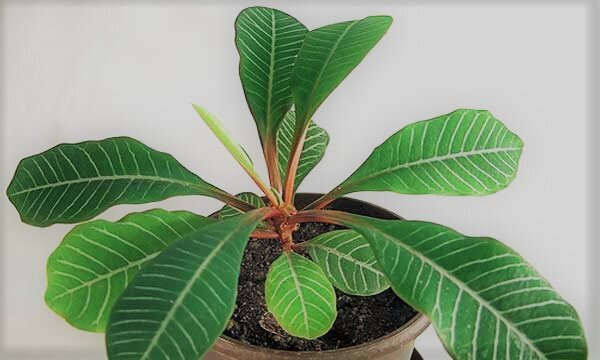
Euphorbia flower has nothing to do with tea, moreover, it is completely undesirable to eat it, because this plant is used for medicinal purposes. Its name comes from the word "milk", since the stems and leaves of the flower contain milky juice. The composition of this milk includes rubber, resin, gum, mineral salts, flavonoids.
The habitat of euphorbiae covers almost the entire planet! However, these heat-loving plants can not be found in cold areas. They prefer warm and even hot, but mostly dry climatic zones of our Earth. In the tropics, these succulents drop in much less often. But at home they feel great, because hot and dry air is their environment!
The euphorbia family is probably the largest, according to various sources, it includes from 800 to 2000 varieties, including poinsetia (the most beautiful euphorbia)! Some species can be attributed to deciduous, others to succulents. At the same time, many varieties, especially those growing in Africa and the Canary Islands, are listed in the Red Book as disappearing. Now consider the most common!
White-eared Euphorbia was nicknamed for its white veins that stretch along the leaves. Leaves are usually located on the crown of the head, making the flower look like a palm tree. It grows actively, and propagated by seeds. At the same time, ripening, seeds shoot in different directions, providing abundant self-seeding.
Euphorbia mile, or miles - is another popular variety of milkweed indoor. Peduncles are formed on the tops of the stems and are most often red, sometimes white and orange, less often yellow. However, this handsome man is not as harmless as it seems! Its leafy dense stem is studded with large thorns, for which the flower received the nickname "crown of thorns."
Euphorbia triangular - the highest of domestic representatives. It grows up to 15 meters in nature, and in room conditions it can gradually rest against the ceiling with its crown. Its long ribbed stems are dotted with small leaf blades; in appearance it looks like a giant cactus!
One of the most unusual representatives of euphorbia is the appearance of the head of a jellyfish. He received such an ominous nickname for resembling the head of the Gorgon jellyfish. Its numerous fleshy stems studded with thorns and really, resemble snakes. This look looks great in hanging flower pots.
Care Rules
Oddly enough, with such an abundance of species, domestic euphorbia has similar cultivation features for all.
Temperature and lighting
All types of euphorbia prefer bright light, in the shade they develop poorly, grow slowly, and variegated forms lose their color.
Some varieties of the flower, especially cactus, easily tolerate direct sunlight. Leafy forms are best kept in some shade during midday hot hours.
Euphorbia at home is quite hardy, including temperature extremes. The most comfortable temperature for him will be 20-25 degrees, the lower limit can be within 10 degrees above zero. However, it is undesirable to leave a flower in a cold place for a long time, yet it is thermophilic! In summer, he will feel great on the balcony.
Watering and humidity
Since euphorbia is a succulent plant, watering it is often not recommended. The optimal watering regime is after drying of the topsoil. In this case, underfilling is better than pouring! After all, excess water will make the plant weak and eventually cause decay.
By air humidity euphorbia room unpretentious! Therefore, at home, this succulent does not need spraying. However, this procedure will not be worse! Sometimes it’s worth pampering your pet by wiping its leaves from accumulated dust (if you are the owner of a deciduous species).
Fertilizers and fertilizing
Top dressing promotes foliage growth and supports flowering. Fertilize better less and less. Excess mineral salts in the soil will be harmful to the plant! Top dressing can be done in the spring and summer, when growth is most intense.
It is not advisable to fertilize in winter, and in spring fertilizer should be added carefully, starting with the minimum dosage (boldly divide the dosage indicated in the instructions by 5). The frequency of feeding is once a month in the spring and 2 times a month in the summer. For more succulent species, fertilizers for cacti and succulents are suitable, and for leafy species, universal complex dressings can also be used.
Reproduction and transplantation
Some flowering species of milkweed at home reproduce by seed. These primarily include the white-chested species, which, shooting seeds, can be in neighboring pots! Cactus-shaped forms are easier to propagate by daughter processes. Also, leafy species are better suited for propagation by cuttings - accessory stems.
Before rooting the cuttings of milkweed in the soil, you need to rinse the slice from the milky juice. After that, you can pollinate the slice with root and glue it slightly in wet sand, or peat substrate. It is necessary to maintain moderate humidity, there should be no dampness, otherwise the stalk will decay! In the light, he will quickly give roots and will be ready to transplant to a permanent place. Seeds are collected and planted under a film in a moist earth mixture, or sand. A container with seeds, like cuttings, is best placed on a light windowsill.
Euphorbia transplant home needs as it grows! Plant in a large pot "with a margin" is not worth it, because excess soil can lead to decay. To the shape of the pot euphorbia room does not have special requirements.
Milk jugs fit a mixture of garden soil and sand in a ratio of 1: 1. The soil for the flower should be loose, drained and breathable! Instead of sand, vermiculite or perlite may be contained in the soil. The soil for cacti and succulents is often too dry, it is better to dilute such a substrate with more saturated purchased mixtures based on lowland peat.