Taking into account the positive dynamics of growth of social and cultural values of the population, nowadays the problem of preservation and transformation of historical and cultural heritage of large cities becomes the most urgent. Today the man faces a difficult task on simultaneous preservation of historical and cultural values of the city and creation of favorable conditions for life, which would meet the modern requirements of the society.
The definition of the concept of "cultural landscape" is rather complicated. This term first appeared in the Guidelines for the Implementation of the World Heritage Convention in 1992. According to the Guidelines, cultural landscapes are joint works of man and nature and "illustrate the evolution of human communities and settlements over the centuries under the influence of unfavorable and/or favourable physical factors of the natural environment, as well as successive social, economic and cultural factors, and external and internal".
In modern geographical science, cultural landscape is understood as a landscape resulting from purposeful and transformative human activities aimed at meeting practical and spiritual needs.
At the current stage of development of the urban environment, the reorganization of industrial zones in Moscow is a priority direction of urban planning. Occupying one of the key places in the general planning structure of the city, the territories of industrial zones have a high potential of town-planning development. However, often the existing condition of the area and construction of industrial zones do not meet modern urban planning and environmental requirements. As a consequence, large areas are idle, used inefficiently, not landscaped and not landscaped.
It is worth considering the most interesting examples of transformation of Moscow industrial zones into cultural landscapes. For example, a unique park on the territory of the former factory was designed by the Dutch and American architect Jerry Van Eyck. The landscape park appeared on the site of the former ZIL plant in the process of redevelopment of the territory, which also includes the construction of the residential area "ZILART".
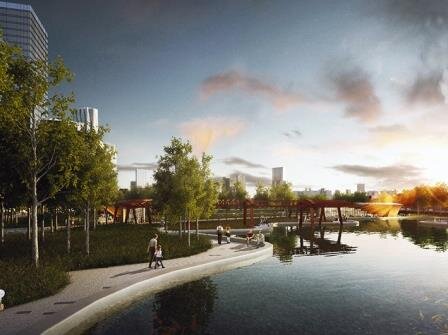
The area of the new park is about 10 hectares. The architectural center of the park is a 1.3 km long pergola (awning), which is also a gazebo, observation deck and walking area. The entire shopping and entertainment infrastructure of the park is planned to be located in 12 pavilions inside this art object. Another feature of this area is a pond with crystal clear water, with a total area of more than 3000 m2 and a five-stage water treatment system. In the cold season, an ice rink is planned to be built on the site of the reservoir.
Another example of the transformation of industrial areas into a cultural landscape is still a project, the implementation of which is already under way and is planned to be completed by 2021.
One of the oldest industrial zones of Moscow "Sickle and Hammer" has the area of the reorganized territory of almost 58 hectares. Now it is planned to build a modern urban area with housing, social infrastructure, new jobs and even urban attractions. The concept of building up the territory of the plant "Sickle and Hammer" was prepared in the course of an architectural competition. Its materials were presented at the World Architecture Festival 2013 in Singapore.
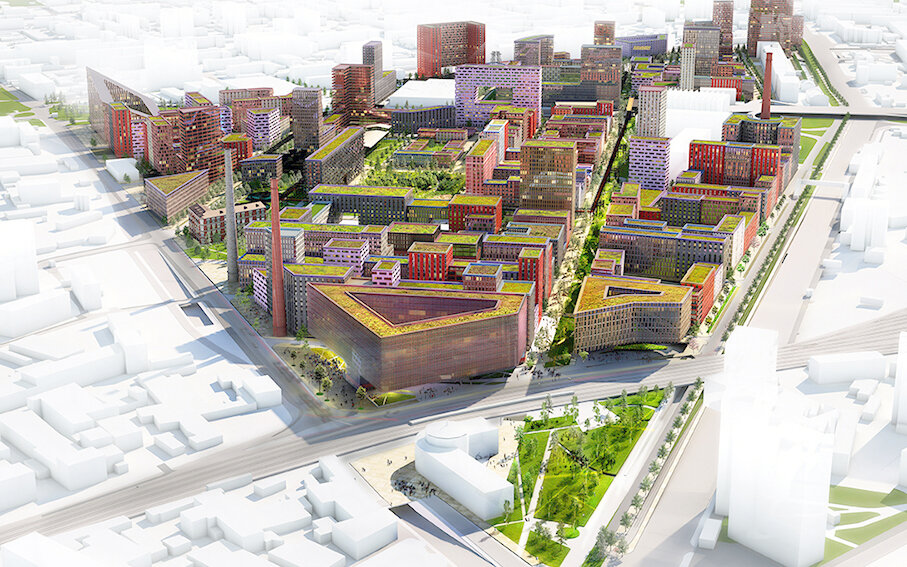
The architects provided unique architectural features of the buildings, took into account the transport and environmental components, and made a huge emphasis on convenience and comfort of people, designing landscaped public spaces, the area of which under the project will be from 30% of the former industrial zone.
In addition to residential real estate "Hammer and Sickle" also involves the construction of schools, kindergartens, clinics, numerous parking lots, offices and other commercial facilities. There will be a media center (172 thousand m2) and a House of Culture and Music, which will be opened on the basis of the former industrial building, which is also waiting for renovation. It will become a "highlight" not only of the new district, but of the whole city: the project will prepare one of the world's leading offices in the field of construction of concert halls "Benthem Crowell" from the Netherlands.
The historical and cultural heritage accumulated by our country is an important component of the foundation of the spiritual development of generations. Therefore, in the conditions of fast-growing cities and rapid development of the latest technologies, it is important not to lose and preserve what is left of our ancestors. Renovation of former industrial zones is a rational and effective method of preserving and transforming the territories of Russian cities into cultural and architectural landscapes.
The result of works on the town-planning transformation of industrial areas is the formation of the cultural landscape, that is, the creation of a favorable urban environment, the development of open public spaces and recreational areas, as well as ensuring environmental safety, social attractiveness and economic efficiency of the territories under the program of reorganization of industrial zones of Moscow.