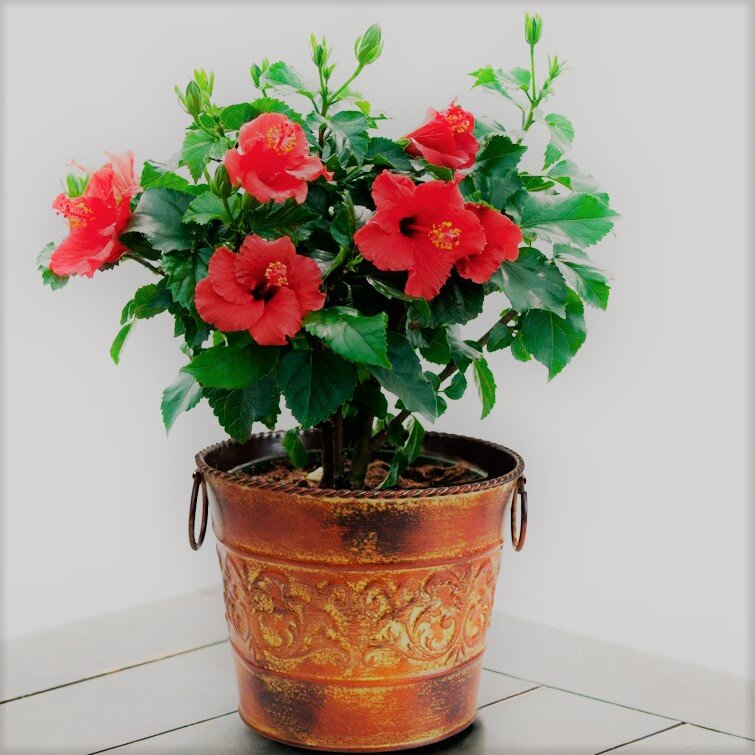
The first information about the plant dates back to Ancient Greece. By the way, the Mediterranean climate is a favorable environment for the Chinese rose! Its habitat covers countries of tropical and subtropical climate. For example, on the streets of Vietnam, or Thailand, the rose feels great! The flower belongs to the family of malvaceae, and its genus includes not only shrubs, but trees and even herbs, totaling up to 500 different species.
In places of primordial growth, its flowers were woven into the hair by local aborigines, perhaps that is why the plant was called the “flower of beautiful women”! Initially, Chinese hibiscus was a tree up to 5 meters high, but for indoor cultivation, breeders bred more miniature varieties. And, although a rose gives you one day to admire its flowers, the flowering period can last for months! Terry flowers will delight you for up to three days.
By the way, the view is not limited only to the Chinese representative. Syrian hibiscus native to Asia Minor is a shrub suitable for growing outdoors. However, only for the southern strip of Russia. Indeed, in the conditions of a short summer, he simply does not have time to bloom! His flowers are often confused with mallow.
There is another species that is sometimes called weed; it is triple hibiscus. The flower up to 80 cm in height has chosen the African continent, and grows on its own in pastures, wastelands. Perhaps that is why he received such an offensive nickname!
Hibiscus dissected - this beautiful view was named "princess earrings". It has the shape of a bell with arched petals resembling the wings of an exotic bird! It is native to Brazil, grows in the coastal strip, or tropical forests, suitable for home gardening.
By the way, the famous Hibiscus tea is not related to the usual indoor rosan! Raw materials for it are cups of Sudanese hibiscus flowers, which after flowering increase in size. Unlike its relatives, this species is distributed mainly in Arab countries, especially in Egypt and Sudan due to climatic preferences.
Care Rules
At home, hibiscus is not picky. Sometimes you can observe gorgeous flowering plants in completely unsuitable conditions! And yet, if you want to achieve a beautiful crown and long flowering, you need to make a little effort.
Temperature and lighting
The only whim of the flower is that it needs light! In summer, it should be diffused sunlight, with shading from direct rays. In winter, when there is a deficit of the sun, it is necessary to provide it with artificial lighting to extend the daylight hours to 10-12 hours.
Chinese hibiscus is able to bloom even in winter, if the room is warm and bright. In the summer, boldly take it out into the air! The flower is not afraid of temperature changes. But when it falls to 12 degrees, it is desirable to return it to the room, under such conditions, the roots cease to absorb moisture.
Watering and humidity
In summer, wide leaves actively evaporate moisture, the higher the temperature, the more active should be watering. However, do not overdo it! It is better to water it less often, but more abundantly, than to supply water often and in a small dose!
In addition, the flower itself signals the need for watering, dropping the leaves. Watering is preferable in the morning, during the day the roots consume water more actively. With decreasing temperature, watering is reduced.
Be sure to spray the Chinese rose, it needs moist air, regardless of the season! Sometimes give the plant a warm shower, after covering the pot with a bag. Hibiscus, care for which is not difficult even for a beginner grower, is a very grateful plant. Subject to minimum conditions, it will certainly bloom! No wonder it is called the "flower of love." During abundant flowering, it is desirable to minimize spraying. Indeed, moisture falling on the flower petals accelerates the process of their withering.
Fertilizers and fertilizing
Experienced florists noticed that excess phosphorus does not affect flowering quality in the best way! Conventional fertilizers for flowering crops contain minerals in the following proportions ≈15-21-25 (nitrogen, phosphorus, potassium). A more successful dosage would be ≈ 10-4-12 (nitrogen, phosphorus, potassium). Therefore, carefully study the composition of the fertilizer!
To prevent chlorosis, Chinese hibiscus can sometimes be fed with magnesium on a sheet (leaf method). The plant responds well to organic fertilizers - mullein and ash. Fertilizing the rose is especially important in the spring and summer, during flowering and the growth of new leaves. By the way, before you “feed” the roots with fertilizer, you must first moisten them with water for irrigation!
Foliar top dressing will be useful - spraying with stimulating drugs, organic, or mineral fertilizers in a reduced concentration (10 times lower than with root top dressing). In winter, if the leaves continue to grow, you can fertilize rosan once a month. With a pronounced dormant period, fertilizers are not used!
Reproduction and transplantation
The cuttings obtained after trimming easily root in water, after which they can be planted in the ground. Some varieties successfully propagated by seed. It is advisable to transplant Chinese hibiscus by transshipment, since its roots are fragile and thin! A transplant is required only if the rose, in your opinion, is tightly in the pot. In too large dishes, the tree gives new leaves, but does not bloom. How to choose a flower pot.
The soil for the plant must be nutritious and moisture-intensive, for this garden soil is mixed with humus, peat and sand in equal proportions. The flower must provide good drainage and air access to the roots. Do not forget to sometimes loosen the ground! The first time after transplanting, it is recommended to water the rose from a tray in order to stimulate root growth.