Fortunately, neither humans nor any other creatures eat Adamites. Therefore, it is not necessary to escape from arsenic poisoning after episodic communication with a beautiful and rare stone. Yes, and jewellery with adamites and adamites on the shelves of jewellery stores can not be found, although in some cases the stone is cut and set in silver.
Adamite's story
French mineralogist Gilbert-Joseph Adam, who worked in the nineteenth century, described adamite from samples brought from South America. The first specimens of beautiful yellow stone were found in the Chilean desert of Atacama, in the territory of the Ganyarsillo ore deposit.
The find took place in 1866. Later, Adamites were discovered in Mexico, and in Greece, and in France. Adamites from Turkey and especially from Africa, from the vicinity of the Namibian city of Tsumeb, are valued today. In Russia, adamite is found in the Far East, in Transbaikalia, near Nizhny Tagil.
Long known to the American Indians, adamite was used in shamanistic rites. The doomed to sacrifice was decorated with adamite beads, and a larger bead was put into his mouth. Swallowed stone dissolved in the stomach of the unfortunate, guaranteeing the inevitable transition to the world of spirits.
Adamite Properties
Adamite (in the Russian mineralogical tradition, Adamine) is rare, fragile and unstable. The hardness of the gem does not exceed 3.5 points on the Mohs scale. Adamite crystals usually do not even reach 10 mm in length, although beautiful deposits of up to 2.5 cm in size are found in individual deposits. Mexican adamites from the state of Durango are especially large and sometimes grow up to 12 centimetres in length.
Adamite is extremely fragile and prone to cracking even without mechanical stress.
Adamite is not common in nature. Zinc arsenate crystals most readily grow on a substrate of limonite or calcite, and in natural cavities and cracks adamite forms geodes and drusen. The thin initial crust of adamite is covered with crystalline grain, after which the growth of well-formed mineral crystals is sometimes observed.
The yellow and green adamite crystals have a characteristic prismatic shape, but can be either needle or tabular. In ultraviolet light, crystals of adamite, not too contaminated with impurities, fluoresce with the glow of a lemon tone.
The stone is easily dissolved in acidic solutions. The products of the dissociation of zinc arsenate, which is adamite, are extremely toxic - so the Native American priests were not mistaken, considering the swallowed adamite as a valid ticket to the country of their ancestors.
The chemical formula of the mineral is Zn2 (AsO4) (OH). The hydroxyl group OH attached to the compound of zinc and arsenic oxide is easily removed by heating. Dehydration causes spontaneous cracking, discolouration and loss of transparency of the mineral.
Colour adamite
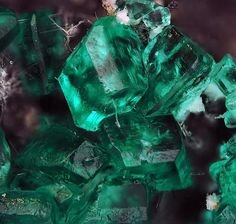
The natural colour of adamite is bright, rich shades of yellow, tan and yellow-green. However, there are also colourless, and pinkish, and lilac, and brownish adamites of uneven colouring. The abundance of copper, partially or completely replacing zinc atoms in the molecule of the substance, makes adamite bright green with a slight blue tint, but weakens the characteristic glass lustre.
Green Adamite Crystal
Adamite, which is copper-free but not devoid of zinc, is called cuproadamite. If the zinc in adamite is completely replaced by copper, the mineral becomes emerald-green olivenite, and its crystals sometimes grow with needle brushes resembling sea urchins.
Cobaltoadamite (especially with a small admixture of manganese) is beautiful with smooth transitions of colour from pink to lilac, lilac and violet. Impurity iron introduces additional adjustments to the colour characteristics of adamite.
Use of adamite
Adamite does not find application in the jewellery industry because of the minimum hardness, pronounced fragility and the tendency to spontaneous destruction upon drying and heating. Nevertheless, individual craftsmen take the risk of turning the catchy mineral into jewellery. Purple Namibian Adamites are faceted with facet, yellow Mexican stones are turned into cabochons.
The aggregate of adamite crystals grown together is greenish-yellow in colour. Spheroid form.
The product is created so that to exclude direct contact of the adamite insert with the body. Such a measure is sufficient to eliminate the negative impact of arsenic compounds on human health. However, in most cases, faceted adamites (a known maximum mass of three carats) enter the mineralogical collections.
Adamite collectables are famous for their exceptional expressiveness and are in steady demand among lovers of natural rarities.