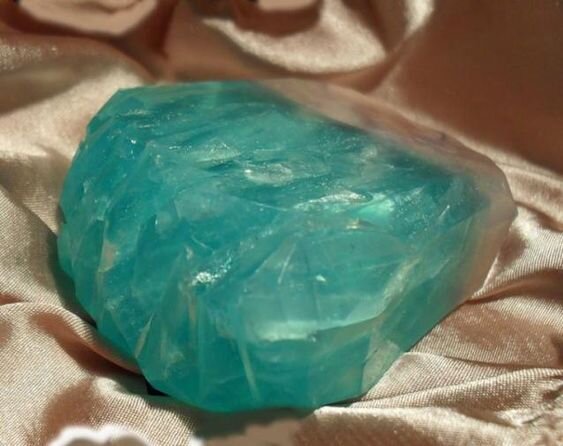
Mineral: Beryl
Colour: Shades of Blue
Mohs hardness: 7.5–8
Density: 2.67–2.71 g / cm3
Aquamarine
6 shared
Aquamarine History
The name given to aquamarine many centuries ago expresses the essence of the stone as well as possible, because from Latin “aqua marina” is translated as “seawater”. The name was assigned to the mineral thanks to the ancient Roman writer Pliny the Elder, who lived in the 1st century AD. e. In addition, it was Pliny who noted the similarity between beryls, emeralds and aquamarines.
Even in the days of the ancient civilization of the Sumerians, which existed until 2000 BC. e., beautiful greenish-blue stones symbolized longevity, happiness and youth. In Rome, aquamarine, as the protector of sailors, also personified sincere love and devotion. And even in the Middle Ages, the stone continued to be used to revive feelings between spouses, cooled to each other.
Physicochemical Properties of Aquamarine
Aquamarine is a solid mineral with a glass sheen and belongs to the beryl family, best known for its precious emeralds. The colour palette is from deep blue to almost transparent pale turquoise, which is caused by impurities of iron. Sometimes among aquamarines, there are specimens with the effect of asterism or “cat's eye”. Such specimens are extremely rare and of particular value.
When aquamarine is heated above 400 ° C, the saturation and brightness of its colour increases significantly. This property is actively used in order to turn an inexpensive pale stone into a more valuable specimen.
Excellent transparency and good hardness - up to 8 on the Mohs scale - makes aquamarine a favorite of cutters, since the stone allows you to experiment with unusual forms of cuts and create real masterpieces. However, the stone is not protected from damage - because of its fragility, it can literally be crushed.
Aquamarine deposits
Aquamarine from granite pegmatites is extracted. Stone is not uncommon and is found almost all over the planet. The largest aquamarine deposits are in Brazil (including in the state of Minas Gerais), in Madagascar and in Russia - in the Urals and Transbaikalia. By the way, it was in Brazil that the largest jewellery-grade aquamarine was mined - its weight was 110.5 kg.
Aquamarine is found in small volumes in many countries, for example, in Australia, India, Namibia, Tanzania, the USA and Sri Lanka. Ukraine is also among the countries where aquamarines are mined. However, few deposits can be compared in quality to Brazilian stones.
The healing and magical properties of aquamarine
Since ancient times, aquamarine was considered the lucky stone of sailors. Legends tell how sirens kept aquamarine in their treasures and offered a gem to sailors who found themselves in the open ocean during a storm.
To this day, aquamarines are considered magical "barometers" - a change in the color of a stone from clear and pure to cloudy and dark indicates an emotional or physical illness of its owner.
Although healing properties in ancient times were attributed to almost all gemstones, aquamarine was considered one of the most powerful doctors: in centuries-old manuscripts, aquamarine is called a panacea for arthritis, eye inflammation, sore throat and seasickness. In addition, the calm, unique colour of the stone helps restore peace of mind, restore the nervous system and relieve melancholy.
Who suits aquamarine
Aquamarine is an ideal stone for those born in March, as well as sailors and scientists.
Astrologers recommend wearing aquamarine to sensitive Cancer and dreamy Pisces. Sagittarius, however, “sea stone” categorically does not fit, as, incidentally, and the Gemini.
Another curious fact: aquamarine has the ability to change its shade when the weather changes. Just like the sea changes its color in clear weather and in a storm. The pale blue color of aquamarine turns pale, acquires a greenish tint before rain or storm. For this quality, aquamarine was highly valued by medieval sailors. Whatever part of the world they went to, they always took with them talismans made of aquamarine, which prompted them the right way and protected them from storms, which represented a mortal danger in the open ocean. Ancient sailors believed that aquamarine is the materialized soul of the sea. It was believed that aquamarine was able to tame and pacify sea storms!