Pay attention! If you have taken some specimens out of the ground to check for ripeness and cracks, it is advisable to dig up the entire crop from the bed as soon as possible. Otherwise, it will begin to grow.
Weather and temperature conditions for harvesting
In addition to the type of maturation and external signs of ripeness, the weather conditions and air temperature should also be taken into account.
It is believed that carrots should be dug up for storage after the first light frost, as if it is better stored in winter. This is partly true, but it is important to remember that freezing increases the risk of infection with grey rot.
Tip! It is advisable to harvest the entire carrot crop before the frost in the autumn or at least immediately after the first small frosts.
If you don't have time to dig up your carrots from bed to bed before the frost, you need to bend the whole canopy to the surface of the ground right away at freezing temperatures. It is not recommended to postpone the event and remove the roots as soon as possible.
Do not harvest carrots in warm weather (18 degrees or higher). Because a sudden change in conditions (i.e. moving the roots from the warm ground to the cold cellar) can cause a deterioration in the bediness of vegetables and reduce the shelf life. It is very important to pay attention to the weather forecast when choosing the dates of harvesting carrots. You should be afraid of the rain. After all, if you gather vegetables in rainy and wet weather (or after it), they will be over-fed with moisture, because of this they will significantly reduce the bediness, and they can easily crack. Collection time in different regions
Due to different weather and climate conditions the terms of harvesting carrots from the vegetable garden in different regions differ. Approximate time of harvesting root crops:
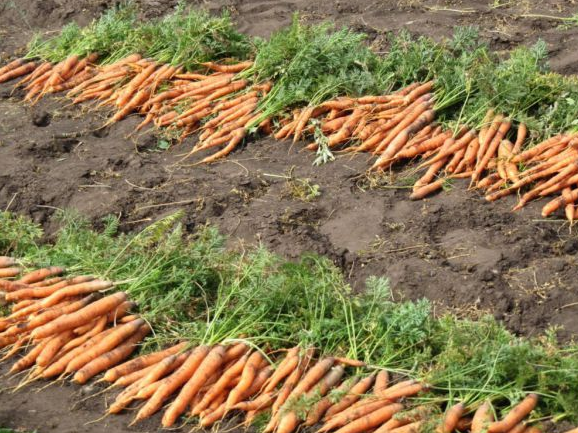
In the Middle strip (Moscow region, Nizhny Novgorod region) - early September - for middle-ripening varieties, mid-September - for lateripening varieties;
In the South (Krasnodar Territory (Kuban), North Caucasus) - end of September - for medium varieties, beginning of October - for late varieties;

In Siberia, the Urals, the North-West (Leningrad Region) - mid-August - medium varieties, the end of August - late varieties.
Timeframe for harvesting carrots according to the 2019 Lunar Calendar
You can choose the time for the procedure by moon cycles. Of course, do not be completely guided by them, much more important are the factors described above. However, this way you can choose the most suitable days.
So, good timing of carrots harvest according to the Lunar Calendar 2019:
August: 19, 20, 21, 22, 23, 24, 25;
September: 8, 9, 16, 17, 18, 19, 20, 21, 25, 26;
October: 3, 4, 5, 6, 15, 16, 17, 18, 19, 22, 23, 24, 25
How to dig up carrots from bed to bed
Important: It is recommended to dig up carrots for storage on a sunny, dry and warm day. The ground must be dry.
The following tips and rules will help you to dig up your carrots correctly from seedbed to storage:
It is advisable to use a tool for harvesting, preferably a fork.
However, if you have light, sandy soil and short carrots on your plot, you can remove them with your own hands by pulling on a shoe. In all other cases, it is necessary to use the tool, otherwise you can easily break the canopy, leaving the root vegetables in the ground.
Remove carrots from the vegetable garden according to the following scheme: first, you carefully dig it up with forks (at least with a spade), and the distance between the forks and the vegetable should be about 15 centimeters. And then grab a shovel and pull it out of the ground.
By the way, to make harvesting more efficient and faster, it's better to do it together: one forks and the other pulls the shoe immediately.
And the most important rule of thumb in carrots harvesting is to be as careful as possible to avoid damaging the roots (especially when digging with forks). After all, damaged roots can not be stored for long, they will have to be eaten immediately.
Video: When and how to properly remove carrots from the bed for storage.
https://youtu.be/V_urboAtYrw
What to do after harvesting carrots: Preparing for storage
So, you did the harvesting, what do you do with the roots? After digging up the carrots from the bed, you have to prepare the vegetables for storage:
We clean the dirt. Immediately after the harvest, the dirt residue on the roots should be gently cleaned with your hands. Never use a knife or other tools.
Sort the crop. Now you must sort the carrots:
All damaged or cracked carrots should be placed in one direction, and they will be used for cooking.
A healthy, well-developed carrot is also put aside and stored for the winter.
Also, if you are interested in getting seeds with your own hands, you can put away some healthy roots.
Cut off the haulm. Then, immediately after sorting, you need to completely cut off the canopy with a sharp, disinfected knife or just twist your hands. It is not recommended to dry the vegetables together with the bottle, otherwise it will suck out all the moisture from the root vegetables in a short period of time, which will significantly reduce its shelf life, as well as reduce the taste. All the more reason not to cut off the canvas before harvesting!
We dry the harvest. After you have unscrewed or cut off the canvas from the carrot, you should dry the root vegetables. To do this, place them in a garden on the ground in one row and leave them in the sun for 2-3 hours.
Prepare them for storage in a dark place. After a short drying time, send the carrots to a dark place for about 5-7 hours, so that the vegetables cooled down a little and prepared for storage (a sharp drop in temperature and change in conditions will adversely affect the bediness).
Storage space and conditions for carrots in winter
After you have harvested and prepared the roots, send the carrots to winter storage. In order to keep the carrot as long as possible, you should choose the most suitable conditions and place:
The optimum temperature is about 4 degrees Celsius;
The humidity is about 80%;
The most suitable place to store carrots in winter is a cellar or basement (it is recommended to treat it with, for example, two percent copper sulfate solution).
https://youtu.be/9GdJtysLg0Y
By the way, this material tells us when and how to put the beets in storage.