You may have heard of blue heat. Blue heat radiators and increasing the efficiency of heating with them. But how well do you know this type of heat and do you know if it's really efficient? Perhaps it is another marketing strategy of the companies that play with our needs to make us buy new more "innovative" products.
In this article, we will go deeper into what blue heat is, how it works and whether it really is more efficient than others. Want to learn more about it?
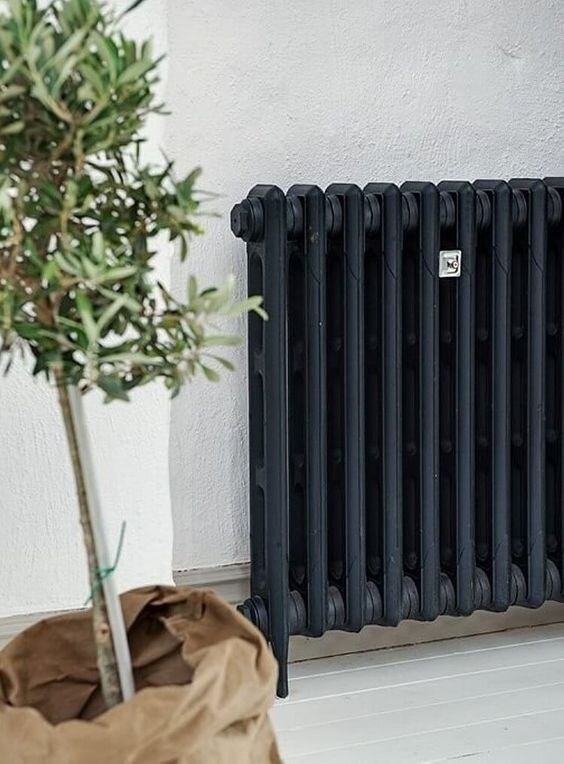
What is blue heat?
Blue heat or blue energy is a term that isn't quite clear yet. Many people ask about it because doubts arise more and more. This term comes from the latest generation of radiators. They are the evolution of the classic electric oil radiators because they also use resistors to heat. Specifically, they use blue heat, since they use a substance that is a heat-carrying fluid called "blue sun".
This is where the name of both the heat and the new radiators come from. To understand what this blue heat is based on we have to travel to 1841 where James Prescott discovered the Joule effect. This effect is what helps to determine if an electric current passes through a conductor. It is known because part of the kinetic energy of the electrons of the electric current, as it passes through the fluid, is transformed into heat. This is the principle of blue heat radiators.
By an electric current that passes through the heat-carrying fluid, it can be heated to give an increase in temperature in the room where it is located.
Advantages of heating
To learn more about this type of heat, we will analyze both the advantages and disadvantages when using it.
- The main advantage is that you can use probes to control the temperature. In this way, they become much more precise and avoid wasting energy. When it comes to saving on your electricity bill, this is a good thing to keep in mind.
- In general, they are similar to common radiators. However, they differ in that, on the one hand, the liquid that replaces the oil of all life circulates inside and, on the other, they have a timer. Again, this is another element to be taken into account for savings. We can program it to have it as long as we want without wasting energy or money. The programmer also regulates the temperature.
- The air expelled by the device through the upper part is distributed throughout the room. In this way, it heats it in a more effective and quicker way.
- They do not produce gases, odors or residues.
- The installation costs are much lower than those of heat pumps. They have simple wall fixing systems.
- Another aspect for which it stands out, less important, is that the design is more attractive than conventional ones. This aspect is aesthetic after all, but it is better to take it into account if it contributes to the design of your living room.
Inconveniences of its use
Just as blue heat radiators have advantages, they also have disadvantages when it comes to using them.
- In some cases, they are able to consume more electricity, so they can be less efficient and more expensive than conventional heating systems.
- It could be said that the use of blue heat is more interesting in homes that are located in places with warmer climates and do not have to be used as often. In general, it is suitable for situations where it does not have to be used for too long. So all we have to do is program it, heat the room quickly and achieve comfort without a lot of energy expenditure.
Consumption of blue heat radiators
In order to make a reference to the consumption compared to the common radiators, it is necessary to see their performance. The performance of an appliance is the relationship between the heat generated by a radiator and the energy it consumes. Therefore, the efficiency of these radiators is 100%, compared to 360% of heat pumps. This makes us see that the production of energy is more expensive.
If the system you want to use is to produce heat through electricity, because the house does not have a gas connection, because there is no room to install a diesel tank, etc.. You should consider the option of installing a heat pump or blue heaters.
Is it worth installing them at home?
After reading everything about blue heat, from what it is to consumption, you're probably wondering if it's worth installing in your home and if it's going to be a huge expense. Well, let's go by parts. First, you need to know the whole marketing strategy that blue heat has in the background. Probably, if we had a commercial at home selling us common radiators, we would not take long to throw it out.
However, if they start talking about the blue heat, we would be intrigued. We have to accept that this blue heat sounds very good and seems to mention a whole technological revolution. That is not the case. It is just a common radiator that, instead of using oil, uses another type of fluid. Once the electric current passes through it, it heats up and the air spreads throughout the room.
When is a blue radiator good for us and when is it not? It is very simple. In those places that either by the climate or by the habits of life of the house, does not have to be used for a long time nor to heat many rooms. It is necessary to take advantage of these radiators for punctual uses and to make use of the rapidity that they have to heat a room of normal size. If you need heating longer, try other heating systems such as heat pumps or a wifi thermostat.