Over the centuries, man has wondered about the mysteries of outer space, trying to unravel them. Astronomical bodies such as a satellite, a star, a meteorite falling to Earth, an asteroid and a comet fascinated and attracted humanity.
Having seen some of these astronomical bodies, we are either trying to apply them in our imagination as divine powers or to think of them as 'falling stars'. Similarly, some say that our fates are related to the movement of celestial bodies.
However, modern astronomy rejects quite a few such myths.
Today we are much more informed about the realities of planets, satellites, comets, and black holes.
Asteroids are small planets
Asteroids, like most of these astronomical bodies, have their own characteristics and properties. Asteroids of celestial bodies move like the planets around the sun.
Planets are celestial bodies that rotate around stars, such as our Sun, at a certain distance at a certain speed. The Earth also has a fixed rotation time around its own axis. This is what causes day and night. In addition, planets have satellites that move around them like the moon around the Earth.
Meteors and comets
Like planets and their satellites, many meteors and comets move around the solar system. This is essentially lifeless matter made up of gases, metals and rocks in space. And they can be either small or weigh hundreds of thousands of tons.
The Italian astronomer Giuseppe Piazzi was the first to discover such astronomical substances on January 1, 1801. This was the discovery of Ceres as then assumed massive asteroid. However, later Ceresera was recognized as a dwarf planet. Since then, more than 10,000 such asteroids and meteors have been found. Astronomers believe that many rotate around the Sun in the belt between Mars and Jupiter and in this belt, Ceres is the only dwarf planet. The distance to this belt is between 32 and 49 million km from the Sun. However, meteors and asteroids are also found away from this belt.
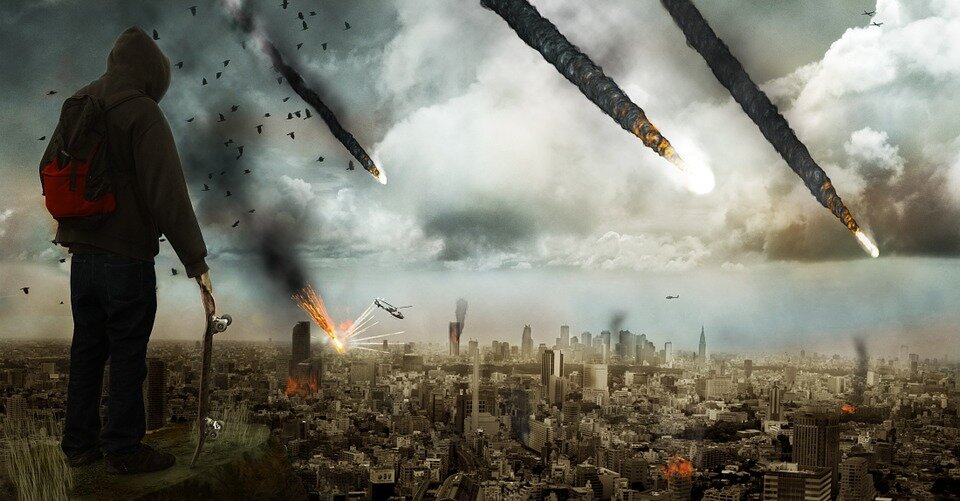
Meteors are luminous particles of falling interplanetary material, and if they survive after crossing the atmosphere and reach the ground they are called meteorites. More often than not, meteors are spoken of as falling meteorites.
In 1961, the International Astronomical Organization classified and named these objects. They called themselves moving bodies meteors. However, all these differences in size. In fact, these meteors are remnants of burned comets or planets. Sometimes these meteors depart from their normal orbit and enter the Earth's dense atmosphere at speeds of up to 30,000 km/h. There are at least 5 to 10 meteor strikes on Earth each year.
Are falling celestial bodies in danger
When a meteor enters the earth's atmosphere from pressure and friction, it is most often burned. We imagine objects such as falling stars.
In 2016, a meteorite in the Welluru area of Tamil Nadu, India, killed a bus driver. This is the first official confirmation that an object from space killed a man.
Although it is officially confirmed that the celestial body in Venezuela killed a cow in 1972 by hitting her in the head. In 2007, the cow killer meteorite was auctioned off. So far, the victim of a meteorite flying in history has been the American Anne Hodges, who entered her home in Alabama on November 30, 1954, causing a serious burn. The most famous incident associated with the fall of the meteorite in the recent past was in Chelyabinsk in 2013.
In fact, the story of a meteorite hitting the Earth millions of years older than the Earth. When the age of the earth was relatively small, the meteorite's fall forced it to split into countless parts.
In addition, the impact of the meteorite on Earth is responsible for the disappearance of dinosaurs from the face of the earth. A massive celestial body some 65 million years ago caused such a huge amount of dust to spread through the sky that there was no sunlight for decades that destroyed many species of animals on earth. But it is also a fact that out of every 5000 such massive bodies, only one is likely to hit the ground. But such a blow could radically change the planet's geography, destroy biodiversity and cause climate change. In fact, many of the large lakes on earth were caused by the meteor shower.
The approach of meteors and the impact of a meteorite can have an impact on radio waves. Among some of the major meteor strikes in Pixkillia, USA, in 1999. A celestial body weighing about 12.4 kg crashed into our planet. In 2009, a meteorite hit the Earth in Bali, Indonesia, causing a 10-meter crater. The energy released was about 50 kilotons or twice as much as Nagasaki's atomic bomb.
The study of meteors has also shed light on many other theories about space and time science. Scientists are studying the presence of various forms of matter or elements in space made of dust and rocks, pieces of fallen celestial bodies. And the final impact of the meteor warned astronomers to remain vigilant and try to assess the next time such an event could happen again so that safety measures could be taken in advance.