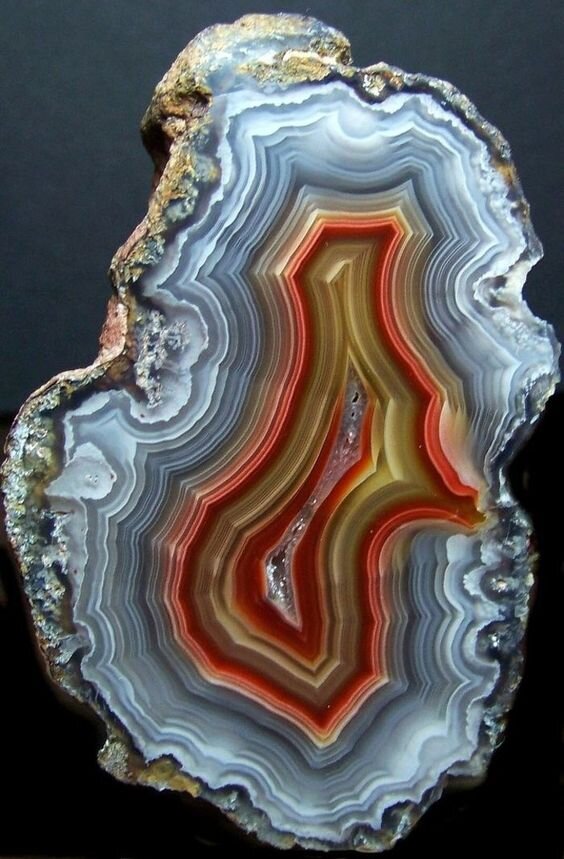
Origin of agate
Agate is a very ancient mineral, the first mention of it dates back to the III century BC. Agate items are found in Egyptian tombs and ancient burials in England and the Urals. According to different versions, its name came from the Achates River in Sicily, or from the Greek “agates”, which means “happy”.
Physico-chemical properties of agate
Agate is a jewellery and ornamental stone, a type of chalcedony, which in turn is a kind of quartz. From a chemistry point of view, agate is silica (SiO2). The raw surface of the mineral is dull, and after polishing acquires a glass lustre.
Agate can partially shine through, or be completely opaque. It has a layered texture, and the layers can be of different colours, which creates a unique pattern on the surface of the mineral, from concentric patterns to images similar to natural landscapes.
A variety of colors and fantasy ornaments on the cut are due to the gradual layering of chalcedony, as well as the formation of voids, which eventually fill up with other minerals, such as rock crystal, hematite and others. Thanks to the decorative properties and the flexibility of processing, agate is very much appreciated among jewelers.
Types of Agate
More than 150 varieties of agate are found in nature depending on the type of pattern on a section. The most common types are:
- Brazilian Agate
- Layers form contrasting concentric patterns.
- Moss or dendrite agate
- Inclusions are like crowns of trees or moss.
- Landscape agate
- Patterns and drawings on a cut of stone are similar to fantastic landscapes.
- Black agate
- A slice of black agate framed in gold. Black agate is otherwise called "magic agate."
- Iris agate
A stone with a special optical effect, creating a rainbow shine under the influence of bright light.
Some types of agate received well-known names, for example, onyx (stone with many parallel multi-coloured stripes), sardonyx (agate with red-brown layers).
Agate deposits
Agate is a fairly common mineral. It is extracted from volcanic and sedimentary rocks on almost all continents. Alluvial deposits are located in South America (the richest in Brazil and Uruguay), Africa, Russia - in the Caucasus and the Urals, as well as in Mongolia and India.
In addition, indigenous deposits are concentrated in the Crimea.
The magical and healing properties of agate
Agate is believed to bring health, happiness, and longevity. Agate red shades symbolize love and devotion before lovers exchanged such stones if they were to be separated for a long time.
The black agate was always considered the strongest; it strengthened the spirit, protected it from evil. Black stones were often used in magic rituals. Agate is credited with the ability to absorb negative energy, protecting the owner from it, so with therapists recommend that the stone be cleaned of negativity by washing it in running water.
Agate was also used as a therapeutic agent. Powdered mineral was used as an antidote for the bites of snakes and scorpions, they also washed their wounds for speedy healing. To alleviate respiratory diseases, the stone is worn in the form of beads and brooches; to normalize cardiac activity, agate is usually worn on the left hand, and as a sedative on the right.
To whom agate is suitable
Blue agate is a stone of creative personalities, revealing their talents. Brown agate attracts wealth and promotes career development. Gray agate is the talisman of the servants of the law; it aggravates the sense of justice and helps resolve conflicts. The yellow stone patronizes those involved in trade. White agate protects children from illness and accidents. Pink stone attracts luck, good for gamblers.
The agate stone belongs to the elements of the Earth and therefore is most suitable for Taurus and Virgo. Agate is contraindicated in Aries and Scorpions.
The value of agate
This is a stone that everyone should have for protection. It attracts good powers, protects from bad dreams, protects against stress and depletion of energy. In ancient times, agates were used to drive away storms. Stones were placed under the head of the sleeper so that bright and varied dreams would come.